
The Protest and Arrests in Delhi

The Protest and Arrests in Delhi
By: M. Burhanuddin Qasmi
Editor: Eastern Crescent, Mumbai
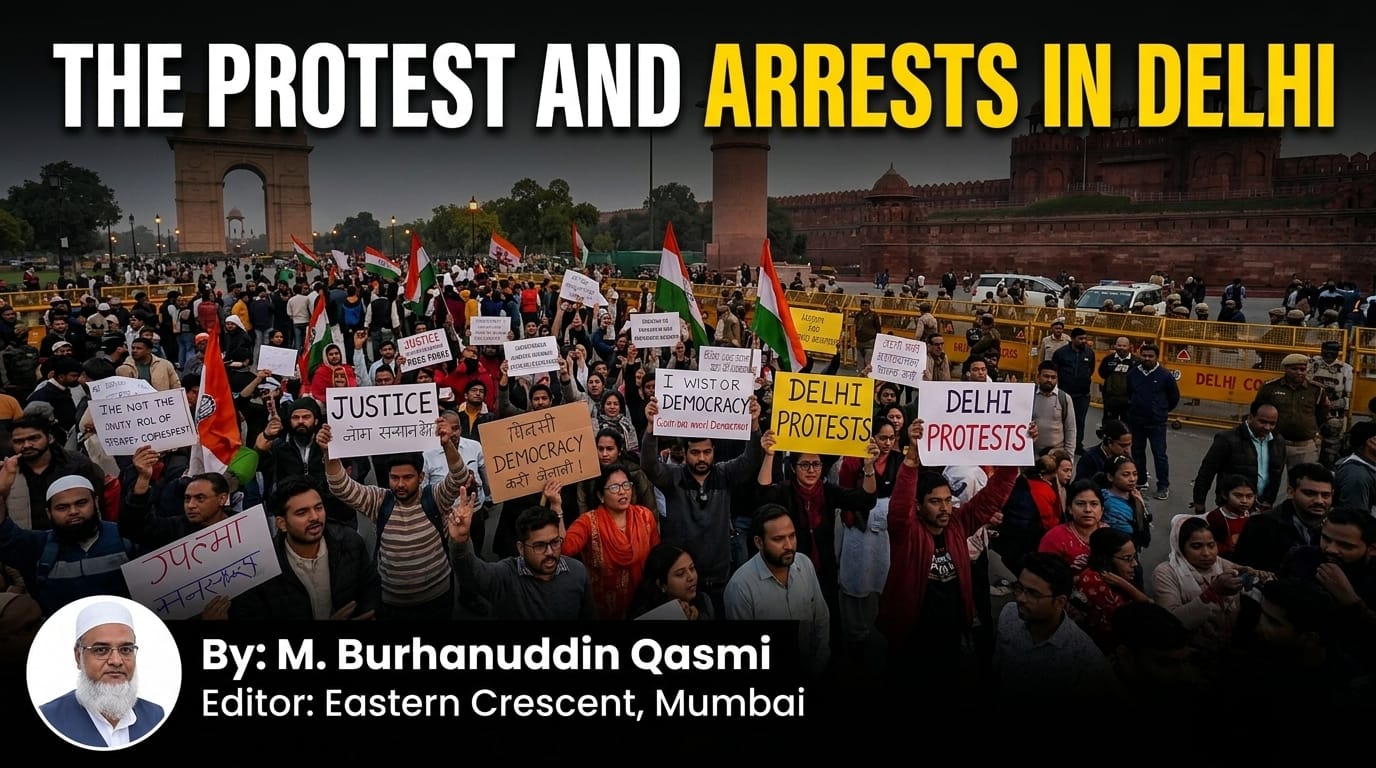
On 10 October 2026, the protest organised by the CJP, lawyers’ organisations, student organisations and civil society members against Chief Election Commissioner (CEC) Gyanesh Kumar and the arbitrary arrests by the Delhi Police unfolded largely as many had expected. Given the stringent and unprecedented security arrangements, it was difficult for the public to do much more than what they managed to accomplish. The scale of the deployment gave the impression that the Government of India was at war with its own citizens.
Notably, while the protesters are making every possible effort to keep the protest peaceful, recognising that resorting to violence would amount to the failure of their movement, unruly elements have reportedly been seen attacking and brutally beating even children and women protesters, while the Delhi Police have apparently done little to stop such violence.
Nonetheless, these are only the initial days of the protest against the CEC and in favour of electoral reforms in India. Undoubtedly, this movement is likely to continue for a considerable time, gathering new dimensions, strength and momentum along the way. Opposition political parties, farmers’ and workers’ organisations, including mazdoor unions, students and young people—many of whom are already part of the movement—are likely to join in greater numbers, bringing renewed energy and strategies. Gradually, the protest may spread beyond Delhi to other states and cities, both large and small, potentially transforming into a pan-India movement against the policies and actions of the government at the Centre.

The indiscriminate arrests and detentions of young people, particularly members of Generation Z, who are educated and represent the future of this country, are neither wise nor likely to help the government shield the present CEC from resignation. It is neither possible for the government to keep railway and bus services suspended and the internet shut down indefinitely, nor will it be easy to sustain such disruptions for long under the country’s current poor economic conditions. Turning Delhi into a fortress and maintaining such an extraordinary security lockdown indefinitely is equally impractical.
India is, undoubtedly, the world’s largest democracy, and these protests concern the democratic rights of all Indian citizens. Whether or not the Indian Godi Media, adequately report what is unfolding on the streets of Delhi, international media outlets have been closely following the developments and reporting on their various dimensions. The world is watching. As a responsible nation, India cannot afford to ignore the concerns and observations expressed by international institutions and forums, including the United Nations Human Rights Council (UNHRC) and the European Union.
As time passes, maintaining restrictions on people’s movement and sustaining an extraordinary security apparatus will become increasingly difficult. Consequently, the strategy of suppressing the protest may begin to lose its effectiveness. The movement is showing the potential to evolve into a broader people’s movement, and no government can indefinitely exercise dictatorial control over the masses in a democratic system—not at all in India, with its population of approximately 1.48 billion, around 37 per cent of whom are young people.

That is why the true scale and character of this protest have yet to emerge. If people from different sections of society continue to join the movement and it maintains its peaceful character through patience, discipline and careful planning, it can certainly succeed, even if the struggle takes longer than expected time. The ideals of Mahatma Gandhi, Dr B. R. Ambedkar, Jawaharlal Nehru and Maulana Abul Kalam Azad should serve as guiding principles, reminding the nation that democratic change must be pursued through popular participation, constitutional values and peaceful resistance.
This mass movement has the potential to turn the whole of India into a Jantar Mantar—a nationwide arena of democratic dissent. The irregularities and serious lapses committed by the Election Commission of India (ECI) during the Special Intensive Revision (SIR) of electoral rolls, as reported by The Indian Express and other media organisations, cannot simply be dismissed as minor mistakes or unforeseen errors. If the reported patterns suggest deliberate bias against particular communities, especially Muslims, the matter becomes far more serious than an administrative failure. Such practices would strike at the very spirit of democracy, undermine citizens’ fundamental rights and erode public confidence in the electoral process.
India’s democratic institutions must command the trust of every citizen, regardless of religion, caste, community or political affiliation. Electoral reforms, therefore, cannot be reduced to procedural adjustments; they must ensure transparency, impartiality, accountability and equal political rights for all. A comprehensive course correction to restore public faith in the electoral system and uphold the country’s democratic values is both necessary and urgent.
The Government of India must act with wisdom, restraint and political maturity before the situation deteriorates further. It must recognise that democratic dissent cannot be permanently silenced through arrests, restrictions or an overwhelming show of force. The government still has an opportunity to address legitimate public concerns, ensure accountability, restore confidence in the Election Commission and initiate meaningful electoral reforms. It should seize that opportunity before delayed decisions turn a manageable political crisis into a prolonged national ordeal.
You May Also Like
 Editorial
Why Should Common Citizens of India Lose Rights for Mistakes Committed by the ECI?
Why Should Common Citizens of India Lose Rights for Mistakes Committed by the ECI?...
 Editorial
Electoral Reform in India Is a Must
Electoral Reform in India Is a Must By: M. Burhanuddin Qasmi Editor: Eastern Crescent,...
 Editorial
July 2026: The Month When the Collapse of Indian Television News Became Impossible to Deny
July 2026: The Month When the Collapse of Indian Television News Became Impossible to...
 Editorial
The First Major Success of the Cockroach Movement
The First Major Success of the Cockroach Movement By: M. Burhanuddin Qasmi Editor: Eastern...
 Editorial
Some Are Happy for Spain's World Cup Victory, Others for Argentina's Defeat
Some Are Happy for Spain's World Cup Victory, Others for Argentina's Defeat By: M....
 Articles
Smart Selection of Qur'anic Verses by Iran During Ayatullah's Funeral
Smart Selection of Qur'anic Verses by Iran During Ayatullah's Funeral By M. Burhanuddin Qasmi...
Comments (0)
Leave a Comment