
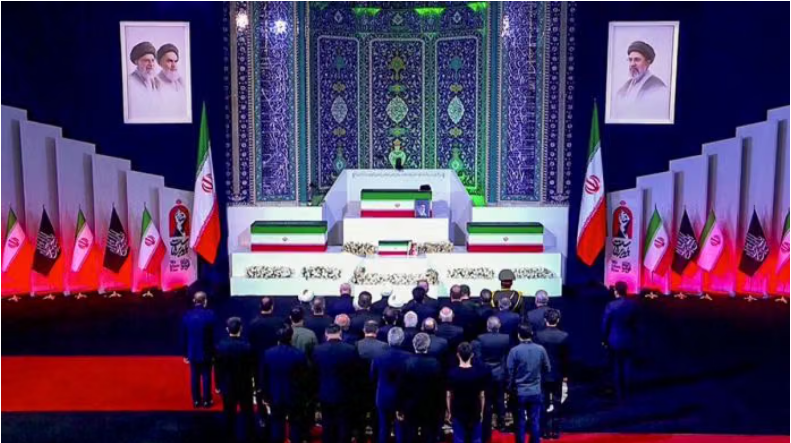
Smart Selection of Qur’anic Verses by Iran During Ayatullah’s Funeral

Smart Selection of Qur’anic Verses by Iran During Ayatullah’s Funeral
By M. Burhanuddin Qasmi
Editor, Eastern Crescent, Mumbai
5 July, 2026
It was both fascinating and remarkable to observe the thoughtful selection of Qur’anic verses by Iran for the visiting delegations from major world powers and neighboring Muslim countries during the state funeral ceremony of Grand Ayatullah Ali Khamenei in Tehran on 4 July 2026.
Grand Ayatullah Ali Khamenei was martyred on 28 February 2026 during the unprovoked war launched by the US-Israel axis. His burial is scheduled to take place in Mashhad on 9 July following massive funeral processions through Qom in Iran and the holy cities of Najaf and Karbala in Iraq.
One of the most striking features of the ceremony was the recitation of carefully selected verses from the Glorious Qur’an as each official delegation approached the coffin. These recitations were undoubtedly acts of worship (Ibadah), yet many observers also viewed them as carrying subtle and meaningful messages through the Words of Allah, without a single political statement being made. Here are a few verses recited when delegation from the following countries were offering prayers and condolences at the coffin site:

Afghanistan
“Indeed, We have given you, [O Muhammad], a clear conquest. That Allah may forgive for you what preceded of your sin and what will follow and complete His favor upon you and guide you to a straight path. And [that] Allah may aid you with a mighty victory.”
[The Qur’an: Surah Al-Fath, Ch. 48, Ayats 1–3]
Brief Explanation:
These opening verses of Surah Al-Fath announce the “clear victory” granted to the Prophet Muhammad ﷺ after the Treaty of Hudaybiyyah, together with Allah’s forgiveness, favour, guidance and promise of decisive support. Many observers viewed their recitation for the Afghan delegation as symbolising victory against the USA following a 20-year war, divine assistance and hope for the future.
Pakistan
“O you who have believed, persevere and endure and remain stationed and fear Allah that you may be successful.”
[The Qur’an: Surah Aal ‘Imran, Ch. 3, Ayat 200]
Brief Explanation:
The concluding verse of Surah Aal ‘Imran calls believers to steadfastness, patience, vigilance and God-consciousness. It encourages endurance during trials and promises success to those who remain firm.

Qatar
“That Allah may forgive for you what preceded of your sin and what will follow and complete His favor upon you and guide you to a straight path.”
[The Qur’an: Surah Al-Fath, Ch. 48, Ayat 2]
Brief Explanation:
Addressing the Prophet Muhammad ﷺ, this verse speaks of Allah’s forgiveness, the completion of His favour and guidance to the straight path. It forms part of the opening verses revealed after the Treaty of Hudaybiyyah and is widely associated with reconciliation and divine blessing.
Saudi Arabia
“Already there has been for you a sign in the two armies which met [in battle]: one fighting in the cause of Allah and another of disbelievers. They saw them to be twice their own number by their eyesight. But Allah supports with His victory whom He wills. Indeed in that is a lesson for those of vision.”
[The Qur’an: Surah Aal ‘Imran, Ch. 3, Ayat 13]
Brief Explanation:
This verse recalls the Battle of Badr and reminds believers that victory comes from Allah rather than numerical or military superiority. Its recitation before the Saudi delegation attracted considerable attention because of its historical context as well as recent imposed wars in Gaza, Iran, Lebanon by Israel and the USA.
Turkiye
“Not equal are those believers remaining [at home]—other than the disabled—and the mujahideen, who strive in the cause of Allah with their wealth and their lives. Allah has preferred the mujahideen through their wealth and their lives over those who remain behind, by degrees. And to both Allah has promised the best [reward]. But Allah has preferred the mujahideen over those who remain behind with a great reward.”
[The Qur’an: Surah An-Nisa, Ch. 4, Ayat 95]
Brief Explanation:
This verse distinguishes those who actively strive in the cause of Allah from those who remain behind without a valid excuse, while affirming reward for all sincere believers. However, Allah prefers those who strive instead of sitting ideal.

India (unofficial group of religious leaders)
“So do not weaken and do not grieve, and you will be superior (successful) if you are [true] believers.”
[The Qur’an: Surah Aal ‘Imran, Ch. 3, Ayat 139]
Brief Explanation:
This verse was revealed in the context of the aftermath of the Battle of Uhud, when the Muslims had suffered losses and discouragement. Allah consoles the believers, urging them not to lose heart or grieve, assuring them that they will ultimately prevail if they remain steadfast in faith.
The Qur’an is for all
Iran also welcomed official delegations from China, Russia, India and several other Non-Muslim and Muslim countries, including Indonesia, Malaysia, Iraq, Lebanon and its friendly neighbour Oman. Delegations representing Hizbullah, Hamas, the Houthis and other members of what is commonly known as the Axis of Resistance were likewise received with the recitation of the Glorious Qur’an as they approached the coffin of the Grand Ayatullah and greeted his family members. Reportedly there were more than 70 delegations from different countries representing different religions and socio-political denominations excluding Europe, most of whom were not invited by Iran. There was a separate verse for each delegation with a separate message from the Qur’an.
The message from Iran to the world
The selection of the Qur’anic recitations appears to have been deliberate and thoughtful. Without issuing any official statement or offering translations of the verses, Iran seemingly conveyed distinct messages to different visiting nations solely through the Words of Allah. Whether this interpretation was intended or not, the symbolism was widely noticed.
The funeral therefore appeared to be more than a moment of national mourning. It also projected an image of political confidence, diplomatic messaging and regional realignment in the aftermath of the forty-day war with the United States of America and Israel. Iranians including many in the world view the war outcome as a significant strategic victory over what the world regard as the world’s dominant military powers.
It is noteworthy that reciting the Qur’an while visiting the coffin or grave of a Muslim is regarded as a virtuous act in Muslim traditions. Iran maintained this devotional practice throughout the funeral while refraining from explaining the choice of different verses for different delegations, allowing the Qur’an itself to speak.

Equally remarkable was the manner in which the recitations were presented. The Qari remained completely unseen—neither on the stage nor on the big screen—yet his beautiful and moving voice filled the venue as a gentle background recitation throughout the funeral. He cited no references, offered no commentary and prolonged none of the recitations. The verses were delivered simply as acts of worship, yet for those attentive to their meanings and contexts, they conveyed messages beyond words.
Taken together, these elements transformed the funeral of Grand Ayatullah Ali Khamenei into a carefully choreographed event of profound religious, cultural and diplomatic symbolism. It is likely to be remembered as one of the most distinctive state funerals of the modern history.
You May Also Like
 Articles
Another Major Blow to the US-Israel Axis in the Middle East
Another Major Blow to the US-Israel Axis in the Middle East By: M. Burhanuddin...
 Articles
Amidst Bloodshed continues in Lebanon, Gaza and the West Bank
Amidst Bloodshed continues in Lebanon, Gaza and the West Bank Iran, US war takes...
 Articles
Human Rights in Islam
Human Rights in Islam By: Shafiul Haque Balrampuri A DELL Student: Darul Uloom Deoband...
 Articles
Disagreement among Scholars is an Intellectual Reality and a Source of Islamic Guidance
Disagreement among Scholars is an Intellectual Reality and a Source of Islamic Guidance By: Maulana...
 Articles
Radiant Beacon of Spirituality: Hazrat Maulana Zulfiqar Ahmad Naqshbandi (Rah.)
By: Khursheed Alam Dawood Qasmi First Acquaintance with Peer Sahib: It was around the...
 Articles
Mufti Muhammad Azharul Haq (Rah.): A Beacon of Knowledge Extinguishes
Mufti Muhammad Azharul Haq (Rah.): A Beacon of Knowledge Extinguishes By: Khursheed Alam Dawood...
Comments (0)
Leave a Comment