
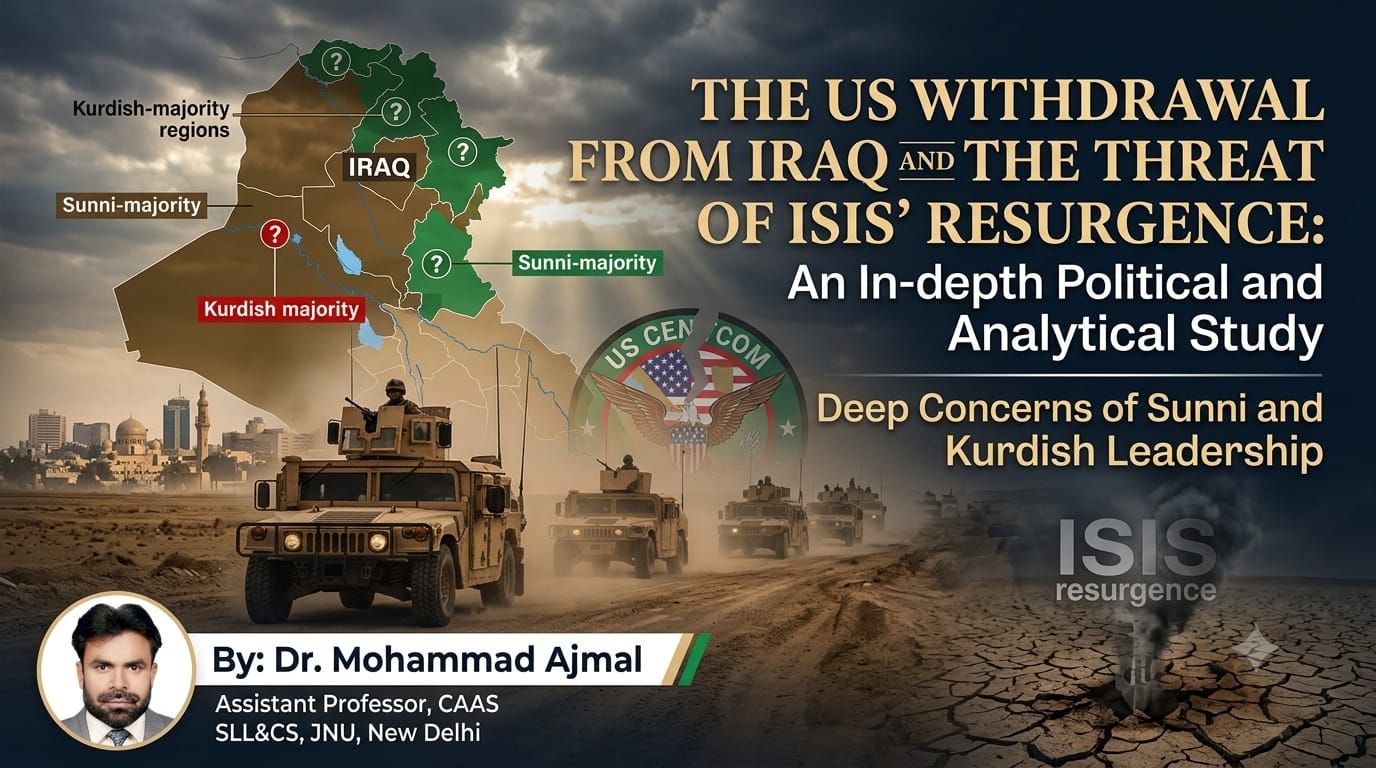
The Withdrawal of US Forces from Iraq and the Threat of an ISIS’ Resurgence:

The Withdrawal of US Forces from Iraq and the Threat of an ISIS’ Resurgence:
An In-depth Political and Analytical Study of the Deep Concerns held by Sunni and Kurdish Leadership
By: Dr. Mohammad Ajmal
Assistant Professor at Centre of Arabic and African Studies, School of Language Literature and Culture Studies at JNU, New Delhi.
The latter part of September 2026 will be remembered as a significant milestone in Iraq’s modern history, marking the successful completion of the full withdrawal of US-led international coalition forces from Iraq and the Kurdistan region. Political and governmental circles in Baghdad are hailing this development as the restoration of full national sovereignty and a monumental historic victory, with celebrations taking place across the country. Yet, beneath this veneer of official enthusiasm and satisfaction, a starkly different and alarming scenario is emerging. The top leadership of Iraq’s two pivotal socio-political groups—the Sunni and Kurdish communities—views this military withdrawal with deep anxiety, uncertainty, and profound security concerns. While the Iraqi government and its security spokespersons repeatedly assert that the national army, special counter-terrorism units, and federal security agencies are fully capable and prepared to maintain control over every inch of the country and crush any internal or external threat, Sunni and Kurdish leaders remain haunted by the bitter lessons of history and the harrowing scenes of the summer of 2014. They vividly recall how, following the initial US withdrawal in 2011, the group ISIS—exploiting the resulting critical security vacuum—rapidly seized control of one-third of Iraq’s territory, unfurling its flag as the world witnessed the unfolding of a catastrophic humanitarian and security crisis.
To understand this complex situation and the potential risks involved, it is essential to examine the recent stances taken by key figures in Iraqi politics. Masood Barzani, a senior leader of the Kurdistan Democratic Party and former president, expressed serious reservations about this withdrawal during an interview with a local Iraqi television channel. Recalling the past, he noted that when U.S. forces first departed Iraq in 2011, Iraqi ministers of defense and interior had admitted in closed-door meetings that the country’s own forces lacked the technical and military capacity to defend the nation without international assistance. Barzani stated unequivocally that the U.S. withdrawal at that time paved the way for the rise of ISIS, and he now harbors a deep fear that this same disastrous scenario could repeat itself. He also emphasized that in 2014, when ISIS launched its lightning offensives and major cities—including Mosul—fell one by one, the Iraqi government was utterly unable to defend itself and was compelled to make urgent appeals for air and ground support from the United States, the European Union, and NATO nations. This perspective held by the Kurdish leadership demonstrates that they are far from convinced by Baghdad’s claims that Iraqi forces are now capable of tackling all challenges on their own.

Sunni political circles share similar concerns regarding this withdrawal, as evidenced by the recent address of Iraqi Parliament Speaker and prominent Sunni leader, Hebat al-Halboosi. While welcoming the occasion of “Sovereignty Day,” al-Halboosi’s tone was marked by a sense of political responsibility and caution rather than celebratory festivity. He warned that the withdrawal of foreign forces must be underpinned by the Iraqi state’s own internal strength and the supremacy of its institutions; it should not pave the way for a security vacuum that could be exploited by terrorists, lawbreakers, anarchists, and external actors to plunge the country back into ruin. Al-Halboosi believes that past experiences have demonstrated that enduring peace is not achieved merely by the departure of foreign troops; rather, it requires robust state institutions, professional security agencies, sovereign decision-making, and—above all—the equal participation of all segments of society, including Sunnis, Shias, and Kurds, in the state’s defense architecture and the construction of its future. His message was clear: if Sunni areas are once again marginalized or alienated due to suspicion, the dream of lasting peace in the country will never be realized.
The concerns voiced by local political leaders are not merely hypothetical or confined to political rhetoric; recent violent incidents on the ground validate their validity. Following the withdrawal of international forces, Iraqi security agencies are grappling with a rising wave of terrorist activities and the resurgence of sleeper cells across various parts of the country. In the final weeks of September 2026, security forces arrested two dangerous extremists wanted for terrorism-related offenses in the Sunni-majority areas of Anbar province, while Kurdish forces detained three suspects in the Sulaimaniyah province of the Kurdistan region for alleged ties to the organization. However, the most perilous and bloody confrontation occurred in the sensitive, disputed area of Altun Kupri (Kirkuk), where Iraqi counter-terrorism forces engaged in a direct armed clash with ISIS militants. During this fierce skirmish, two suicide bombers wearing explosive-laden belts were killed, and a third accomplice was captured. An innocent young Iraqi man also lost his life due to gunfire that erupted inside nearby shops during the operation. While these incidents demonstrate the vigilance of security agencies, they also serve as a warning that the organization retains the capability to conduct operations on the outskirts of Iraqi cities and confront security forces.
Atheel al-Najafi, the former governor of Mosul and a key leader of the Sunni “Muttahidoon” alliance, has offered a profound security and social analysis of the situation, shedding light on the internal dimensions of the Iraqi crisis. His central argument is that the organization is far from dead, and its sleeper cells are not as dormant or inactive as the Iraqi government portrays them to be in an attempt to reassure itself and the public. According to him, when an extremist group is capable of engaging in open armed conflict against security forces within urban areas, it clearly indicates that the group still possesses safe havens, state-of-the-art weaponry, logistical support, and robust supply lines. He considers it a grave error to view cooperation with the United States and the international community in the war on terror merely as part of proxy conflicts between other nations or a global Cold War. He maintains that protecting the lives and property of Iraqi citizens is a purely Iraqi national interest, not a bargaining chip to be exploited in the regional power struggle between the US and Iran. Furthermore, Iraqi forces currently lack any alternative to the satellite intelligence, aerial surveillance, and technical training previously provided by the international coalition.

The second and most critical point Atheel al-Najafi highlighted is not merely the fear of an ISIS resurgence; rather, he is deeply concerned that Iraqi security agencies might—under the guise of counter-terrorism—revert to the same oppressive and sectarian style of governance that prevailed under Noori al-Maliki prior to 2014. During that era, entire Sunni communities and cities were branded as “accused” or “suspect” in the name of security and counter-terrorism; consequently, even ordinary citizens who had sacrificed their lives and property to fight terrorism fell victim to state oppression. When a state begins to view its own citizens as enemies, society withdraws its partnership with the state and, regrettably, becomes indifferent. This is precisely what happened in 2014, when ordinary people were caught in a vice between state oppression and the terror of ISIS. Later, when the state altered its approach—choosing to win public trust rather than harass the populace—terrorists became isolated within society, and peace was restored. Najafi warns Iraqi authorities against adopting a policy of persecution and suspicion toward Sunni populations under the pretext of security, as oppressive policies breed further chaos rather than ensuring safety.
Another concerning aspect of this entire scenario is the ongoing crisis and regional tension in the Middle East, where various external powers have a vested interest in perpetuating chaos and instability within Iraq. These powers seek to use Iraq as a “bargaining chip” to ensure the security of their own nations. However, it must be borne in mind that external powers do not manufacture crises from scratch; rather, they exploit the vulnerabilities and flaws that the Iraqi leadership itself leaves within the system. The greatest threat to Iraq does not lie at its geographical borders; the most critical vulnerability is the lack of trust between the state and its people—particularly the Sunni and Kurdish populations. Unless the Baghdad government urgently bridges this internal trust deficit, external forces could once again exploit this security vacuum to bring about Iraq’s ruin.
A comparative overview of Sunni and Kurdish concerns reveals that while Sunni leadership fears renewed targeting of Sunni populations by security agencies, arrests based on suspicion, and a return to the repressive era of 2011–2014, the Kurdistan leadership is alarmed by weakening security control in disputed territories—particularly Kirkuk—and the resurgence of terrorists. Sunnis demand social justice, reconstruction, and equal partnership in security decision-making, whereas Kurds insist on robust joint intelligence and security coordination between Baghdad and Erbil, alongside continued international air and logistical support. The concerns of both factions are valid; instability could lead to external factions dominating Sunni regions, while any compromise on the autonomy of the Kurdistan region could bring foreign investment to a complete halt.

Therefore, while the withdrawal of the international coalition from Iraq may appear to be a symbolic and political victory for Iraqi sovereignty, it could prove to be an extremely risky gamble given the objective security realities on the ground. Statements from seasoned politicians such as Masood Barzani, Haibat al-Halboosi, and Atheel al-Najafi, along with recent clashes in Kirkuk, make it clear that the threat of terrorism has not yet been averted. Iraq’s future now hinges entirely on the strategy and political foresight of the Baghdad government. If the government persists with the old approach of maintaining security solely through military might while marginalizing the Sunni and Kurdish communities, history will repeat itself, and the country will once again plunge into a quagmire of devastating civil war and terrorism. Conversely, if the Iraqi government learns from past mistakes—winning the trust of all segments of society, fostering national unity, and building strong, apolitical state institutions—it can certainly succeed in laying the foundation for a stable, prosperous, and secure Iraq, even in the absence of foreign forces.
You May Also Like
 Asia
AsiaUS-Iran War, Regional and Global Impacts; Serious Challenge to World Peace and a Possible WW3
US-Iran War, Regional and Global Impacts; Serious Challenge to World Peace and a Possible...
 Articles
Amidst Bloodshed continues in Lebanon, Gaza and the West Bank
Amidst Bloodshed continues in Lebanon, Gaza and the West Bank Iran, US war takes...
 RELIGION
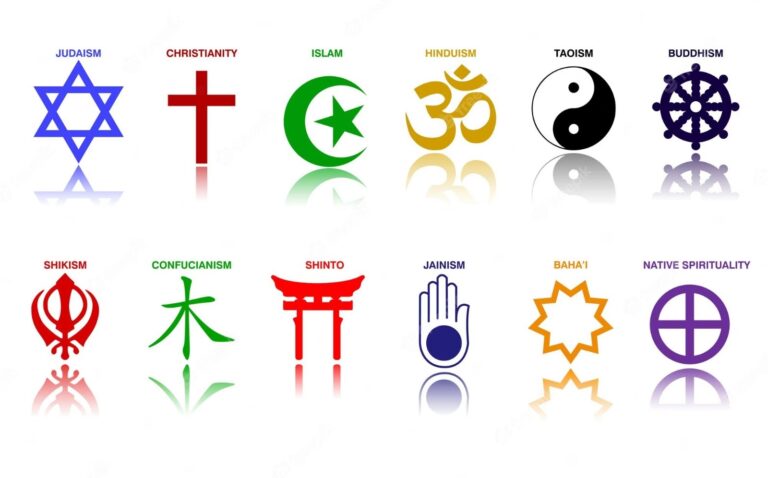
A Glance Over Major Religions of the World
A Glance Over Major Religions of the World By M. Burhanuddin Qasmi Director: Markazul Ma’arif...
 Qur'anic Wisdom
System of Zakat: Purifying Wealth, Empowering Society
System of Zakat: Purifying Wealth, Empowering Society By: Mufti Jaseemuddin Qasmi Coordinator Online Darul...
 Qur'anic Wisdom
"We Called to Him, ‘O Ibrahim, You Have Fulfilled the Dream.”
“We Called to Him, ‘O Ibrahim, You Have Fulfilled the Dream.’” [Part: 33, from...
 Islam
Islam“Good and evil are not equal. Repel evil deed by that deed which is better”
By Mufti Jaseemuddin Qasmi Coordinator Online Darul Ifta & Lecturer at MMERC, Mumbai [Part...
Comments (0)
Leave a Comment