
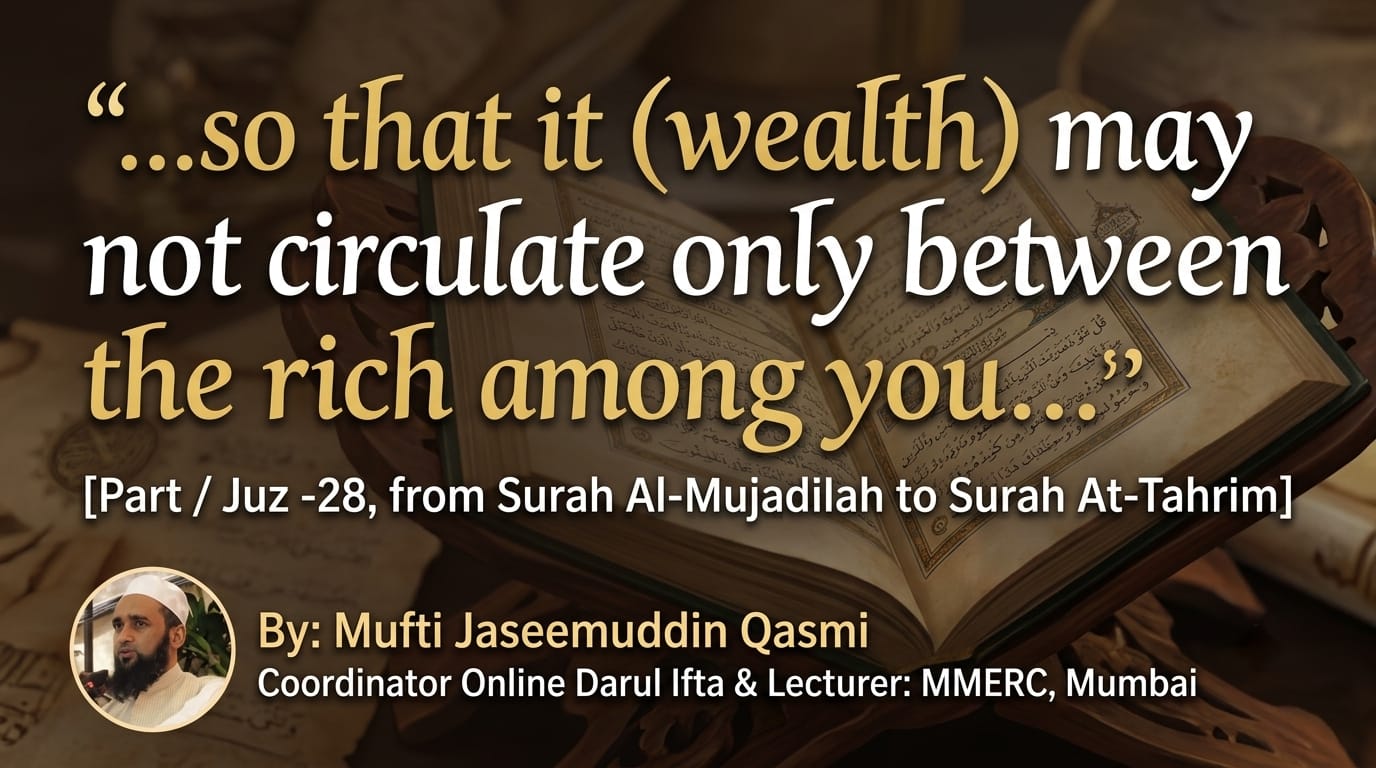
“…so that it (wealth) may not circulate only between the rich among you…”

- Zihār and Its Ruling
- Whispering and Wrong Way of Greeting
- Make Room for Others in Gathering
- Plot to Assassinate the Prophet (saws) and the Exile of Banū Naḍīr
- Wealth Should Not Remain in the Hands of the Rich Alone
- Dealing with Non-Muslims and Ḥāṭib’s Secret Letter
- Rulings Regarding Divorce, Reconciliation, the Waiting Period, and Maintenance
“…so that it (wealth) may not circulate only between the rich among you…”
[Part / Juz -28, from Surah Al-Mujadilah to Surah At-Tahrim]
By: Mufti Jaseemuddin Qasmi
Coordinator Online Darul Ifta & Lecturer: MMERC, Mumbai
﷽
Surah Al-Mujadilah
Part – 28 begins with Surah Al-Mujadilah. This is a Madani Surah and consists of 22 ayahs.
The Surah mainly discusses four important topics. The first topic is Zihar. The second topic concerns the secret conversations and private meetings of some Jews and hypocrites. They would sometimes whisper among themselves in a way that made the Muslims fear that they were plotting against them. Some of the Companions also wished to speak privately with the Prophet (saws) about certain matters or seek his advice. This Surah explains the rulings regarding such private conversations.
The third topic is the etiquette that Muslims should observe in their gatherings and assemblies, especially when sitting together as a community.
The fourth topic is the discussion of the hypocrites and their characteristics.
Zihār and Its Ruling
The background to the revelation of this ayah is that there was female Companion Khawlah (ra)who was married to Awsibn al-Sāmit (ra), who had grown old. On one occasion, he said to his wife, “You are to me like the back of my mother.” When a man says such words to his wife, it is known as Zihār.
Before Islam, among the polytheists, the ruling of Zihār was that the husband and wife would become permanently separated, leaving no way for them to reunite. Although Awsibn al-Sāmit (ra) had uttered these words in a moment of anger, he later regretted what he had said.
The woman became deeply distressed and came to the Prophet (saws) to ask about the ruling concerning Zihār. The Prophet (saws) said that no ruling from Allah regarding this matter had yet been revealed to him, and he expressed the possibility that she might have become unlawful for her husband.
She repeatedly explained to the Prophet (saws) that her husband had not used any words of divorce against her. At the same time, she began pleading with Allah Almighty, expressing her concern that she had young children who would be left helpless and their lives might be ruined.
While she was still making this plea, these ayahs were revealed, explaining the ruling of Zihār and the way to undo its consequences.
In ayahs 2, 3, and 4, Allah Almighty states that uttering such a statement does not make the wife a real mother, but the wife becomes unlawful for her husband until he performs the prescribed expiation (Kaffārah) for Zihār.
The expiation is to free a slave. However, since slavery has completely disappeared today as a result of Islam’s approach toward protecting human dignity, freeing a slave is no longer practically possible. Whoever is unable to do this, must feed sixty poor people. If a person does not have the financial means to do that, he must fast for sixty consecutive days.
Until the expiation is completed, the wife remains unlawful for the husband, and marital relations with her are not permitted.
Whispering and Wrong Way of Greeting
One of the mischievous practices of the Jews was that, sometimes, when they saw the Muslims, they would begin whispering among themselves and making gestures in a way that made it appear as though they were plotting something against the Muslims. Some hypocrites also behaved in the same manner. This caused distress to the Muslims, so they were prohibited to do such secret conversations. However, they did not stop despite this prohibition. Therefore, ayahs 7 to 10 were revealed, in which Allah Almighty stated that He is present wherever they engage in secret conversations, and on the Day of Judgment, they will come to know the reality and consequences of their actions.
Another mischievous practice of the Jews was that when they met the Muslims, instead of saying “As-salāmuʿalaykum”, they would say “As-sāmuʿalaykum.”As-salāmuʿalaykum means “Peace be upon you,” whereas As-sāmuʿalaykum means “May death or destruction be upon you.” Since the two expressions differ by only one letter, the listener would not always notice the difference when they were spoken. In this way, they tried to vent their hatred and hostility toward the Muslims. Ayah 8 refers to this mischievous behavior of theirs.
Ayah 9 teaches Muslims that when they engage in private conversations, they should not discuss sinful or evil matters. Rather, they should speak about things that are good, righteous, and beneficial.
Make Room for Others in Gathering
In ayah 11, a general principle regarding gatherings is mentioned is that people should make room for those who arrive. The ayah also makes it clear that if the leader or person in charge of a gathering feels that more space should be made for those who have arrived, he may ask those already seated to move and make room for the newcomers.
The following ayahs then mention the hypocrites who would falsely swear that they were believers.
﷽
Surah Al-Hashr
Plot to Assassinate the Prophet (saws) and the Exile of Banū Naḍīr
Surah Al-Hashr begins here. It is a Madani Surah consisting of 24 ayahs, and it was revealed in 2 AH.
The Jews of Madinah would conspire against the Muslims despite having entered into peace agreements with them. The disbelievers had also promised them that if they attacked the Muslims, they would support them.
On one occasion, the Prophet (saws) went to the Banū Naḍīr to discuss the implementation of certain terms of the agreement. The people of Banū Naḍīr then plotted to assassinate him. They planned that, while the Prophet (saws) was sitting with them, one of their men would climb above him and drop a rock on him, killing him.
Allah Almighty informed the Prophet (saws) of their plot through revelation. The Prophet (saws) immediately left the place. Following this incident, he sent a message to Banū Naḍīr informing them that their agreement with the Muslims was now terminated. He gave them a specific period of time in which they were required to leave Madinah. He also made it clear that if they did not leave within that period, the Muslims would be free to take action against them.
Some hypocrites went to Banū Naḍīr and asked them not to leave Madinah. They promised that if the Muslims attacked them, they would stand by them and provide them with support.
Consequently, Banū Naḍīr did not leave Madinah within the stipulated period. After the deadline had passed, the Prophet (saws) laid siege to their fortresses. However, the hypocrites failed to provide them with any assistance. Eventually, Banū Naḍīr surrendered, and the Prophet (saws) ordered them to leave Madinah. They were, however, permitted to take all their wealth and possessions with them, except for their weapons.
This Surah was revealed in connection with this incident.
Wealth Should Not Remain in the Hands of the Rich Alone
Arabic word ‘Fay’ refers to wealth or property left behind by an enemy without the Muslims having to engage in an actual battle to obtain it. In ayah 7, Allah Almighty explains who is entitled to receive this wealth.
In the same ayah, Allah Almighty lays down a comprehensive and just principle of economics:
“…so that it (wealth) may not circulate only between the rich among you...”
In other words, Islam teaches that basic necessities and opportunities should be accessible to everyone and that wealth should continue to circulate throughout society, so that the wealth of the world does not remain under the control and monopoly of only the rich people.
Ayah 9 highlights the remarkable qualities of the Ansar (the Companions of Madinah). Despite being in financial difficulty themselves, they preferred their Muhajir brothers the Makkan Companions over themselves and gave them priority. They also harboured no jealousy or hatred toward them.
﷽
Surah Al-Mumtahinah
Here begins Surah Al-Mumtahinah. This is a Madani Surah, and it consists of 13 ayahs. The Surah mainly deals with two subjects.
The first is that women were exempted from the terms of the Treaty of Hudaybiyyah. According to the treaty, if a woman came to the Muslims after accepting Islam, the Prophet (saws) would examine her to know whether she had genuinely accepted Islam or had come for some other reason. If she was found to be a true believer, she would not be sent back to Makkah.
In such a case, if she was married and her husband had remained in Makkah, the Surah explains the rulings concerning her marriage and mahr (dower). One of these rulings is that a Muslim woman cannot remain married to a non-Muslim man.
Therefore, if the wife of a non-Muslim man accepts Islam, her husband should also be invited to accept Islam. If he accepts Islam during her ‘iddah (waiting period), their marriage will remain valid. However, if he does not accept Islam, the Muslim woman will no longer remain in his marriage. After completing her ‘iddah, she may marry a Muslim man.

Dealing with Non-Muslims and Ḥāṭib’s Secret Letter
The second topic of this Surah is that what kind of relationships with non-Muslims are permissible and what kind are prohibited. Thus, Allah says in ayah 8:
“Allah does not forbid you to be righteous and act justly toward those who do not fight you because of religion and do not expel you from your homes. Indeed, Allah loves those who act justly.”
However, Muslims are prohibited from taking as close friends and allies those non-Muslims who fight against them and commit oppression. This has also been mentioned earlier in Surah ĀlʿImrān, ayah 28.
The background to the revelation of some of the ayahs of this Surah is as follows:
The disbelievers of Makkah violated the Treaty of Hudaybiyyah within just two years of its conclusion. After this, the Prophet (saws) began preparing for a decisive battle against the disbelievers of Makkah. At the same time, he wanted to ensure that the Quraish remained unaware of his preparations.
During this period, a woman named Sārah came to Madinah seeking help. When she was about to return to Makkah, Ḥāṭib ibn Abī Baltaʿah (ra) gave her a letter addressed to the disbelievers of Makkah, informing them about the Prophet’s (saws) preparations for war.
Ḥāṭib (ra) was a sincere Companion. However, out of concern for the safety of his family, he hoped to win the goodwill and protection of the people of Makkah by sending them this information. Through revelation, the Prophet (saws) was informed of the matter, and the letter was intercepted.
When Ḥāṭib (ra) was questioned about it, he explained his reasons and apologized. In view of his good intentions and sincere faith, the Prophet (saws) forgave him for this mistake. It was in connection with this incident that the opening ayahs of this Surah were revealed.
Allah says in ayah 3 of Surah Al-Mumtahinah: “Neither your relatives nor your children will benefit you on the Day of Resurrection. He will judge between you, and Allah is seeing what you do.”
﷽
Surah As-Saff
Here begins Surah As-Saff. It is a Madani Surah and consists of 14 ayahs. This Surah particularly mentions the conduct of the Children of Israel (Bani Israel). They repeatedly caused all kinds of hardship and trouble to their own Prophet, Musa (as). As a result, their hearts became inclined towards deviation. When Prophet Isa (as) came, they also rejected his prophethood. They likewise paid no heed to the glad tidings he had given about the coming of the Messenger of Allah Muhammad (saws).
﷽
Surah Al-Jumu‘ah
Here begins Surah Al-Jumu‘ah. It is a Madani Surah and consists of 11 ayahs. In the first Ruku of the Surah, the prophethood of the Prophet Muhammad (saws) and the purposes of his mission are explained, and the whole of humanity is invited to believe in him (saws).
In ayah 9, Allah says: “O you who have believed, when the adhanis called for the prayer on the day of Friday, then proceed to the remembrance of Allah and leave trade. That is better for you, if you only knew.”
After the first call to prayer for Jumu‘ah, one should leave for the Jumu‘ah prayer and not engage in any other activity. Likewise, no buying or selling transaction is permissible until the Jumu‘ah prayer has ended. The “remembrance of Allah” mentioned in the ayah refers to the Jumu‘ah sermon (khutbah) and prayer.

In the early days of Islam, the Prophet (saws) would deliver the sermon after the Jumu‘ah prayer. Once, when the Jumu‘ah prayer had ended and the Prophet (saws) was delivering the sermon, a merchant caravan arrived in Madinah carrying some goods. The arrival of the caravan was announced by the beating of drums. At that time, there was a shortage of food and other necessities in Madinah, so a large number of the Companions left the sermon and went towards the caravan, while only a few people remained in the mosque.
Ayah 11 admonished those who left the Masjid in this manner, making it clear that leaving the sermon was not permissible. This ayah also indicates that not only the Jumu‘ah prayer is obligatory, but listening to the Jumu‘ah sermon is also wajib (obligatory).
﷽
Surah Al-Munafiqun
Here begins Surah Al-Munafiqun. It is a Madani Surah and consists of 11 ayahs.
This Surah was revealed when the Prophet (saws) was returning from the Battle of Banu al-Mustaliq. During the journey, a dispute arose between a Muhajir (a Muslim immigrant from Makkah) and an Ansari (a Muslim of Madinah) over a matter concerning water. The Muhajir called upon the Muhajirs for help, while the Ansari called upon the Ansar. The situation became so tense that there was a fear that a fight might break out between the Muhajirs and the Ansar.
When the Prophet (saws) learned about the incident, he came to them and said that fighting in the name of the Muhajirun and the Ansar was an act of ignorant tribalism and prejudice, from which Islam had freed them. He (saws) further said that such foul slogans of tribalism must be abandoned by Muslims. After that, the dispute came to an end, and those who had been involved in the physical quarrel apologized to one another and reconciled.
The dispute came to an end, but there were also some hypocrites among the Muslim army. When Abdullah ibn Ubayy, the leader of the hypocrites, learned about the incident, he said to his companions, “You gave the Muhajirun refuge in your city and allowed them to gain power over you, to the extent that they have now begun to attack the original inhabitants of Madinah.” He then added, “When we return to Madinah, the honorable will surely drive out the humiliated.” By this, he clearly meant that the original inhabitants of Madinah would drive the Muhajirun out.
A sincere Ansari Companion, Zayd ibn Arqam (ra), was also present there at that time. He disliked what was said and informed the Prophet (saws) that ‘Abdullah ibn Ubaiy had made such a statement. When the Prophet (saws) asked ‘Abdullah ibn Ubaiy about it, he flatly denied having said anything of the sort. The Prophet (saws) chose to overlook the matter, thinking that perhaps Zayd ibn Arqam (ra) might have misunderstood what had been said.
Zayd ibn Arqam (ra) was deeply distressed that ‘Abdullah ibn Ubaiy had made him appear to be a liar before the Prophet (saws). The Prophet (saws) then set out from there with his Companions. They had not yet reached Madinah when this Surah was revealed, confirming the truthfulness of Zayd ibn Arqam (ra) and exposing the true nature of the hypocrites.
Allah says in ayah 10: “And spend from what We have provided you before death approaches one of you and he says, ‘My Lord, if only You would delay me for a brief time, so I would give charity and be among the righteous.’”
﷽
Surah At-Taghabun
Here begins Surah At-Taghabun. This Surah is Madani and consists of 18 ayahs. Like the other Makki Surahs, this Surah also focuses on calling people towards the fundamental beliefs of Islam. In view of Allah Almighty’s perfect power and absolute authority, people are invited to believe in Tawheed (the Oneness of Allah), Prophethood, and the Hereafter.
By highlighting the reasons behind the destruction of previous nations, attention is drawn to the fact that every person should believe in Allah’s Messenger and the Book revealed to him and should prepare for the Hereafter. If a person’s wife and children become an obstacle in this righteous path of the religion, he should understand that, by doing so, they are not acting in his best interest; rather, they are,in fact, becoming his enemies.
﷽
Surah At-Talaq
Rulings Regarding Divorce, Reconciliation, the Waiting Period, and Maintenance
Here begins Surah At-Talaq. It is a Madani Surah and consists of 12 ayahs. This Surah explains certain rulings concerning divorce that were not mentioned in Surah Al-Baqarah.
It is mentioned in this surah that if divorce is to be given, the appropriate time is when the waiting period (iddah) is about to begin. The Prophet (saws) explained this by instructing that divorce should not be given while the wife is menstruating. Rather, it should be given during a period of purity (tuhr) in which the husband has not had sexual intercourse with her.
After divorce, the preferred method of reconciliation (ruju‘) is also explained: the husband should take her back in the presence of two witnesses. It is further stated that the waiting period of women who no longer menstruate is three months, while the waiting period of a pregnant woman lasts until she gives birth.

A divorced woman should spend her waiting period in her former husband’s home, and during this period, her former husband is responsible for providing her maintenance (nafaqah). The maintenance that a husband is required to provide for his wife and children is according to his financial means; he is not required to spend beyond his capacity.
A divorced woman may also receive payment from her ex-husband for nursing and caring for their child. All these rulings are mentioned in this Surah.
﷽
Surah At-Tahrim
Here begins Surah At-Tahrim. It is a Madani Surah and consists of 12 ayahs. The main topic of this Surah is how husbands and wives should adopt a moderate and balanced attitude towards each other and towards their children.
On the one hand, loving one’s spouse and children within reasonable limits is what Islam demands. On the other hand, it is also necessary to keep a watch over them so that they do not deviate from the commandments of Allah Almighty.
In this connection, an incident occurred with the Prophet (saws) himself. In order to please some of his wives, he had sworn that he would no longer drink honey. Thereupon, Allah Almighty addressed him, saying: “Why do you prohibit for yourself something that Allah has made lawful for you?”
One of the lessons in the ayah is that one must not declare something haram that Allah has made halal.
You May Also Like
 Qur'anic Wisdom
“And do not bestow favor to acquire more”
“And do not bestow favor to acquire more” [Part/ Juz 29 — From Surah...
 Qur'anic Wisdom
“I Have not Created Jinn and Mankind Except to Worship Me.”
“I Have not Created Jinn and Mankind Except to Worship Me.” [Part /Juz'-27 from...
 Mufti Jaseemuddin Qasmi
“If A Sinful Person Brings You a News, Investigate…”
“If A Sinful Person Brings You a News, Investigate…” (Part /Juz - 26 from...
 Qur'anic Wisdom
“Whoever Desires the Harvest of the Hereafter, We will Increase for him his Harvest…”
“Whoever Desires the Harvest of the Hereafter, We will Increase for him his Harvest…”...
 Islam
Islam“Good and evil are not equal. Repel evil deed by that deed which is better”
By Mufti Jaseemuddin Qasmi Coordinator Online Darul Ifta & Lecturer at MMERC, Mumbai [Part...
 Qur'anic Wisdom
“He is the Messenger of Allah and Last of the Prophets”
“He is the Messenger of Allah and Last of the Prophets” [Part-22, from Surah...
Comments (0)
Leave a Comment