
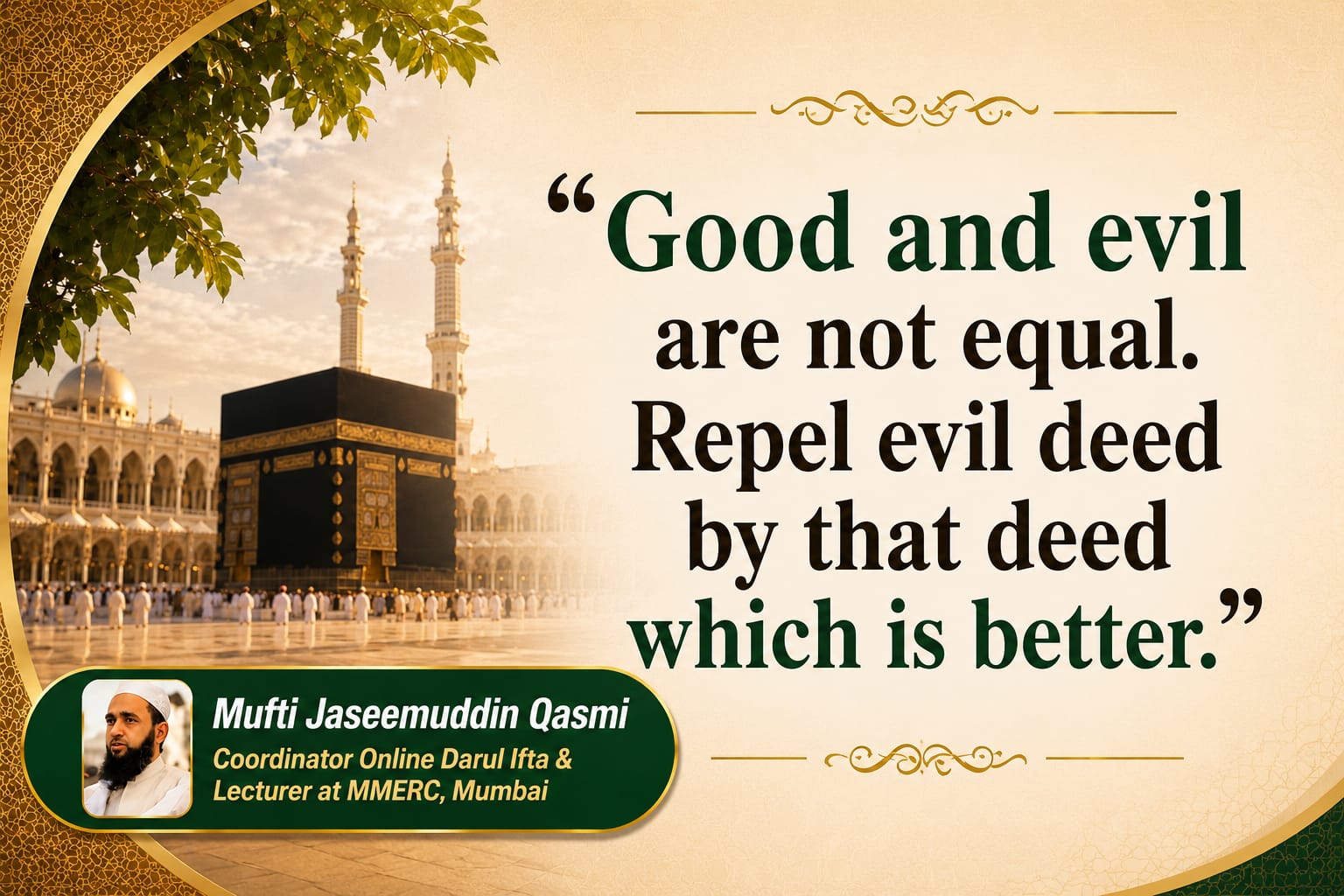
“Good and evil are not equal. Repel evil deed by that deed which is better”

By Mufti Jaseemuddin Qasmi
Coordinator Online Darul Ifta & Lecturer at MMERC, Mumbai
[Part 24: from Surah Az-Zumar, ayah 32, to Surah Ha-Mim As-Sajdah (Fussilat), ayah 46]
Various Beliefs of the Polytheists
In the first ayah of the twenty-fourth Part of the Qur’an, Allah says:“So who is more unjust than one who lies about Allah and denies the truth when it has come to him? Is not Hell an abode for the disbelievers?
The pagan Arabs of Makkah believed that the angels were daughters of Allah, and they worshipped numerous idols, associating them with Allah in worship. This ayah describes such beliefs as fabricating falsehoods against Allah.
Allah saysh in ayah 33 of Surah Az Zumar, “And the one who has brought the truth and the one who believed in it – those are the righteous.”
One meaning of this ayah is that a truly God-fearing person is one who speaks the truth and acknowledges the truth when it is presented. It is obvious that those who spread falsehood or reject the truth cannot be counted among the righteous.
Another interpretation is that the term muttaqi (God-conscious person) refers both to the one who brings the true message—that is, the Prophet—and to those who affirm and accept that truthful message, that is, the believers.
The following ayahs then mention the reward that these righteous people will receive from Allah: “They will have whatever they desire with their Lord. That is the reward of the doers of good. So, that Allah may remove from them the worst of the deed they did and reward them their due for the best of the deed they used to do.”
The polytheists used to threaten the Prophet (saws), saying, “Do not speak ill of our deities and idols; otherwise, if they become angry, they will afflict you with madness and make you insane.” Ayah 36 responds to this claim:“Is Allah not sufficient for His servant? Yet they frighten you with those besides Him. And whoever Allah leaves astray, there is no one to guide him.”
Allah says in ayah 38, “And if you asked them, “Who created the heavens and the earth?” they would surely say, “Allah.” Say, “Have you seen those you pray other than God? If God willed any harm for me, can they lift His harm? And if He willed a blessing for me, can they hold back His mercy?” Say, “Sufficient for me is Allah; the people who trust, must rely only upon Him.”
Even during sleep, the soul is captured
In ayah 42, Allah says:“It is Allah Who gives death to living beings at the time of their demise, and to those who do not die, during their sleep; so He restrains the soul on which the decree of death has been passed, and leaves the other till the appointed term. Indeed in that are signs for a people who think.”
Even during sleep, the soul is taken in a certain extent; however, it is returned whenever Allah wills. If the appointed time of death has arrived, then the soul is taken completely and permanently.
What Will Happen after the Trumpet Is Blown?
Ayah 68 mentions the occurrence of the Day of Judgment:“And the Horn will be blown, and whoever is in the heavens and whoever is on the earth will fall dead except whom Allah wills. Then it will be blown again, and at once they will be standing, looking on.”
When the Divine Trumpet will be blown for the first time, everyone will be struck unconscious. Those who are alive will die, and those who have already died, their souls will have a state of unconsciousness. Then, when the Trumpet is blown for the second time, the souls will return to the bodies of the dead, and those who were unconscious will regain consciousness. At that moment, people will look around in astonishment as they witness the strange and terrifying scenes of the Day of Resurrection. Thereafter, they will be swiftly brought before Allah to give an account of all that they had done in the world.

This ayah also mentions that there will be some individuals whom Allah wills not to be overcome by the terror of that Day. According to some commentators of the Qur’an, this refers to angel Jibrīl, angel Isrāfīl, angel Mīkā’īl, and the Angel of Death. Other scholars have stated that it refers to the Prophets and the martyrs (shuhadā’).
Allah says in ayah 69, “And the earth will shine with the light of its Lord, and the record of deeds will be placed, and the prophets and the witnesses will be brought, and it will be judged between them in truth, and they will not be wronged.”
That is, when Allah, the Almighty and Exalted, descends in a manner befitting His Majesty to hold His servants accountable for their deeds, the Plain of Resurrection will be illuminated by His light and splendour.
The “witnesses” mentioned in the ayah may include the angels, the members of the Ummah of Prophet Muhammad (saws), and even people’s parts of the body like hand, leg etc. will bear witness to their actions on that Day.
﷽
Sūrah Ghāfir begins from here. It is also known as Sūrah al-Mu’min. This is a Makkan sūrah and consists of 85 ayahs.
From this sūrah up to Sūrah al-Aḥqāf, each sūrah begins with the disjointed letters Ḥā Mīm (حم). Since all of these seven sūrahs commence with Ḥā Mīm, they are collectively known as the Ḥawāmīm.
Because of the remarkable eloquence, literary beauty, and rhetorical excellence that characterize these sūrahs, they have also been given the title ‘Urūs al-Qur’ān (The Bride of the Qur’an).
These sūrahs place particular emphasis on the fundamental doctrines of Islam—Tawḥīd (the Oneness of Allah), Risālah (Prophethood), and Ākhirah (the Hereafter). They address and refute the objections raised by the disbelievers, warn of the dreadful consequences of disbelief, and recount incidents from the lives of various Prophets as lessons and reminders for mankind.
Regret of the Disbelievers and the Horrors of the Day of Judgment
Regarding the disbelievers, Allah says in ayah 11 of Sūrah Ghāfir: “They will say, “Our Lord, You made us lifeless twice and gave us life twice, and we have confessed our sins. So is there any way out?”
The first death means the period before a person was born, when he did not yet exist and was, in a sense, lifeless. The second death refers to the death that comes at the end of one’s worldly life.
What the disbelievers mean by this statement is: In the world, we believed that we did not exist before our birth and that death would eventually come to us at the end of life. However, we did not believe in the existence of two lives. Now in this Day of Judgment, we have become certain of this second life as well.
Allah says in ayah 18, “And warn them, (O prophet), of the Approaching Day, when hearts are at the throats, filled with distress. For the wrongdoers, there will be no devoted friend and no intercessor to be obeyed.”
That is, due to extreme fear and panic, people’s hearts will be pounding and rising up to their throats. They will clutch their throats with both hands, trying to hold their hearts back lest they burst out with their breath.
The Order to Kill the Male Children of the Israelites
Ayah 25 mentions a part of the story of Prophet Musa (as). When Musa (as) brought the message of the true faith to the people and many began to believe in him, the people of Pharaoh proposed that the sons of those who embraced faith should be killed, while the women should be left alive so that they could be enslaved and forced into service.
This decree had been issued once before the birth of Musa (saws), and it was issued a second time when people began accepting the message of Prophet Musa (saws) and embracing faith.

Sham‘un’s Powerful Speech in Pharaoh’s Court
Ayahs 28–35 narrate the speech of a believing man from Pharaoh’s people who had kept his faith hidden. According to some narrations, he was Pharaoh’s cousin and his name was Sham‘un. However, when it appeared that Pharaoh’s oppression against Prophet Musa (as) and his followers was about to intensify, and Pharaoh expressed his intention to kill Musa (as), this believer publicly declared his faith and delivered a powerful speech in Pharaoh’s court.
Thus, the Quran says, “And a believing man from the family of Pharaoh who concealed his faith said, “Do you kill a man merely because he says, ‘My Lord is Allah’ while he has brought you clear proofs from your Lord? And if he should be lying, then upon him is the consequence ofhis lie; but if he should be truthful, there will strike you some of what he promises you. Indeed, Allah does not guide one who is a transgressor and a liar.”
“O my people, sovereignty is yours today, you have dominion in the land. But who would protect us from the punishment of Allah if it came to us?” Pharaoh said, “I do not show you except what I see, and I do not guide you except to the way of right conduct.”
“And he who believed said, “O my people, indeed I fear for you a day like that which befell the former groups—like the fate of the people of Noah, and of ‘Aad and Thamud and those after them. And Allah wants no injustice for His servants.And O my people, indeed I fear for you the Day of Calling -The Day you will turn your backs fleeing; there is not for you from Allah any protector. And whoever Allah leaves astray – there is no any guidefor him.”
“And Yusuf had already come to you before with clear proofs, but you remained in doubt of that which he brought to you, until when he died, you said, ‘Allah will never send a messenger after him.’This is how Allah leaves astray those who are transgressors and full of doubt.”
﷽
When Was Zakāh Made Obligatory?
Here begins Sūrah Fussilat. This is a Makkan sūrah and it contains 54 ayahs. Another name of this sūrah is Sūrah Hā Mīm as-Sajdah. In ayah 7, Allah Almighty says: “Those who do not pay zakah, are such that they completely deny the Hereafter.”

This sūrah is Makkan and zakāh is also mentioned in some other Makkan sūrahs, which indicates that zakāh had already been made obligatory in Makkah. However, its detailed rulings and regulations were revealed later in Madinah.
Creation of the Earth and the Heavens in Four Days
In ayahs 9 and 10, Allah Almighty says: “Say, “Do you indeed disbelieve in He who created the earth in two days and attribute to Him equals? That is the Lord of the worlds.”
“And He placed on the earth firmly set mountains over its surface, and He blessed it and determined therein its (creatures’) sustenance in four days without distinction – for (the information of) those who ask.”
The meaning of “placing blessings in the earth” is that Allah continually brings forth from it,the things that benefit His creation in appropriate quantities and according to need.
These four days include the creation of the earth itself. Thus, the earth was created in two days, and in another two days Allah arranged upon it the mountains and other necessities for human life, as well as provisions and food. Then, in two days, He created the seven heavens. In this way, the creation of the universe was completed in a total of six days, as mentioned in several other sūrahs.
Since the calculation of days is not possible without the sun and the moon, and at that time the sun and moon had not yet been created, it necessarily follows that either some other measure of time is intended by these “days,” or the reference is to the day concerning which Allah says:
“Indeed, a day with your Lord is like a thousand years of what you count.” (Sūrah al-Ḥajj)
The meaning of the lastphrase of the ayah is that, this is the same answer for all those who ask about the creation of the earth and the heavens.
Allah says in ayah 11 of Sūrah Fussilat, “Then He turned to the heaven while it was smoke, and He said to it and to the earth: ‘Come willingly or unwillingly.’ They both said: ‘We come willingly.’”
In the beginning, Allah had created the substance of the heavens in the form of smoke. He then transformed it into the seven heavens within two days, adorned the nearest heaven with stars, and established its permanent order and system.
The command “Come” means: Submit yourselves to Our command and become subject to Our will. Thus, both the heaven and the earth responded in complete obedience, saying, “We come willingly.”
Those Who Mislead Others Will Be Punished
In ayah 25, Allah says: “And We appointed for them companions who made attractive to them what was before them and what was behind them, and the Word (of punishment) has come into effect upon them among nations which had passed on before them of jinn and men. Indeed, they were losers.”
This includes those devils who used to tempt people into committing sins and incite them toward acts of disobedience, as well as those human beings who fabricated various arguments to portray sinful actions as beneficial and necessary, trying to persuade others on that basis. This, too, was a consequence of their own evil deeds, as mentioned in Surah Az-Zukhruf, ayah 36.
Qualities of a Preacher
Ayah 30 mentions those believers who embraced faith and remained steadfast upon it until their death. Allah says: “Indeed, those who have said, “Our Lord is Allah” and then remain steadfast- the angels will descend upon them, (saying), “Do not fear and do not grieve but receive good tidings of Paradise, which you were promised.”
Ayahs 33 and 34 mention the excellence and characteristics of a true preacher of Islam. Allah says: “And who is better in speech than one who invites to Allah and does righteousness and says, “Indeed, I am of the Muslims.” “And good and evil are not equal. Repel evil deed by that deed which is better; and then you will see that one who was once your enemy, has become your close friend.”
Although it is permissible to respond to a wrongdoer with an equivalent measure of retaliation, what is better and more virtuous is to repay evil with kindness and goodness.
In ayah 37, the worship of the sun and the moon is explicitly prohibited. Therefore, the concept of Surya Namaskarin Hinduism as an act of veneration or worship directed toward the sun is, from the Islamic perspective, a clear form of shirk, that is, associating partners with Allah.

There Is No End to Objections
Some of the disbelievers of Makkah used to object to the Qur’an by asking why it had been revealed in the Arabic language. They argued that if it had been revealed in another language, it would have been a clear miracle, since the Prophet (saws) did not know any language other than Arabic. In their view, the revelation of a scripture in a foreign language to him would have conclusively demonstrated that it had come from Allah.
Ayah 44 responds to this objection by showing that there is no end to such excuses and objections. Had the Qur’an been revealed in a language other than Arabic, these same people would have objected, saying, “Why has a non-Arabic Qur’an been sent to an Arab Prophet?”
In short, when people do not want to accept the truth, they can always find countless excuses to reject it. Whatever the circumstances, they continue to raise objections rather than sincerely seeking guidance.
You May Also Like
 Articles
Radiant Beacon of Spirituality: Hazrat Maulana Zulfiqar Ahmad Naqshbandi (Rah.)
By: Khursheed Alam Dawood Qasmi First Acquaintance with Peer Sahib: It was around the...
 Islam
IslamHuman Creation: Existence for the Sacred Trust of Earthly Vicegerency
Human Creation: Existence for the Sacred Trust of Earthly Vicegerency By: Mohammad Taukir Rahmani...
 Islam
IslamWhy Is the Man Alone Bound by Divine Law?
Why Is the Man Alone Bound by Divine Law? By: Mohammad Taukir Rahmani EC...
 Culture
The Flood of Heresy: A Manifestation of Ideological Colonialism and a Trial for Islamic Consciousness
The Flood of Heresy: A Manifestation of Ideological Colonialism and a Trial for Islamic...
 Islam
IslamThe Veil of Hidden Polytheism: A Subtle Breach in the Fortress of Faith
The Veil of Hidden Polytheism: A Subtle Breach in the Fortress of Faith By:...
 Islam
IslamAllah's two Invisible Systems for the Protection of Islam
Allah's two Invisible Systems for the Protection of Islam By: Md Salman Alam Qasmi...
Comments (0)
Leave a Comment