
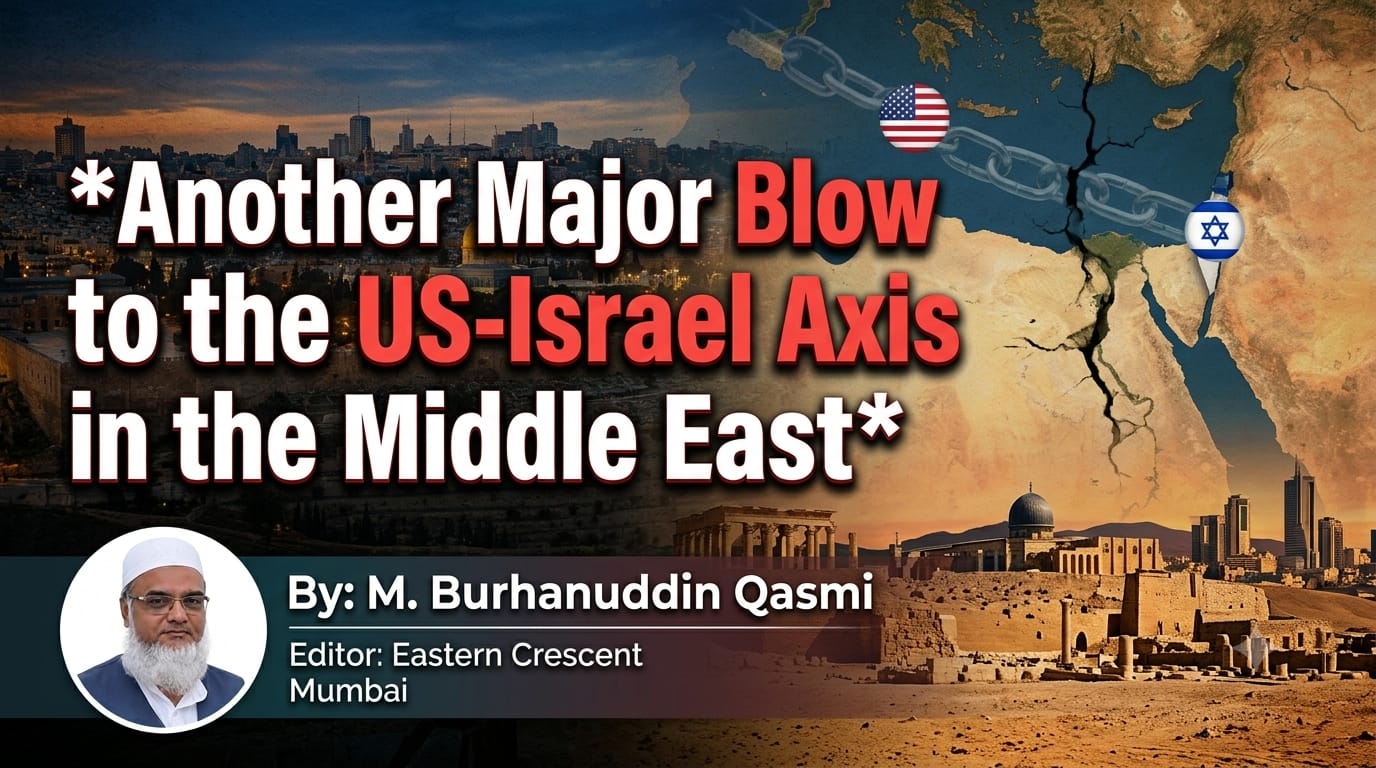
Another Major Blow to the US-Israel Axis in the Middle East

Another Major Blow to the US-Israel Axis in the Middle East
By: M. Burhanuddin Qasmi
Editor: Eastern Crescent, Mumbai
The geopolitics of the Middle East is changing so rapidly that many could not have seen it coming. Ansarullah Houthis of Yemen have reportedly taken control of nearly 3,000 sq km of territory—although different reports vary regarding the size of the area—including Mocha Port, parts of the Bab Al-Mandeb area and nearby islands, from Saudi/UAE/US-backed Yemeni forces. This means that the entire Red Sea coastline of western Yemen is now under Houthi control, following their sweeping advances between 2 and 10 September 2026. The speed of these developments is reminiscent of what the world witnessed in the recent past, when Ahmad Ash-Sharaa’s forces took control of Syria in 2024 and the Taliban recaptured Afghanistan in 2021.
At present, the two most important and strategic waterways in the world—the Strait of Hormuz in the Persian Gulf and the Bab Al-Mandeb in the Red Sea—appear to be beyond the effective control of the US-Israel axis, a development that could also severely affect traffic through the Suez Canal. In this strategic landscape, the Gulf countries find themselves surrounded from the south, north and east by Iran, its ally Oman, and the Houthis, who control large parts of western Yemen. This is undoubtedly a major and unexpected blow to the USA and its allies in the region, and a significant strategic advantage for Iran amid the ongoing war in the Middle East.

Global trade is already facing severe challenges, oil prices are sky-high, and the world economy is rapidly sinking. US President Donald Trump appears to be under stress, with no clear way out of the unprovoked war that he started for Netanyahu against Iran, but which has now put the whole world in trouble. Iran’s economy is in poor condition too, but it has developed ways of dealing with sanctions over the past several decades.
We appreciate that, so far, Turkey and Pakistan have declined to directly take part in this war against the Houthis on behalf of Saudi Arabia. They have also stated that conflicts predating the Makkah Pact are excluded from the Pact among the three countries, under which an attack on one would be considered an attack on all three. The Makkah Pact concerns future wars, while the Saudi-Houthi conflicts belong to earlier rounds of conflict. Here again, the US deep state seems to be struggling to counter Turkey’s efforts to keep the Makkah Pact away from the ongoing war and to restrain Pakistan from becoming directly involved. On the other hand, Pakistan has good relations with Iran, which it will likely seek to preserve.
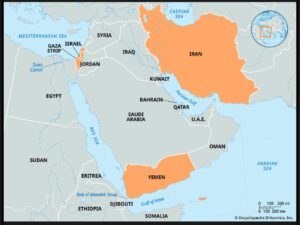
Saudi Arabia and the UAE are also divided over Yemen, as both have different interests and their own proxies on the ground, sailing in different boats and in different directions. At present, it clearly appears that neither Saudi Arabia nor the UAE is in a position to stop the Houthi advances, while their US-Israel allies are not in a position to provide decisive assistance. Turkey and Pakistan were the last hope, but that hope, so far, remains only a hope for Saudi Arabia. To show solidarity with the UAE, Israel or the USA, or both, may once again drop some bombs from the sky, killing more innocent Yemenis. But such airstrikes are unlikely to bring about any major change on the ground.
Middle Eastern geopolitics is changing, and so is the balance of power in the world. Our world is moving from a unipolar to a multipolar order. Russia and China are gradually sharing global power, while the dollar’s monopoly is slowly but steadily fading away.

It is time for India to come forward and take a stand of its own, without being burdened by Trump or Netanyahu. BRICS can be a genuine platform for India to express its position on the world stage and call for peace in the Middle East. India may also revive its earlier position in support of the freedom of Palestine. We have consistently stood with the Palestinian cause from 1947 through the tenures of Prime Minister Atal Bihari Vajpayee and Dr Manmohan Singh. We hope and pray that a day will come when the Arabs and Muslims are united, and when Gaza and Palestine are liberated from the Zionist occupation and the genocidal regime of Israel, In-Shaa-Allah.
You May Also Like
 Articles
Smart Selection of Qur'anic Verses by Iran During Ayatullah's Funeral
Smart Selection of Qur'anic Verses by Iran During Ayatullah's Funeral By M. Burhanuddin Qasmi...
 Articles
Human Rights in Islam
Human Rights in Islam By: Shafiul Haque Balrampuri A DELL Student: Darul Uloom Deoband...
 Articles
Amidst Bloodshed continues in Lebanon, Gaza and the West Bank
Amidst Bloodshed continues in Lebanon, Gaza and the West Bank Iran, US war takes...
 Articles
Disagreement among Scholars is an Intellectual Reality and a Source of Islamic Guidance
Disagreement among Scholars is an Intellectual Reality and a Source of Islamic Guidance By: Maulana...
 Articles
Radiant Beacon of Spirituality: Hazrat Maulana Zulfiqar Ahmad Naqshbandi (Rah.)
By: Khursheed Alam Dawood Qasmi First Acquaintance with Peer Sahib: It was around the...
 Articles
Mufti Muhammad Azharul Haq (Rah.): A Beacon of Knowledge Extinguishes
Mufti Muhammad Azharul Haq (Rah.): A Beacon of Knowledge Extinguishes By: Khursheed Alam Dawood...
Comments (0)
Leave a Comment