
The Rising Trend of Suicide: Causes, Context and Prevention

The Rising Trend of Suicide: Causes, Context and Prevention
By: Mohammad Taukir Rahmani
Subeditor: Eastern Crescent
What is that moment when a person who once cherished life finally decides to end it? Why does the hand that once reached out to hold the hands of loved ones one day move towards extinguishing the very flame of its own life? Why does a heart that was dreaming of the future only yesterday suddenly begin to believe that there is nothing ahead but darkness? And perhaps the most important question is this: does such a person truly want to end their life, or are they desperately seeking relief from an unbearable pain for which they can no longer see any way out?
Suicide is not merely the death of an individual; it is also a painful reflection of the family, relationships, social environment and psychological state surrounding that person. Behind it, there is often a crisis that remains invisible to the outside world. Profound hopelessness, prolonged psychological distress, loneliness, broken relationships, financial hardship, academic or professional failure, marital difficulties, violence, social humiliation, substance abuse, mental illness, and sudden traumatic events can push a person to a point where they can no longer see a way out of their suffering. This is why reducing suicide to mere cowardice, a weak will, or a lack of faith does not help us understand the problem; instead, it can make it even more complicated. At times, a person needs to be heard before being advised, shown compassion before being judged and offered help before being blamed.
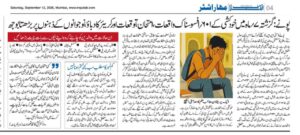
Suicide is a major public health concern worldwide. Every year, millions of people across the globe lose their lives to suicide, while many more experience suicidal thoughts or reach the stage of attempting to take their own lives. Yet statistics reveal only the scale of the problem; they cannot fully convey the pain through which a person passes before reaching such a point. It is also important that “suicide is more prevalent among non-Muslims.” Such an absolute claim is not academically sound. But, unfortunately data reads so. For instance, according to the Urdu newspaper Inquilab on Saturday 12th September, more than 600 people—all non-Muslims—committed suicide within 7 months in 2026 in Pune alone. However, suicide rates vary across countries and societies and are shaped by numerous factors beyond religion, including age, gender, economic circumstances, mental health, family relationships, social isolation, substance abuse, cultural influences, urban or rural settings, and systems of reporting. Even when comparing different religious groups, differences in population structure and social conditions cannot simply be disregarded.

At the same time, a number of research studies have identified a possible protective association between religious affiliation and the risk of suicide. This does not mean that religious people are immune to suicide or that non-religious people are necessarily more vulnerable to it. The reality is far more complex. In certain circumstances, the potential protective effect of religion may arise not only from faith itself, but also from factors such as a sense of community, social support, a sense of purpose in life, hope, moral responsibility, and strong religious prohibitions against suicide. Therefore, the more accurate conclusion is that religious affiliation can serve as a protective force against suicide for some individuals and in some societies; however, suicide rates cannot be properly understood solely through the lens of religion or the absence of religion.
When Does a Person Become Their Own Enemy?
In many cases, suicidal thoughts do not emerge suddenly. They are often preceded by days, months, and sometimes years of accumulated pain. A failure, a divorce, a debt, an examination, or the breakdown of a relationship may appear to be the final trigger, but in many instances, it is simply the last pressure placed on an emotional and psychological burden that was already there.
Human beings can endure hardship, but when a person begins to believe that circumstances will never improve, the weight of that hardship can become many times heavier. Hopelessness narrows a person’s vision of the future. Today’s pain begins to feel permanent, while the possibilities of tomorrow gradually disappear from view. Here, an important distinction needs to be understood: being unable to see a future and having no future at all are not the same thing. A crisis can severely narrow the way the mind perceives its circumstances.
Today, we have more means of communication than ever before, yet the crisis of genuine human connection also appears to be deepening. Despite having thousands of online connections, some people are unable to share their real suffering with even a single person. A person may have family members at home, friends around them, and hundreds of contacts on social media, and yet remain deeply lonely within. Someone becoming unusually quiet, withdrawing from others, remaining persistently sad, speaking negatively about their own worth, or repeatedly saying, “There is no point in my life,” should never be dismissed as something trivial.

The family can be the first and strongest protective shield for a person. But when that shield is weakened by constant conflict, humiliation, violence, unnecessary comparisons, unrealistic expectations, or emotional neglect, an individual’s distress can intensify. Telling a child again and again that someone else scored higher, constantly branding a young person as a failure, dismissing a son’s or daughter’s emotions as mere stubbornness, or treating every concern raised by a husband or wife as nothing more than a complaint may seem like minor behaviours on the surface. Yet when repeated over time, such patterns can leave deep emotional wounds. A home is not merely a place to eat and live; it should be the place where a person can return even after being defeated by the world.
Debt, unemployment, business losses, prolonged financial pressure, and the feeling of being unable to meet the needs of one’s family can subject a person to severe psychological distress. Particularly in societies where success is measured by wealth and failure by financial status, an economic crisis can also undermine a person’s self-confidence and sense of self-worth. But financial failure is not failure in life. Money can be earned again, employment can be found again, and a business can be rebuilt; life, however, cannot be brought back once it is lost.
The race for success has become increasingly intense for today’s younger generation. Examinations, admissions, employment, competition, careers, and anxiety about the future can sometimes push psychological stress to dangerous levels. Parents and teachers need to understand that the result of a single examination does not determine an entire child’s life. A failure can be an opportunity to learn, improve, and grow; it is not the end of a person’s identity or potential.
Love is one of the fundamental emotional needs of human beings. That is why the breakdown of an important relationship can be profoundly painful for some people. Unrequited or failed love, divorce, marital conflict, betrayal, or the loss of someone dear can plunge a person into a severe emotional crisis. But the end of a relationship does not diminish a person’s worth. A relationship may be a part of life; it is not the whole of life.
Domestic violence, sexual or physical abuse, harassment at school or in the workplace, persistent humiliation, blackmail, and social degradation can leave deep and lasting effects on a person’s mind. In such situations, simply telling someone to “be patient” is not enough. Safety, legal assistance, intervention by family members or trusted individuals, and, when necessary, professional support may also be essential.
Substance abuse can impair a person’s judgment, emotional stability, and ability to exercise self-control. The financial, family, social, and health problems that may follow can further intensify an existing crisis. For this reason, preventing substance abuse and ensuring access to appropriate treatment also have an important role to play in suicide prevention.
Social media has certainly brought the world closer, but it has also created a new arena for comparison. When people see others’ carefully selected photographs, achievements, expensive cars, beautiful travels, and seemingly perfect lives, they may begin to view their own lives as inferior. They forget that they are seeing a carefully selected snapshot of someone else’s life while experiencing the entire background of their own. This constant comparison can foster feelings of inadequacy, falling behind, and worthlessness, particularly among young people.
Islam offers human beings a fundamental understanding of life: life is not without purpose. A person is not merely a creature at the mercy of circumstances; rather, they are entrusted with a life given by Allah and are responsible for how they live it. Whether in happiness or sorrow, success or failure, ease or hardship, every condition of life carries meaning.
Rather than leaving human beings trapped in the darkness of despair, the Qur’an teaches them to place their hope in the mercy of Allah. It develops an awareness that trials should not be seen as evidence that life has reached its end, but as opportunities for patience, prayer, turning back to Allah, and continued effort. Because, every cloud has a silver lining as Qur’an states in Al-Sharh. This religious consciousness can give a person the profound reassurance that they are not alone. A connection with Allah, along with prayer, patience, and trust in Him, can provide inner strength, while family, the mosque, the wider community, kinship, and mutual support can create an external social safety net.
Yet an important and delicate balance must also be maintained. If a person is suffering from severe mental illness, depression, or a serious psychological crisis, simply telling them to “strengthen their faith” is not a complete solution. Just as seeking medical attention for a physical illness does not contradict trust in Allah, seeking help from a mental health professional or qualified healthcare provider for a psychological illness is not contrary to faith. Prayer can provide spiritual support, while treatment can help stabilise the mind; there is no justification for presenting the two as opposing alternatives.

Similarly, frightening, shaming, or publicly humiliating a person experiencing suicidal thoughts by branding them a sinner is not helpful. What they need is a safe space in which to express their suffering, compassionate listening, and timely support.
Prevention is not simply about telling someone to “be patient”; it is about standing beside them. Suicide prevention is not the responsibility of any one individual or institution. Families, educational institutions, religious centres, healthcare professionals, the media, and society as a whole can all play a meaningful role.
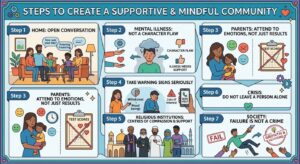
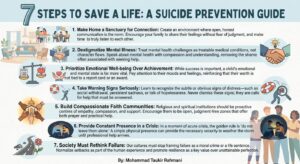
First Step: Make the Home a Place for Open Conversation
There should be an environment where a son does not fear speaking about his failures, a daughter can share her worries, a husband or wife can talk openly about their mental and emotional state, and even older family members do not feel ashamed of acknowledging their own vulnerabilities.
Second Step: Mental Illness Should Not Be Treated as a Character Flaw
Depression, severe anxiety, and other mental health conditions should not simply be dismissed as weak faith, laziness, or a weak personality. Such attitudes can become a barrier to seeking help. When necessary, qualified medical and mental health support should be sought.
Third Step: Parents Should Pay Attention Not Only to Results but Also to Their Children’s Emotions
A child’s grades, employment, and achievements matter, but their emotional well-being and sense of security matter even more. After every setback, parents should also ask: “How are you feeling?”
Fourth Step: Take Warning Signs Seriously
If someone repeatedly talks about death, feeling worthless, hopelessness, or ending their life; suddenly withdraws from everyone; begins giving away important possessions; or shows an unusual change in behaviour following a severe crisis, these signs should not be ignored. In such circumstances, it is important to ask directly rather than criticise, stay with the person, and help connect them with appropriate professional support.
Fifth Step: Make Religious Institutions Centres of Compassion and Support
If imams, preachers, and religious leaders approach mental health problems not merely through the lens of blame, but with compassion, hope, patience, treatment, and human understanding, many people may be encouraged to seek help before their situation reaches a critical point.
Sixth Step: Do Not Leave a Person Alone During a Crisis
If there is an immediate concern that someone may be at risk of suicide, they should not be left alone. A trusted person should stay with them, immediate medical or emergency assistance should be sought, and access to potentially dangerous means should be restricted. The World Health Organization also recognises restricting access to such means as an effective suicide-prevention measure.
Seventh Step: Society Should Not Treat Failure as a Crime
We need a society in which an unemployed young person is not treated with contempt, a student who has failed is not regarded as a failure in life, a divorced woman or man is not subjected to social death, financial loss in business is not treated as a character defect, and mental illness is not turned into a source of shame.
Ultimately, suicide prevention is not simply about preventing death; it is about giving a person a reason to look towards life again. For one person, that reason may be a mother’s voice; for another, a phone call from a friend; for someone else, a teacher’s attention, an imam’s compassion, a doctor’s support, or a renewed belief in the mercy of Allah.
So we should not ask only, “Why do people die by suicide?” We must also ask, “How many pathways back to life have we made available to those who are struggling?”
Perhaps saving a life does not always require some extraordinary act. Sometimes, a moment of attention, a conversation, a hug, a phone call, a safe place, connecting someone with a professional, or simply making them feel, “You are not alone. Your pain can be heard, and things will not always remain this way,” may be enough to make a difference.
There may be times in life when every path appears to be closed, but the inability to see a way forward is not proof that no way exists. That is perhaps the greatest deception of a crisis: it makes a person believe, in the darkness of the moment, that the night will last forever. In that darkness, our task is not to pass judgment, but to light a lamp; not to blame, but to offer support; and not merely to preach patience, but to provide, alongside patience, help, treatment, human connection, hope, and a practical way forward. Because sometimes, what a person needs to be saved from is not death itself, but loneliness.
You May Also Like
 Articles
Begin the New Year with Self-Introspection and a Life Manifesto
Begin the New Year with Self-Introspection and a Life Manifesto By: Mohammad Taukir Rahmani...
 Lifestyle
The Battle between Truth and Falsehood – Since the Dawn of Time
The Battle between Truth and Falsehood – Since the Dawn of Time Mohammad Taukir...
 Lifestyle
Syed Iqbal Zaheer and His Lifelong Quest for Knowledge and Scholarship
Syed Iqbal Zaheer and His Lifelong Quest for Knowledge and Scholarship By: Dr. Manzar...
 Lifestyle
Dr. Muhammad Manzoor Alam: A Scholar, Thinker and Reformer
Dr. Muhammad Manzoor Alam: A Scholar, Thinker and Reformer By: Khursheed Alam Dawood Qasmi...
 Islam
IslamTrailblazer: Where Faith, Philosophy, and Science Converge
Trailblazer: Where Faith, Philosophy, and Science Converge By: Mohammad Taukir Rahmani Lecturer at MMERC,...
 Lifestyle
The Blessed Birth of Prophet Muhammad (saws) and Conditions of Arabia
The Blessed Birth of Prophet Muhammad (saws) and Conditions of Arabia By: Khursheed Alam...
Comments (0)
Leave a Comment