
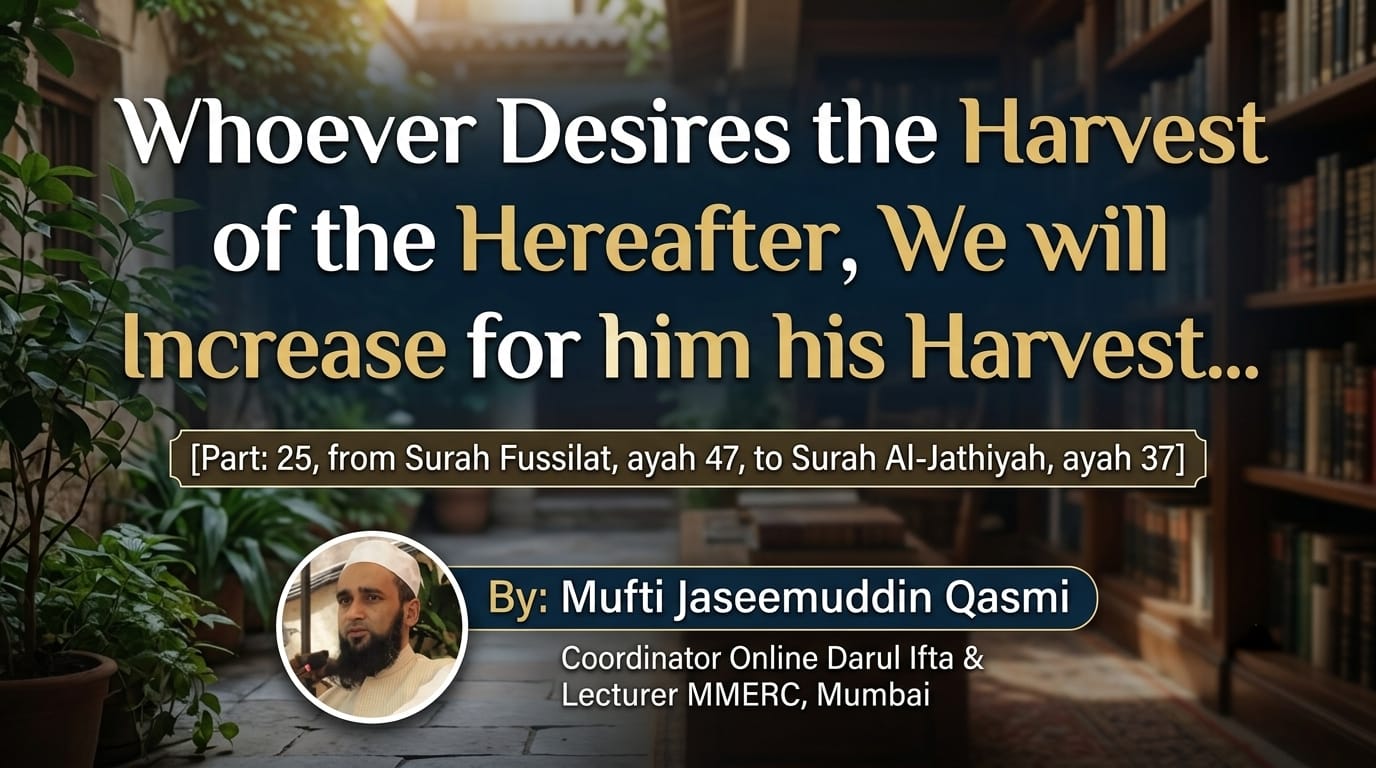
“Whoever Desires the Harvest of the Hereafter, We will Increase for him his Harvest…”

“Whoever Desires the Harvest of the Hereafter, We will Increase for him his Harvest…”
[Part: 25, from Surah Fussilat, ayah 47, to Surah Al-Jathiyah, ayah 37]
By: Mufti Jaseemuddin Qasmi
Coordinator Online Darul Ifta & Lecturer MMERC, Mumbai
In the first ayah of Part: 25, Allah the Almighty says: “To him alone is attributed knowledge of the Hour (of the Day of Judgment). And neither fruits emerge from their coverings nor does a female conceive or give birth except with His knowledge. And the Day He will call to them, “Where are My ‘partners’?” they will say, “We announce to You that there is no longer among us any witness.”
That is, only Allah has complete knowledge of the unseen, and everything that happens in creation is by His knowledge, while all false partners will be powerless and denied on the Day of Judgment.
Allah says in ayah 53 of Surah Fussilat, “We will show them Our signs in the horizons and within themselves until it becomes clear to them that it is the truth. But is it not sufficient that your Lord is a Witness over all things?”
That is, Allah will show signs to the deniers within their own selves as well. Thus, despite the apparent lack of worldly means, they witnessed these signs in their own experience during the Battle of Badr. Likewise, during the era of the Rightly Guided Caliphs, Allah’s signs in the universe became manifest through the great victories and conquests.
Surah Ash-Shura
﷽
From here begins Surah Ash-Shura. This is a Makkan surah consisting of 53 ayahs. Like other Makkan surahs, it also emphasizes the fundamental beliefs of Tawhid (the Oneness of Allah), Risalah (Prophethood), and the Hereafter. It also describes the praiseworthy qualities of the believers. In this context, ayah 38 highlights the importance of mutual consultation (shura). At the end of the surah, it is explained that Allah Almighty does not speak directly to any human being face to face; rather, He communicates through revelation (wahi). The different forms of this revelation are then described in the ayahs.
Makkah Is the Mother of All Settlements
In ayah 7, Allah Almighty says: “And thus We have revealed to you an Arabic Qur’an that you may warn the Mother of Cities (Makkah) and those around it of the Day of Gathering, about which there is no doubt. A group will be in Paradise and a group in the Blaze Fire.”
Makkah is called “the Mother of all Settlements” in this ayah, because, according to a narration, after creating the world, Allah began spreading the earth from this very place. Moreover, the first house ever built on earth was built here—the House of Allah, which we know as the Ka’bah (Baitullah).
Ayah 17 states: “It is Allah who has sent down the Book with truth, and the balance. And what will make you perceive? Perhaps the Hour (the Day of Judgment) is near.”
The greatest “Balance” is the religion of Islam, which establishes perfect justice by defining and safeguarding the rights of both the Creator and His creation with complete fairness.
Allah says in ayah 20, “Whoever desires the harvest of the Hereafter, We will increase for him his harvest; and whoever desires the harvest of this world (only), We will give him part of it, and he has no portion in the Hereafter.”
How to Treat the Wrongdoers
The summary of Ayah 23 is that when the Prophet (saws) invited people to Islam, the disbelievers persecuted and harassed him. It was the context in which this ayah was revealed. Referring to the Prophet’s family ties with the Quraish of Makkah, Allah instructed him to tell them that he did not ask for any reward in return for conveying the message. Rather, he asked them only to honor the rights of kinship that existed between them by refraining from harming him or placing obstacles in his path as he carried out his mission.
In ayahs 37, 38, and 39 of Surah Ash-Shura, the qualities of the believers are described. Accordingly, it is stated: “And those who avoid the major sins and immoralities, and when they are angry, they forgive. And those who have obeyed their Lord and established prayer and whose affair is decided by consultation among themselves, and they spend from what We have provided them. And those who take revenge when they are oppressed.”
After ayah 40, several ayahs state that if someone is oppressed, he has the right to revenge. However, he is not permitted to cross the limits in revenge. Rather, he may inflict upon the wrongdoer only the same degree of harm that was inflicted upon him. This is what justice demands. But if a person remains patient and forgives, Allah will grant him the best reward.
Ayahs 49 and 50 state that Allah, the Sovereign of the heavens and the earth, grants male offspring to whom He wills and female offspring to whom He wills. He bestows both sons and daughters to some, while He leaves others childless. Indeed, He has power over all things.
So the message for us in this ayah is that children are a gift from Allah, and He alone decides whether a person has sons, daughters, both, or no children. We should accept His wisdom with gratitude and trust His perfect plan.
How Allah Communicates with Human Beings
The summary of ayah 51 is that, in this worldly life, Allah does not speak to any human being face to face. Rather, He communicates through one of three modes. The first is described as Waḥi (revelation), whereby Allah conveys whatever He wills by inspiring it directly into a person’s heart. The second is communication from behind a veil, meaning that His words are heard without any visible form being seen, as occurred with the Prophet Musa (as). The third mode is that Allah sends His message to a prophet through an angel, who conveys His revelation.
Surah al-Zukhruf
﷽
Here begins Surah al-Zukhruf. It is a Makkan surah comprising 89 ayahs. In this surah, the polytheists are made to realize that blindly following their forefathers in matters of fundamental beliefs is an entirely erroneous course of action. It then cites the example of the Prophet Ibrahim (as), asking that if they insist on following their forefathers, why do they not follow Ibrahim, who openly and unequivocally declared his complete dissociation from polytheism?
Prophethood has nothing to do with Wealth
This sūrah also responds to the objections that the polytheists used to raise objections against the Prophet (saws). One of their objections was that if Allah intended to appoint a messenger, why was a wealthy and influential chieftain not chosen for this mission? In reply, Allah makes it clear that worldly wealth and material prosperity bear no relationship to a person’s sanctity or nearness to Him. Allah may grant gold, silver, and abundant worldly riches even to the disbelievers, but this in no way signifies that they are favored by Him, because, compared to the blessings of the Hereafter, this worldly wealth and riches have no value.
The sūrah further explains that Allah distributes worldly resources according to His perfect wisdom and through an established system of providence. In this context, it briefly recounts the account of the Prophet Musa (as) and Pharaoh. Pharaoh had raised a similar objection against Musa (as), arguing that he possessed neither wealth nor worldly status, whereas Pharaoh himself enjoyed immense power and riches. Yet the outcome was that Pharaoh was drowned because of his disbelief, while Musa (as) ultimately dominated by the will of Allah.
The surah also mentions briefly Prophet Isa (as) stating his true status.
The word Zukhruf in Arabic means “gold.” In ayah 35 of this surah, this word is mentioned. The ayah says, “And gold ornament. But all that is not but the enjoyment of worldly life. And the Hereafter with your Lord is for the righteous.” It is for this reason that the sūrah is named Sūrah al-Zukhruf.
The Qur’an was Preserved in al-Lawḥ al-Maḥfūẓ
Ayah 4 states: “And indeed it is, in the Mother of the Book with Us, exalted and full of wisdom.” The Glorious Qur’an has existed in al-Lawḥ al-Maḥfūẓ from pre-eternity. From there, it was sent down to the heavenly realm, and thereafter it was revealed to the Prophet Muḥammad (saws) gradually, as circumstances required.

The Supplication for Riding Means of Transportation
Ayahs 12–14 state: “And It is He Who created the all things in pair, and has made ships and animals for you which you ride. So that you may sit upon their backs and then remember the favor of your Lord when you have settled upon them and say, “Subhana alladhi sakhkhara lana hadha wa ma kunna lahu muqrinin. Wa inna ila Rabbina lamunqalibun.” (“Exalted is He who has subjected this to us, and we could not have otherwise controlled it. And indeed we will surely return to our Lord.”)
The Arab polytheists had the belief that the angels were the daughters of Allah. Beginning with ayah 15, this belief is refuted and its falsehood is made clear.
The Interdependence of Human Livelihoods
Ayah 31 of Az-Zukhruf states: “And they said, ‘Why was this Qur’an not sent down upon a great man from the two cities?’”
Here the “two towns” referred to are Makkah and Ṭāʾif. Since these were the two main cities of the region, the polytheists argued that, if the Qur’an were to be revealed, it should have been sent down upon one of the wealthy and influential leaders of either of these two cities.
Ayah 32 responds to this objection by pointing out that such a proposal means that these people consider themselves entitled to decide who should be granted the blessing of prophethood and who should not. Yet even the distribution of worldly wealth and the means of livelihood—which are of far lesser significance than prophethood—has not been entrusted to them, for they are unfit even for that, let alone for deciding the matter of prophethood. Rather, Allah Himself has established a system in which every individual is made dependent upon others for the fulfillment of their needs. This mutual dependence is reflected in the varying levels of people’s livelihoods and incomes, through which one person serves the needs of another, enabling them to benefit from one another’s services.
Baseless Objection of the Disbelievers
In ayah 36, it is stated:”And whoever is blinded from remembrance of the Most Merciful – We appoint for him a devil, and he is to him a companion.”
This indicates that one of the punishments for committing sins heedlessly, without any sense of remorse, is that Satan is allowed to gain dominance over such a person. As a result, he prevents them from turning toward righteousness and keeps them engaged in a life of sin.
Allah says in ayah 57 of Surah Az-Zukhruf , “And when the son of Mary was presented as an example, immediately your people laughed aloud.”
When the ayah of Surah Al-Anbiya was revealed in which the idolaters were addressed and told: “Indeed, you and those whom you worship besides Allah are the fuel of Hell,” one of the disbelievers objected by saying that many people also worship Prophet Isa (as). Therefore, according to the apparent implication of this ayah, he argued, (God forbid) Isa (as) would also have to be among the fuel of Hell, even though Muslims believe that he was one of Allah’s prophets.
When the other disbelievers heard this, they raised a great commotion, claiming that this man had presented a very powerful objection. In reality, however, the objection was entirely baseless. The ayah was addressing the idolaters, not the Christians. Moreover, besides idols, it referred only to those beings who had instructed people to worship them. Therefore, there was no question of including Prophet Isa (as) in its meaning, because he never instructed anyone to worship him. Few ayahs of surah Zukhruf were revealed on that occasion.

Every Desire Will Be Fulfilled in Paradise
Ayah 71 describes some of the blessings of Paradise: “Plates and vessels of gold will be circulated among them. And whatever the souls desire and what delights the eyes are available in it, and you will abide therein eternally.”
Ayah 77, on the other hand, portrays the condition of the inhabitants of Hell.
Surah al-Dukhān
﷽
Drought ends after the Prophet’s Supplication
Here begins Surah al-Dukhān. It is a Makkan surah comprising 59 ayahs. The surah was revealed at a time when Allah Almighty afflicted the disbelievers of Makkah with a severe drought as a warning. The famine became so intense that people were driven to eating even leather. At that point, the disbelievers, through Abu Sufyan, appealed to the Prophet (saws), requesting him to pray to Allah for relief from the drought. They promised that if the famine were lifted, they would embrace Islam.
The Prophet (saws) prayed, and Allah the Most Merciful, brought the drought to an end. However, once the hardship had passed, the disbelievers broke their promise and did not accept Islam.
This incident is mentioned in ayahs 10–15 of this surah. The rest parts of the surah focus on affirming the doctrines of Divine Oneness (Tawḥīd), Prophethood (Risālah), and the Hereafter (Ākhirah).
When Are the Decrees for the Coming Year Decided?
Ayahs 3–4 Surah al-Dukhān state: “Indeed, We sent it (Qur’an) down during a blessed night. Indeed, We were to warn. On that night, every wise matter is determined.”
The “blessed night” referred to here is Laylat al-Qadr (the Night of Decree). It was on this night that the Qur’an was sent down from the Preserved Tablet (al-Lawḥ al-Maḥfūẓ) to the lowest heaven, and from there it was revealed gradually to the Prophet Muhammad (saws) over time.
On this night, the major events destined to occur during the coming year are entrusted to the angels for their execution by Allah’s command. These include such matters as who will be born, the provision (rizq) that each person will receive, who will pass away, and other decrees relating to the affairs of creation.
The disbelievers of Makkah rejected the doctrine of resurrection after death. They would challenge the Prophet (saws) by saying, “If what you claim is true, then bring our forefathers back to life.”
Instead of responding directly to this frivolous demand, the Qur’an reminds them that a nation far more powerful than them, had already been destroyed because of its disobedience to Allah. So, what standing did these people have before Him? Thus, Allah says in ayah 37: “Are they better or the people of Tubba’ and those before them? We destroyed them, (for) indeed, they were criminals.”
Tubbaʿ was not the name of a single individual but the royal title borne by the kings of Yemen. The Qur’an does not specify which Tubbaʿ is meant in this ayah. According to Ḥāfiẓ Ibn Kathīr, the “people of Tubbaʿ” is another name for the people of Sabaʾ (Sheba).
The surah then goes on to describe the punishment of the inhabitants of Hell.
Surah al-Jāthiyah
﷽
Here begins Surah al-Jāthiyah. It is a Makkan surah consisting of 37 ayahs.
The surah primarily emphasizes three central themes. First, it draws attention to the countless signs of Allah Almighty’s perfect power and infinite wisdom that are obvious throughout the universe. Anyone who ponders upon these signs with reason and sincerity cannot but conclude that the Creator of this universe has no need of any partner in the governance of His dominion. Consequently, associating others with Him in worship is entirely baseless.
Second, the Prophet (saws) is informed that he has been given certain rulings of the Sharīʿah that differ in some respects from those prescribed for earlier ummahs. Since all divine laws originate from Allah, such differences should not be regarded as surprising or objectionable.

Third, the surah vividly portrays the awe-inspiring scenes of the Day of Resurrection and the events that will unfold on that Day.
Ayah 4 states: “And in your own creation, and in the living creatures that He has spread throughout the earth, there are signs for people who possess strong faith.”
Ayahs 36 and 37 of Surah al-Jathiyah state the attribute of Allah, “Therefore to Allah is due all praise, Lord of the heavens and Lord of the earth, Lord of the Worlds. And to Him belongs the Greatness in the heavens and the earth, and He is the All-Mighty, the All-Wise.”
You May Also Like
 Qur'anic Wisdom
“Read in the Name of Your Lord Who Created.”
“Read in the Name of Your Lord Who Created.” (Part / Juz: 30, from...
 Qur'anic Wisdom
“And do not bestow favor to acquire more”
“And do not bestow favor to acquire more” [Part/ Juz 29 — From Surah...
 Qur'anic Wisdom
“…so that it (wealth) may not circulate only between the rich among you...”
“…so that it (wealth) may not circulate only between the rich among you...” [Part...
 Qur'anic Wisdom
“I Have not Created Jinn and Mankind Except to Worship Me.”
“I Have not Created Jinn and Mankind Except to Worship Me.” [Part /Juz'-27 from...
 Mufti Jaseemuddin Qasmi
“If A Sinful Person Brings You a News, Investigate…”
“If A Sinful Person Brings You a News, Investigate…” (Part /Juz - 26 from...
 Islam
Islam“Good and evil are not equal. Repel evil deed by that deed which is better”
By Mufti Jaseemuddin Qasmi Coordinator Online Darul Ifta & Lecturer at MMERC, Mumbai [Part...
Comments (0)
Leave a Comment