
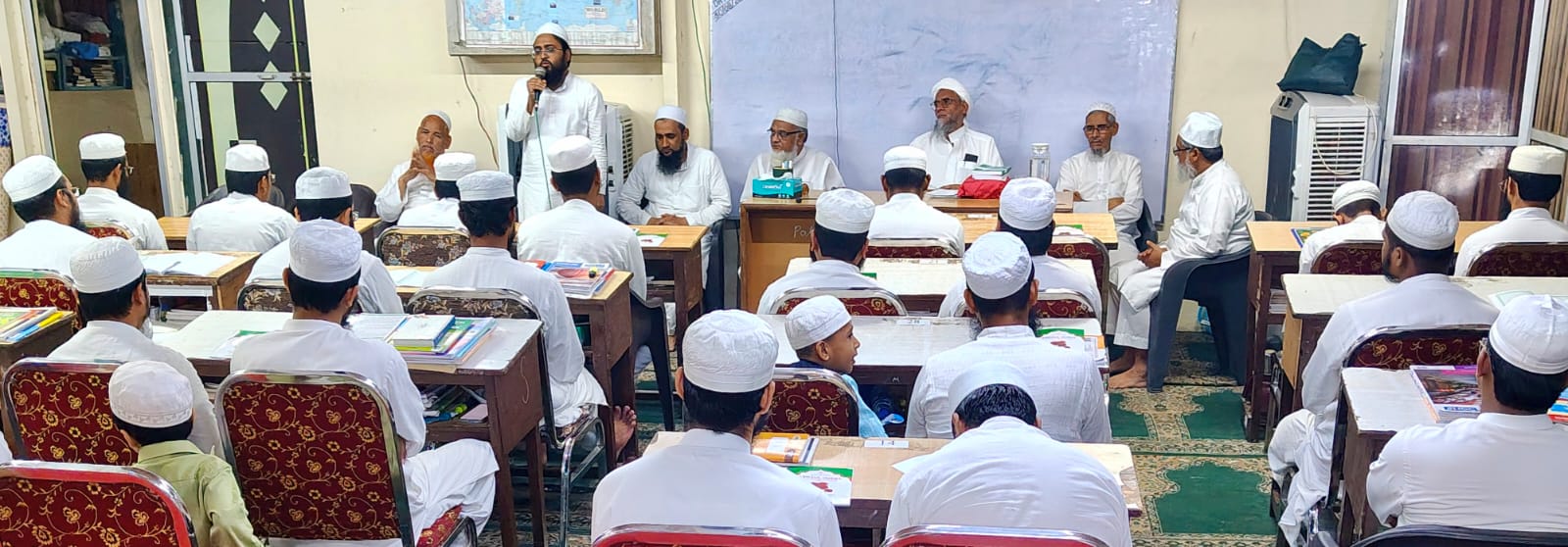
Sheikh Muhammad Yahya Baskandi Visits MMERC, Mumbai; Emphasises Purpose of Education, Spiritual Purification and Stronger Bond with Allah

Sheikh Muhammad Yahya Baskandi Visits MMERC, Mumbai; Emphasises Purpose of Education, Spiritual Purification and Stronger Bond with Allah
Mumbai, August 31, 2026:
(Mohammad Taukir Rahmani) — Sheikh Muhammad Yahya Baskandi, a prominent Islamic scholar and spiritual figure from Assam, Amir-e-Shariat of Imarat-e-Shariah Assam and Sheikh-ul-Hadith at Darul Uloom Baskandi, visited the Markazul Ma’arif Education and Research Centre (MMERC), Mumbai, on Sunday, August 30. He addressed the students after Maghrib and Isha prayers, delivering an insightful and thought-provoking discourse on the true purpose of education, worship of Allah, reliance upon Him, spiritual purification, Tasawwuf and the importance of maintaining a strong relationship with Allah Almighty.
Sheikh Muhammad Yahya, son of the renowned scholar and spiritual personality Sheikh Ahmad Ali Baskandi (RA), began his address by drawing an analogy from the two components of the Kalimah and their complementary relationship. He explained that just as the Kalimah is complete through its two components, different aspects of human life are also interconnected and complement one another.
He expressed that Allah Almighty is One and human beings have one head, except this they have been endowed with pairs of various organs, including eyes, ears, hands and feet. These physical faculties enable human beings to fulfil their worldly responsibilities and, through the guidance of the Shariah, progress towards recognising and knowing Allah Almighty. He emphasised that worldly responsibilities and spiritual development should not be viewed as contradictory; rather, both have their proper place in a balanced human life.
The Sheikh further stressed that along with learning and remembering the Names of Allah, Muslims should also remain conscious of the blessed name, life and teachings of the Messenger of Allah, Prophet Muhammad (peace and blessings be upon him). Drawing the students’ attention towards the purpose of education, he cited the famous Hadith, “Actions are judged by intentions” (إِنَّمَا الْأَعْمَالُ بِالنِّيَّاتِ), and reminded them that intention is fundamental to the value and acceptance of every action. Students, therefore, should continuously reflect upon the purpose behind their pursuit of knowledge.
Knowledge for the Recognition of Allah
Sheikh Muhammad Yahya explained that the knowledge of the Shariah is not merely intended for the accumulation of information or academic qualifications; rather, its ultimate purpose is Ma’rifatullah — the recognition and knowledge of Allah Almighty.
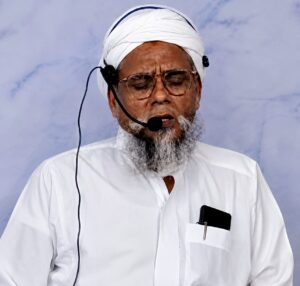
He said that genuine knowledge should cultivate awareness of Allah, fear of Him, sincerity and commitment to practising Islam in one’s daily life. According to him, the real spirit of education lies in transforming knowledge into faith, character and action.
Recalling the approach of the pious scholars of the past, he said that the elders of the Ummah would not merely prepare students for economic pursuits after graduation. Rather, after completing their studies, many students were encouraged and spiritually prepared to devote themselves to the service of Islam, religious guidance, reform and propagation.
He emphasised that the purpose of acquiring knowledge should not be confined to securing a livelihood. While earning a lawful living is necessary, equal attention must be given to the ultimate purpose of human existence — the worship and servitude of Allah Almighty. Both dimensions of life have their legitimate place, and neglecting either can disturb the balance of human existence.

Reliance upon Allah and Strengthening the Bond with Him
During his address, Sheikh Muhammad Yahya placed particular emphasis on Tawakkul — reliance upon Allah Almighty. Quoting the Qur’anic verse, “And whoever relies upon Allah, He is sufficient for him” (وَمَنْ يَتَوَكَّلْ عَلَى اللَّهِ فَهُوَ حَسْبُهُ), he encouraged the students to place their trust in Allah and develop firm confidence in His help and provision.
He stated that when a person sincerely seeks spiritual benefit and maintains a genuine relationship with Allah, Allah opens avenues of livelihood as well. The fundamental requirement, he stressed, is to strengthen one’s relationship with Allah Almighty.
He further remarked that when the fear of Allah becomes firmly established in the heart, the fear of the world loses its grip. Just as people maintain relationships with officers and responsible authorities in worldly affairs and approach them regarding their needs, believers should develop a constant relationship with Allah in every matter of their lives. Awareness of Allah’s supervision, power and assistance should remain present in every aspect of life.

Education Must Be Accompanied by Training and Spiritual Purification
Drawing attention to an important aspect of contemporary religious education, Sheikh Muhammad Yahya said that Darul Uloom Deoband and Ulama serve as guides for the Muslim community, but education alone is not sufficient. Guidance, character-building, spiritual training and Tazkiyah-e-Nafs (purification of the soul) are equally essential.
He expressed concern that, at times, considerable emphasis is placed on academic education while the dimensions of spiritual training, purification and a living relationship with Allah are overlooked. Such neglect, he cautioned, can eventually give rise to negative traits such as jealousy, resentment, mutual hostility and group divisions.
He urged the students to understand that alongside intellectual development, the purification of the heart and cultivation of noble character are essential. Only then can graduates emerge as genuine guides and servants of the community rather than merely academically qualified individuals.
What Does Society Expect from Us?
The Sheikh also invited the students to engage in serious self-reflection by asking:
“What does our society expect from us? And what do our parents expect from us after educating us?”
He reminded the students that their educational journey should not be viewed merely as a means of achieving personal success or financial stability. The expectations of their parents, the needs of society and the responsibilities of serving Islam must also remain before them.

The Importance of Remaining in Wudu
Sheikh Muhammad Yahya particularly advised the students to remain in a state of Wudu (ablution) during their studies, especially while attending classes. Highlighting the spiritual benefits of Wudu, he described it as a means of maintaining spiritual connection, goodness and blessing.
In an illustrative comparison, he likened Wudu to a kind of “network”, explaining that just as a system depends upon connectivity to function effectively, spiritual connection and purity are important for the emergence of the light and blessing of knowledge.
He further gave the students a practical example: when a vehicle gets a puncture, people immediately make arrangements to repair it. But, he asked, when the “vehicle” of human life becomes spiritually punctured, what arrangements are made to repair it?
Through this analogy, he drew attention to the importance of Wudu, purity and the means available in Islamic law for maintaining ritual cleanliness, encouraging the students to take these matters seriously.
The Role of Tasawwuf and Tazkiyah
After the Isha prayer, Sheikh Muhammad Yahya continued his address and placed particular emphasis on the importance of Tasawwuf, Tazkiyah-e-Nafs and inner reform.
He explained that the essence of Tasawwuf lies in the purification of the inner self, refinement of character and strengthening one’s relationship with Allah Almighty. Intellectual and academic excellence, he stressed, must be accompanied by spiritual development so that knowledge is reflected in a person’s conduct, character and actions.
The address concluded with a heartfelt prayer by Sheikh Muhammad Yahya Baskandi for the students and the institution. The gathering came to an end with his supplication, while the students listened attentively and benefited from his advice and spiritual guidance.
At the conclusion, Director of MMERC, Maulana Muhammad Burhanuddin Qasmi, expressed his gratitude to Sheikh Muhammad Yahya Baskandi on behalf of the students and the institution. He requested prayers for the progress, welfare and success of MMERC and assured the Sheikh that the students and faculty would strive to put his valuable advice into practice.
The Sheikh’s visit and address served as a significant reminder that education should go beyond academic attainment: it should lead to action, character-building, spiritual purification and a meaningful relationship with Allah Almighty. His message encouraged the students to maintain a balance between their worldly responsibilities and the ultimate purpose of life — the worship and service of Allah.
You May Also Like
 EDUCATION
MMERC Mumbai Organises 1st English Elocution Competition
MMERC Mumbai Organises 1st English Elocution Competition "Delivering speeches in English of this standard...
 EDUCATION
Teachers' Training Session at Al-Hidayah Residential School, Badlapur
Teachers' Training Session at Al-Hidayah Residential School, Badlapur EC News Desk 12 June 2026...
 EDUCATION
 EDUCATION
Educational Crisis and the Existential Questions of Muslim Youth: An Analytical Study
Educational Crisis and the Existential Questions of Muslim Youth: An Analytical Study By: Abu...
 EDUCATION
Quran Online India Organizes International Islamic Educational Program
Quran Online India Organizes International Islamic Educational Program Press Release Chennai, India – 18...
 Breaking News
2nd Elocution Competition Held at Markazul Ma’arif, Mumbai'
2nd Elocution Competition Held at Markazul Ma’arif, Mumbai' "Choosing topics in line with current...
Comments (0)
Leave a Comment