
0%
Culture
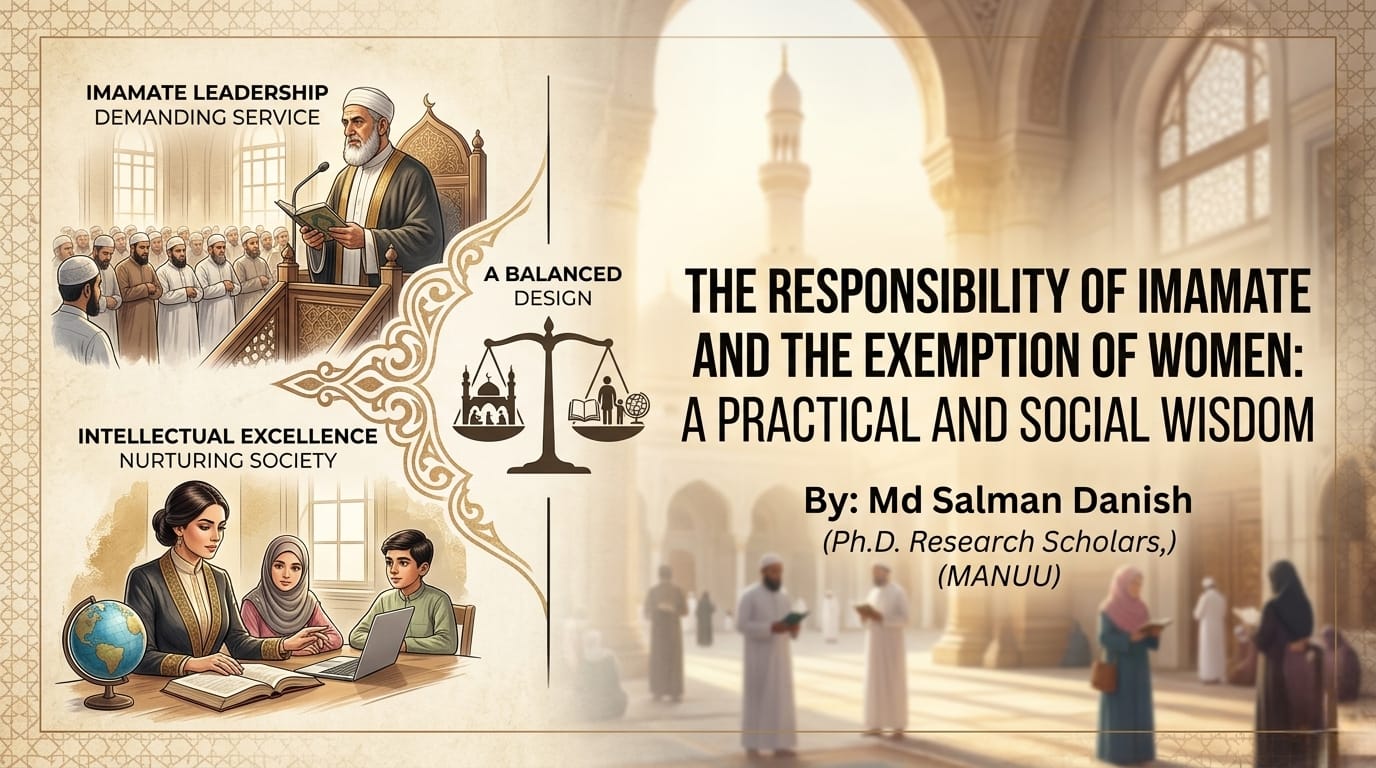
The Responsibility of Imamate and the Exemption of Women: A Practical and Social Wisdom

Save this article for later
The Responsibility of Imamate and the Exemption of Women: A Practical and Social Wisdom
By: Md Salman Danish
Ph.D. Research Scholars, MANUU
Ph.D. Research Scholars, MANUU
In Islam, the position of an Imam is not merely occasional or ceremonial; rather, it is a continuous, structured, and highly significant religious responsibility. An Imam is required to lead the five daily prayers regularly, and this duty continues throughout the month and the entire year. It demands not only religious knowledge and competence but also punctuality, physical effort, and consistency. An Imam must go to the mosque before each prayer and return home afterward, repeating this process five times a day. While this may seem simple on the surface, in reality, it is a demanding and continuous responsibility that requires discipline and perseverance.
In this context, when the issue of women leading prayers is considered, certain practical and natural factors come into view. The most important of these is that women go through a monthly biological cycle (menstruation) which typically lasts between three to ten days or more. During this period, Islamic law exempts them from performing prayers, and consequently, they cannot lead them either.

If a woman were assigned the role of an Imam, it would create an issue of continuity. Every month, the leadership of prayer would be interrupted for several days, requiring repeated arrangements for a substitute Imam. Particularly in larger mosques or well-organized religious institutions, this situation could lead to administrative and practical difficulties, potentially affecting the smooth and consistent functioning of congregational worship.
Another important aspect is the preservation of modesty, privacy, and personal dignity. Menstruation is a highly personal and sensitive matter, and women generally prefer not to disclose such conditions publicly. If a woman were appointed as an Imam and became absent during specific days each month, people might begin to notice a pattern, leading to questions or assumptions. In this way, a private matter could unintentionally become public, which may result in psychological discomfort and conflict with the values of modesty and dignity.
Islamic teachings place great emphasis on protecting an individual’s honour, privacy, and dignity. Assigning a role that may inadvertently expose a woman’s private condition or subject her to repeated public attention may not align with these principles. Therefore, this perspective can be understood not merely as a restriction, but as a form of consideration rooted in wisdom and social sensitivity.

Furthermore, Islamic rulings take into account not only ideal or theoretical situations but also real social behaviour. In reality, people tend to observe, question, and draw conclusions from patterns. The absence of an Imam is often noticed and discussed. Hence, such rulings reflect practical wisdom grounded in social realities.
In conclusion, the role of an Imam requires continuous presence and commitment, whereas the natural biological condition of women introduces periodic interruptions. Along with this, considerations of privacy, modesty, and social sensitivity also play an important role. For these reasons, in the Islamic system, the responsibility of leading congregational prayers has been entrusted to men, which can be understood as a practical, social, and ethical wisdom.
You May Also Like
 Culture
Redefining Muslim Leadership in Contemporary India-A Framework of Inclusive Community Governance
Redefining Muslim Leadership in Contemporary India-A Framework of Inclusive Community Governance By: S. Masood...
138 · Sep 19, 2026
 Culture
How to Combat Hate Speech and Hate Crime in India
How to Combat Hate Speech and Hate Crime in India By: S. Masood Husain...
142 · Aug 30, 2026
 Culture
Reforming Muslim Society in India: A Call for Introspection and Renewal
Reforming Muslim Society in India: A Call for Introspection and Renewal By: S. Masood...
375 · Aug 22, 2026
 Culture
A Child Reflects the Home He Grows In
A Child Reflects the Home He Grows In By: Mohammad Taukir Rahmani Subeditor: Eastern...
767 · May 9, 2026
 Culture
The Flood of Heresy: A Manifestation of Ideological Colonialism and a Trial for Islamic Consciousness
The Flood of Heresy: A Manifestation of Ideological Colonialism and a Trial for Islamic...
218 · Aug 6, 2025
 Culture
Meaning of Love for the Prophet Muhammad (SAWS)
Meaning of Love for the Prophet Muhammad (SAWS) By: Khursheed Alam Dawood Qasmi Moon...
158 · Sep 15, 2024
Comments (0)
Leave a Comment