
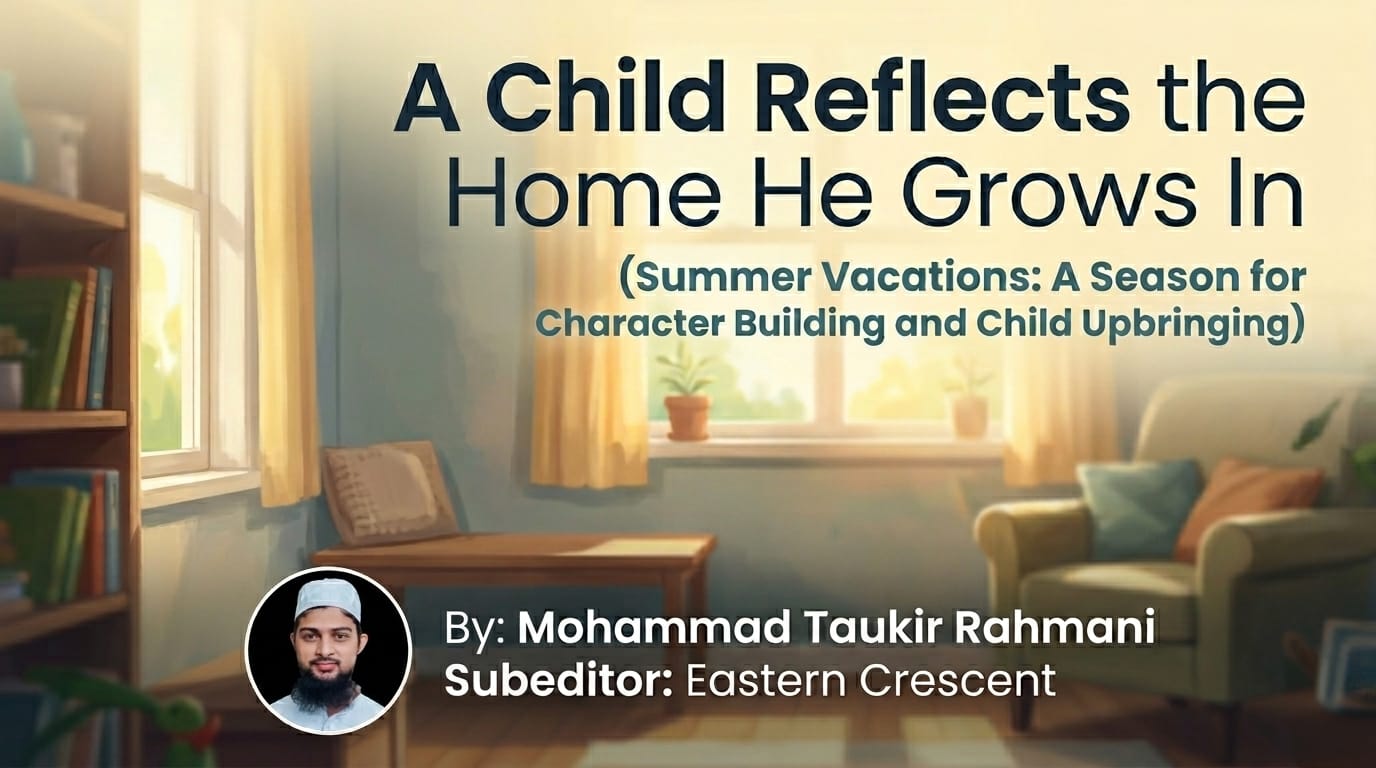
A Child Reflects the Home He Grows In

A Child Reflects the Home He Grows In
By: Mohammad Taukir Rahmani
Subeditor: Eastern Crescent
Summer vacations do not merely arrive with the intensity of heat; they also open the door to a new phase in human relationships. When the gates of educational institutions close, the doors of homes, in a deeper sense, begin to open. The children who, until yesterday, were bound by books, assignments, schedules, and academic discipline now enter an environment where there is both freedom and silent influence. This freedom may outwardly appear to be liberation from restriction, but in reality, it is an entrance into a different kind of order—an order without a formal curriculum, yet one whose impact is far deeper and more enduring.
When a child steps out of school and enters the atmosphere of home, learning does not cease; rather, the nature of learning changes. No lesson is now written upon a blackboard before him—instead, it appears embodied in living character and daily conduct. A teacher’s sentence may leave an imprint upon the mind, but a parent’s behavior settles into the heart. That is why, at this stage, upbringing becomes a silent process—a process in which words are few, yet influence is immense. It is not difficult to understand that human beings are shaped far more profoundly by what they witness than by what they merely hear. If a child repeatedly observes that his parents speak with patience, maintain dignity even in disagreement, and preserve discipline and grace in their daily routines, these qualities gradually transfer into his personality in an almost imperceptible manner. On the other hand, if the home is dominated by disorder, harshness, tension, and emotional friction, those very elements quietly seep into the child’s character as well—even if they were never verbally taught to him.

This reality may be understood in this way: a child is not a blank sheet of paper, but a sensitive mirror. He does not merely retain words; he absorbs tones, manners, emotional atmospheres, and the very nature of relationships. If light stands before the mirror, it reflects light; and if darkness surrounds it, it reflects darkness. Therefore, the assumption that children are shaped merely through advice and instruction is an incomplete understanding. In truth, they are formed by the environment in which they live. It is precisely here that the role of parents transforms into a profound test of character and responsibility.
A moment of carelessness—such as bitterness between husband and wife, or shouting insults at one another in anger—may appear to be nothing more than a temporary emotional reaction. Yet in the mind of a child, it leaves a lasting imprint. He does not simply hear those words; he internalizes that pattern of relationship itself, allowing it to become part of his psychological and emotional framework. Gradually, the same mode of behavior begins to emerge in his own attitudes and interactions.
Conversely, when parents preserve seriousness, gentleness, emotional maturity, and mutual respect within their relationship, it no longer remains merely a commendable moral quality; it becomes a living form of education. The child learns that disagreement is a natural part of life, but that its expression must remain dignified and humane. He comes to understand that true strength does not lie in the loudness of one’s voice, but in the depth and steadiness of one’s character. Such lessons are not found in textbooks; they are acquired only through observation and lived experience.
Thus, summer vacations become an invisible school of character—one where attendance is never recorded and no examination papers are distributed, yet the training received there shapes the course of an entire lifetime. The real question is not whether children will learn during this period, for they inevitably will. The real question is: what will they learn? And the answer to that question lies hidden within the parents’ own way of living—because children ultimately do not become what they are told; they become what they consistently see.
Once it becomes clear that the atmosphere of the home itself functions as a silent teacher, then directing that teacher toward the right course becomes an unavoidable responsibility. Upbringing is not merely the act of giving advice; rather, it is the creation of an environment in which every passing moment quietly delivers a message into the child’s heart. Summer vacations, in this regard, present an extraordinary opportunity, because during this period children remain closest to their parents, and it is this very closeness that shapes the contours of their personalities.

For this reason, it is essential for parents to establish a regular system of collective learning within the home. Every day, at a fixed and designated time—when all family members are present—a brief yet consistent gathering should take place in which everyone participates. This should not remain a mere exercise in reading; rather, it should become an intellectual and spiritual sitting where the luminous dimensions of the Prophetic Seerah, the profound events from the life of the Prophet ﷺ, and the practical models found in the lives of the noble Companions (RA) are thoughtfully presented and discussed.
Likewise, the sacrifices, perseverance, struggles, and unwavering commitment of the pious predecessors, the Tābi‘īn, and the great spiritual masters should also be shared within these gatherings—their endurance through hardships, their patience in adversity, and their steadfast pursuit of purpose despite immense trials. For incidents and narratives are never merely stories; they are living examples that penetrate the human heart with a depth far greater than ordinary words ever can.
When a child hears how, even in the most difficult moments of the Prophet’s ﷺ life, moral excellence and dignity were never abandoned, or how the noble Companions (RA) remained steadfast upon their faith and purpose despite severe trials and persecution, a standard begins to form within his mind. He gradually comes to realize that the true beauty of life does not lie in comfort and ease, but in remaining faithful to principles under all circumstances. Likewise, when he listens to the lives of the pious elders and spiritual giants—their continuous struggle, sacrifice, patience, and unwavering perseverance—a silent conviction awakens within him: that a human being is not meant to become a slave to desires, but rather a servant of purpose and higher meaning.
Yet this process of upbringing cannot remain confined to those educational gatherings alone. The real test lies within the routines of daily life, where every small action quietly transforms into a profound lesson. For this reason, parents must be especially careful not to make their children dependent upon mobile phones and screens. The most effective way to achieve this is for parents themselves to abandon unnecessary and excessive usage, particularly in front of their children. A child imitates far more than he obeys advice; he listens less, but observes constantly.
If parents themselves remain perpetually absorbed in their phones while simultaneously forbidding their children from using them, this contradiction plants confusion within the child’s mind. But if parents consciously maintain distance from screens, give importance to conversation, and prioritize spending meaningful time with their children, then that very conduct becomes a form of silent education. The child intuitively receives the message that what truly matters are human beings and relationships—not machines and devices.

Thus, these seemingly small actions collectively shape a far greater reality. On one side, the Seerah of the Prophet ﷺ, the events of the Prophetic life, and the examples of the Companions and righteous elders provide intellectual direction and moral vision; on the other, the daily conduct and habits of parents cultivate the child’s heart, temperament, and character. When these two dimensions come together, upbringing ceases to be a temporary activity and instead becomes a living and continuous process—a process that kindles within the child a light capable of guiding him through the most complex paths of life with clarity, balance, and steadfastness. And it is precisely this inner light that ultimately becomes his greatest success.
You May Also Like
 Culture
The Flood of Heresy: A Manifestation of Ideological Colonialism and a Trial for Islamic Consciousness
The Flood of Heresy: A Manifestation of Ideological Colonialism and a Trial for Islamic...
 Culture
Redefining Muslim Leadership in Contemporary India-A Framework of Inclusive Community Governance
Redefining Muslim Leadership in Contemporary India-A Framework of Inclusive Community Governance By: S. Masood...
 Culture
How to Combat Hate Speech and Hate Crime in India
How to Combat Hate Speech and Hate Crime in India By: S. Masood Husain...
 Culture
Reforming Muslim Society in India: A Call for Introspection and Renewal
Reforming Muslim Society in India: A Call for Introspection and Renewal By: S. Masood...
 Culture
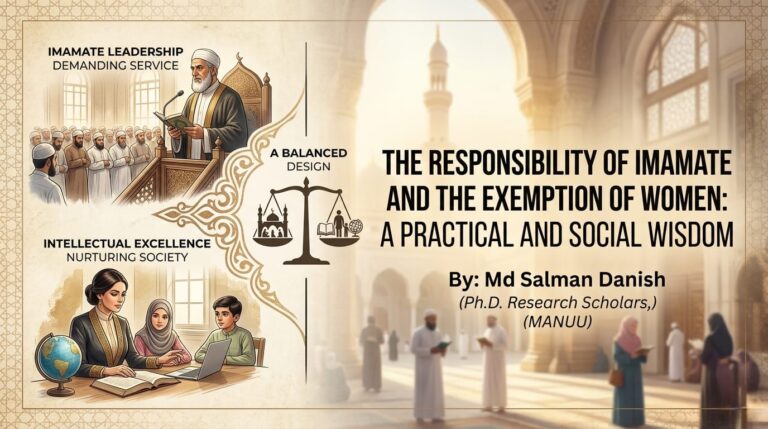
The Responsibility of Imamate and the Exemption of Women: A Practical and Social Wisdom
The Responsibility of Imamate and the Exemption of Women: A Practical and Social Wisdom...
 Culture
Meaning of Love for the Prophet Muhammad (SAWS)
Meaning of Love for the Prophet Muhammad (SAWS) By: Khursheed Alam Dawood Qasmi Moon...
Comments (0)
Leave a Comment