
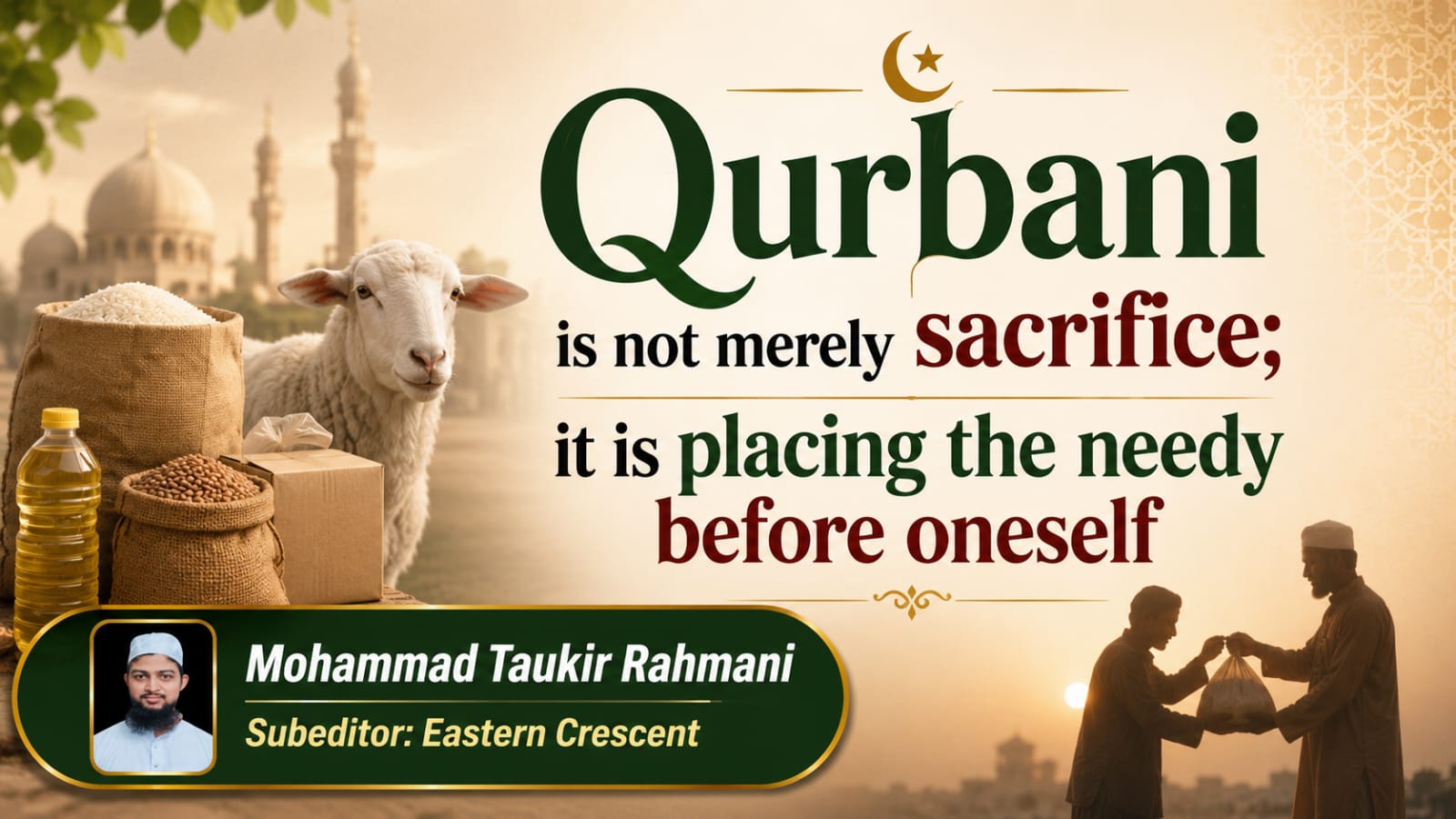
Qurbani is not merely Sacrifice; It is Placing the Needy Before Oneself

Qurbani is Not Merely Sacrifice; It is Placing the Needy Before Oneself
By: Mohammad Taukir Rahmani
Subeditor: Eastern Crescent
In the heart of every believer lives a quiet longing: the desire to one day become a traveler on that sacred journey where the feet walk upon the earth, yet the soul converses with the heavens; to stand among those fortunate souls whose spiritual thirst is quenched by presenting themselves before the House of their Lord. Yet life does not always move according to human wishes. Sometimes circumstances block the way, sometimes financial limitations restrain one’s steps, and at times, despite possessing every apparent means, an unseen decree of destiny stands in between. Thus, a yearning cherished for years remains buried in the heart as a silent ache.
But the reality is that the doors of devotion are never closed. The Lord who made attendance at His Sacred House a supreme honor has also opened countless avenues of mercy for those who, due to unavoidable reasons, cannot reach there physically.
The opening days of Dhul Hijjah are among the greatest manifestations of this divine generosity. These are days in which time outwardly appears ordinary, yet the rewards hidden within them multiply beyond measure. It is much like the earth remaining the same and the seed remaining the same, but with the arrival of the right season, the harvest increases manifold. A farmer who recognizes the value of the season gains an extraordinary crop through seemingly ordinary effort. The same is true of these blessed days. The prayer is the same prayer, the charity is the same charity, and the fasting is the same fasting, yet their spiritual weight and impact increase immensely during these days. It is as though the servant is being granted an opportunity: if he could not physically join the great caravan of Hajj, he may still fill his soul with the spiritual blessings flowing from it.
Among these acts of worship is one practice that is not merely a ritual, but an entire consciousness in itself — an act whose inward reality is far deeper than its outward form. This is Qurbani.

On the surface, it appears to be the slaughtering of an animal, but in truth, it is a symbolic exercise in placing the knife upon the hidden selfishness, greed, and unhealthy attachment to worldly possessions that reside within the human soul. It is a declaration that a servant stands ready to sacrifice his preferences, desires, and attachment to wealth before the command of his Lord. This is precisely why reducing Qurbani to a mere social custom strips it of its soul and essence.
At this point, an important misunderstanding has silently taken root within our society. In many households, people assume that if one family member performs Qurbani, the obligation is automatically fulfilled on behalf of everyone else. However, the basis of this responsibility is not family association or companionship — it is financial capability.
Just as the meal eaten by one person cannot satisfy the hunger of every member of the household, similarly, an act of worship that becomes individually obligatory upon every financially capable person cannot be discharged by the action of a single family member alone. If five members of a household possess the means, then the responsibility of Qurbani rests separately upon each of them. Emotional association may unite people in spirit, but legal obligation is tied to the individual’s own financial standing.
At first glance, this misunderstanding may appear minor, but its consequences are far-reaching. When a religious obligation begins to drown beneath layers of convenience and self-created justifications, the true spirit of worship gradually weakens. A person consoles himself by thinking, “Since Qurbani has already been performed in the house, my responsibility has also been fulfilled.” Yet inner satisfaction is not always proof of truth.
Often, people manufacture excuses merely to silence the discomfort of their conscience. Such justifications may provide temporary emotional comfort, but they carry no real weight on the scale of truth. And this is precisely where a seemingly small negligence begins to create cracks in a person’s greater spiritual ambitions and sacred aspirations.

Another remarkably strange misconception is held by those who believe that since they do not consume meat, Qurbani is not obligatory upon them. In reality, the obligation of Qurbani has nothing to do with dietary habits or personal preference. It is linked solely to financial capability. If a person possesses the required means, then whether he eats meat or not, Qurbani remains obligatory upon him regardless.
After the outward act of Qurbani is completed, another stage begins — and it is often here that the real test starts. The animal has been slaughtered, the echoes of Takbir have faded, and the external form of the Sunnah appears fulfilled. Yet then comes the decisive moment: whether the spirit of this worship will travel beyond the walls of our homes and reach those who truly need it.
Sadly, in many households, the shares of Qurbani seem to fall victim to a silent form of appropriation even before they are distributed. The meat that was meant to arrive at the doorstep of the needy and become a source of joy upon their faces often ends up buried within the cold layers of freezers. Outwardly, this may appear to be a minor oversight, but if viewed more deeply, it is not merely the withholding of meat — it is the withholding of the very message this act of worship was meant to circulate throughout society.
Consider a tree that bears fruit upon its branches yet never allows those fruits to fall to the earth. Its lushness would remain confined to itself alone. No hungry person would benefit from it, no traveler would find shade beneath it, and the blessings of its fertility would never spread. Wealth functions in much the same way. When it erects walls only around itself, it ceases to be a blessing and slowly turns into a burden. The distribution of Qurbani meat is, in reality, an act of breaking those walls. It teaches the human being that the true beauty of sustenance lies not in hoarding it, but in allowing it to flow. Water gives life when it flows, but when it stagnates, it begins to breed decay.
At times, a person deeply longs for great acts of worship. The desire for Hajj burns within his heart; the intention is sincere, the means become available, and the pathways even appear to open before him. Yet at the final moment, some obstacle unexpectedly arises. On the surface, it may seem like nothing more than an unfortunate turn of circumstances, but the deeper realities of life often remain concealed behind outward causes.

It is possible that somewhere within our actions lies a subtle lapse that quietly erects barriers along our path. And among those hidden lapses could be this very matter: that we failed to uphold true honesty and trustworthiness in distributing the shares of Qurbani; that we withheld the right of the deserving under the excuse of personal convenience; and in suppressing a small right, we unknowingly weakened our own knock upon the door of a far greater blessing.
This is not merely an emotional appeal. It points toward one of the unchanging laws of life: the hands that open for others often find the doors of heaven opened for them. The heart that gathers the prayers of the helpless begins to witness unseen ease unfolding in its own journey. Sometimes a spontaneous prayer emerging from the lips of a hungry person accomplishes what years of planning and effort could never achieve.
If every share of Qurbani reaches those who genuinely deserve it with honesty and integrity; if this distribution carries not merely ritual compliance but genuine compassion; if, on that blessed day, a struggling household receives a portion of the happiness already present in our own homes — then it is not far-fetched that those very prayers may transform an apparently impossible dream into reality in the coming years.
In the end, the true question of Qurbani is not merely what we slaughtered. The real question is: what changed within us?

If the animal was sacrificed but greed remained alive, if the meat was distributed but the heart did not expand in generosity, then the outer form of worship may have survived while its spiritual impact faded away. But if every portion reached its rightful destination with honesty, empathy, and sincerity, then this distribution ceases to be merely the distribution of meat. It becomes the planting of seeds of blessing within a person’s destiny — seeds whose harvest may appear one day in the form of Hajj, another day in the form of acceptance before Allah, and sometimes in the form of an inner peace before which every worldly blessing feels insignificant.
You May Also Like
 Editorial
RECLAIMING MERIT: WHY THE JSSC-CGL CANCELLATION IS A TURNING POINT FOR RECRUITMENT REFORM
RECLAIMING MERIT: WHY THE JSSC-CGL CANCELLATION IS A TURNING POINT FOR RECRUITMENT REFORM When...
 Editorial
Azerbaijan’s Aliyev Is Digging His Own Political Grave
Azerbaijan’s Aliyev Is Digging His Own Political Grave By: M. Burhanuddin Qasmi Editor: Eastern...
 Editorial
The Protest and Arrests in Delhi
The Protest and Arrests in Delhi By: M. Burhanuddin Qasmi Editor: Eastern Crescent, Mumbai...
 Editorial
Why Should Common Citizens of India Lose Rights for Mistakes Committed by the ECI?
Why Should Common Citizens of India Lose Rights for Mistakes Committed by the ECI?...
 Editorial
Electoral Reform in India Is a Must
Electoral Reform in India Is a Must By: M. Burhanuddin Qasmi Editor: Eastern Crescent,...
 Editorial
July 2026: The Month When the Collapse of Indian Television News Became Impossible to Deny
July 2026: The Month When the Collapse of Indian Television News Became Impossible to...
Comments (0)
Leave a Comment