

Is It the FIFA World Cup or the FIFA Worst Cup?

Is It the FIFA World Cup or the FIFA Worst Cup?
By M. Burhanuddin Qasmi
Editor, Eastern Crescent, Mumbai
The FIFA World Cup is celebrated as the most popular and unifying sporting event on the planet. It is meant to transcend borders, politics, and prejudice, offering humanity a rare moment of collective joy and shared passion. Football, in its purest form, represents fairness, freedom, equality, and mutual respect—values that FIFA proudly claims to uphold. Yet, as the 2026 FIFA World Cup is set to begin on 11 June 2026 across the United States, Canada, and Mexico, troubling developments are casting a shadow over what should have been a global celebration of sport.
The United States, one of the three host nations, has repeatedly failed to guarantee smooth entry and fair treatment for players, officials, journalists, and delegations from certain participating countries. This raises a fundamental question: if a host nation cannot ensure equal dignity and unhindered access for all participants, what do FIFA’s rules say about such a situation? More importantly, should hosting arrangements not be reconsidered, with affected matches immediately relocated to Canada and Mexico—the two co-hosts that have not imposed such barriers?
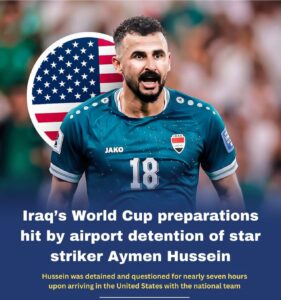
The world has already witnessed disturbing incidents involving football personnel arriving in the United States. Iraqi players and media representatives reportedly faced humiliating treatment at American airports, where they were subjected to excessive questioning, delays, and suspicion. Rather than being welcomed as representatives of a nation competing on football’s grandest stage, they were treated as liabilities. Such incidents do not merely inconvenience individuals; they undermine the very spirit of the World Cup and send a dangerous message that nationality, rather than merit and achievement, determines how people are treated.
Reports have also surfaced regarding visa difficulties faced by officials and representatives associated with teams from various regions, including Africa and parts of Europe. Whether these cases are isolated or part of a broader pattern, the effect is the same: participants are forced to navigate political and bureaucratic obstacles that have no place in international sport. A World Cup burdened by discrimination and unequal treatment ceases to be a celebration of global unity and becomes a symbol of exclusion and division.
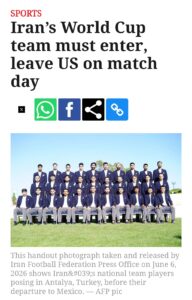
Among the most concerning examples is the situation facing Iran. Because of U.S. restrictions, the Iranian team may be required to operate under conditions that no other participating nation is expected to endure. The prospect of players having to leave American territory after matches and manage additional travel and logistical burdens simply because of their nationality contradicts every principle of competitive fairness. Football is a game of endurance, preparation, recovery, and concentration. When one team is subjected to extraordinary off-field hardships, the integrity of the competition itself comes into question.
No player, coach, official, or team representative should face barriers, uncertainty, humiliation, or unequal treatment because of their nationality. Participation in the World Cup is earned through talent, hard work, sacrifice, and determination. It is not a privilege bestowed by political authorities. Teams from Iran, Iraq, Africa, Asia, Europe, and the Americas all reach this tournament through the same qualification process. To subject some of them to additional burdens after they have rightfully earned their place is a betrayal of football’s most cherished ideals.
FIFA must therefore act decisively. Either it ensures full support, equal treatment, and unrestricted access for all qualified teams and officials, or it relocates the affected matches away from the United States. Anything less would amount to tacit acceptance of discrimination and unequal treatment. FIFA cannot claim neutrality while allowing barriers that compromise both fairness and the spirit of competition.
Equal treatment and fair play—both on and off the field—are among the most fundamental principles of international sport. If FIFA fails to uphold these principles, justice- and freedom-loving people around the world will have every reason to question the legitimacy of the tournament and call for a boycott of the 2026 World Cup. Public confidence in the competition cannot survive if participants are treated differently based on nationality.

Furthermore, in the true spirit of sportsmanship and solidarity, leading football nations from Europe, South America, Africa, and Asia may find themselves compelled to reconsider playing on U.S. soil if discriminatory barriers continue. A World Cup cannot genuinely represent the world while denying equal dignity, opportunity, and respect to some of the very teams that have qualified to participate in it.
The stakes for FIFA could hardly be higher. The organization has often faced criticism over governance, transparency, and accountability, yet the World Cup remains its greatest symbol and most powerful instrument of global influence. If the 2026 tournament becomes associated with discrimination, unequal treatment, and political exclusion, FIFA risks not only damaging its reputation but also eroding the trust of millions of football supporters across the globe.
The World Cup’s enduring appeal lies in its promise that the world’s nations can compete as equals, regardless of politics, race, religion, or geography. Unity cannot be achieved through exclusion. Fairness cannot coexist with discrimination. Freedom cannot flourish under selective restrictions. If FIFA allows one host nation to impose obstacles on certain teams while others compete without such burdens, the tournament will fail to embody the values it claims to represent.

The world is watching. Every denied visa, every humiliating airport interrogation, every discriminatory restriction, and every unnecessary burden imposed on a participating team chips away at the integrity of the competition. The World Cup should be remembered as a festival of humanity and sporting excellence, not as a showcase of political prejudice and unequal treatment.
FIFA must rise to this challenge before the opening whistle is blown on 11 June 2026. It must either secure genuine equality for all participants or relocate affected matches to Canada and Mexico, where the principles of fair play can be better protected. Anything less would represent a failure of leadership and a betrayal of football’s universal spirit.

The choice before FIFA is clear: uphold fairness, equality, and unity—or allow prejudice and discrimination to transform the beautiful game into what many may come to remember as the FIFA Worst Cup 2026.
You May Also Like
 Editorial
The Protest and Arrests in Delhi
The Protest and Arrests in Delhi By: M. Burhanuddin Qasmi Editor: Eastern Crescent, Mumbai...
 Editorial
Azerbaijan’s Aliyev Is Digging His Own Political Grave
Azerbaijan’s Aliyev Is Digging His Own Political Grave By: M. Burhanuddin Qasmi Editor: Eastern...
 Editorial
Why Should Common Citizens of India Lose Rights for Mistakes Committed by the ECI?
Why Should Common Citizens of India Lose Rights for Mistakes Committed by the ECI?...
 Editorial
Electoral Reform in India Is a Must
Electoral Reform in India Is a Must By: M. Burhanuddin Qasmi Editor: Eastern Crescent,...
 Editorial
July 2026: The Month When the Collapse of Indian Television News Became Impossible to Deny
July 2026: The Month When the Collapse of Indian Television News Became Impossible to...
 Editorial
The First Major Success of the Cockroach Movement
The First Major Success of the Cockroach Movement By: M. Burhanuddin Qasmi Editor: Eastern...
Comments (0)
Leave a Comment