

Hamas’s Withdrawal: A New Turn in Strip’s Politics Then… Hope for Peace or a New Phase of War?

Amidst more than a Thousand Days of Pogrom, Hunger, and Destruction in Gaza
Hamas’s Withdrawal: A New Turn in Strip’s Politics
Then… Hope for Peace or a New Phase of War?
By: Dr. Mohammad Ajmal
Assistant Professor at Centre of Arabic and African Studies, School of Language, Jawaharlal Nehru University New Delhi
The 1,000th day of the Israeli war on Gaza has been completed. These 1,000 days are not just a military standoff, but a story of genocide, collective punishment, hunger, displacement, destruction of infrastructure and global indifference that has shaken the conscience of the entire world. These days changed the lives, dreams and futures of millions of people, while also raising serious questions about the credibility of the global justice system. Figures released by the Gaza State Media Office and the Palestinian Ministry of Health on the completion of the 1,000th day paint a picture of a human tragedy that is difficult to find in modern history. According to them, more than 73,000 Palestinians have been killed so far, including exceeding 21,500 children and more than 1,000 infants, and over 173,000 people have been injured, while about 42,000 are in need of urgent and specialized treatment.
In addition, about 9,500 people are still missing and are feared to be trapped under the rubble. These are not just numbers, but behind each number is a family, a dream and a complete life. Each and every murdered person was the support of a home, every injured person is an unfinished story and every missing person is the hope of a mother, father or child who is still waiting for a miracle. During this period, more than 223,000 tons of explosives were dropped on Gaza. According to experts, this amount is equivalent to the use of explosive force many times greater than the destruction caused by the atomic bomb dropped on Hiroshima. Such intense bombing on a besieged area of only 365 square kilometers turned Gaza into ruins. According to official figures, the rubble of destroyed buildings has exceeded 66.8 million tons, under which are buried not only bricks and mortar, but also the memories, books, dreams and lives of thousands of families. The housing sector has been almost completely destroyed. 268,000 residential units have been completely demolished, while 148,000 houses have been severely damaged. Nearly two million people have been displaced and are forced to relocate repeatedly.

The United Nations estimates that the damage to infrastructure has exceeded $70 billion, while experts say that rebuilding Gaza will be one of the most difficult projects in modern history. The health system has also almost collapsed. About 94 percent of the medical centers that were operational before the war have been destroyed or disabled to some extent, while most hospitals suffer from severe shortages of medicines, fuel, electricity and medical equipment. Doctors are trying to save the lives of the wounded with limited resources, sometimes even having to perform operations by the light of a mobile phone. On the basis of the information received from the Palestinian Ministry of Health, there are 17,000 patients who have received medical referrals for treatment abroad, but are not being allowed to leave Gaza. Their condition is deteriorating with each passing day, and many patients who could have been treated are losing their lives. The Rafah border crossing, instead of being a ray of hope for thousands of patients, students and civilians, has also been in a state of constant uncertainty. Although it has been opened on a limited basis, most Palestinians are still forced to live under siege.
The most tragic effects of this war have been on children and women. Nearly 58,000 children have been orphaned and more than 47,000 women have become widows. An entire generation has lost their parents, siblings and relatives before their eyes. These wounds are not only physical but also psychological. The food crisis has also reached its peak. As a result of Israeli attacks, approximately 98.5 percent of arable agricultural land has been destroyed, leading to a famine in Gaza. Approximately 1.6 million Palestinians are severely malnourished, including more than 100,000 children under the age of five. Fifty-five thousand pregnant and breastfeeding women are also facing malnutrition. According to the Gaza State Media Office, approximately 400,000 people have access to only one meal a day. Hunger has become a weapon of war, not a humanitarian crisis.
This entire crisis has also put the global justice system on the line. International law, human rights, the Geneva Conventions and UN resolutions appeared helpless when their implementation was inevitable. The political interests and diplomatic support of world powers also played a significant role in prolonging this war, due to which millions of innocent civilians continued to suffer. Despite all this destruction, the patience, courage and perseverance shown by the people of Gaza is a bright chapter in history. Prayers offered on the rubble, makeshift schools set up under the open sky, the spirit of sharing bread with each other despite hunger and the hope of survival with each new morning are symbols of the invincible spirit of this place.

These thousand days of Gaza are not just the story of Palestine, but the story of the test of all humanity. Future generations will surely ask, where was the world when thousands of children were being killed, when hospitals and schools were being reduced to rubble, when hunger was being weaponized, and when an entire population was being subjected to collective punishment? History will surely answer this question, but it will not be a source of pride for world powers, human rights advocates, and silent spectators. The thousand days of Gaza have passed, but the Palestinian people’s ordeal is not over. Justice is still awaited, peace is still far away, and humanity is still being tested. Hopefully, the day will come soon when Gaza will echo not with the thunder of gunfire but with the laughter of children, when hospitals will be filled with the light of life rather than bombs, when rubble will be replaced by construction, when hunger will be replaced by comfort, and when the world will stand on the principle of justice rather than force. Because the tragedy of Gaza is not just the tragedy of Palestine, but the tragedy of all humanity. If even this bloody tale of a thousand days could not awaken the conscience of the world, then perhaps future generations will write that in the 21st century, not only Gaza burned, but humanity was also reduced to ashes.
On the other side, Hamas, the largest Palestinian resistance movement, has announced the end of its government in Gaza after 20 years and the dissolution of the administrative committee, indicating that it will hand over urban administration to a technocratic national committee. The decision is being described as a significant shift in Hamas’s political strategy and part of the ongoing political negotiations and efforts to shape the future administrative structure in Gaza after the ceasefire, paving the way for a technocratic committee to run urban and administrative affairs in the territory. Hamas’s move is aimed at pressuring Israel to implement other parts of the US-backed peace plan and ensure a peaceful transfer of power, thereby eliminating the justification Israel needs to continue its aggression.
According to a Hamas official, the movement has decided to dissolve the current government structure and give interim responsibility to a publicly acceptable figure until the Gaza National Administrative Committee officially begins its work. However, Hamas has made it very clear that withdrawing from the civilian government does not mean agreeing to its complete disarmament. Hamas says that administrative powers can be transferred, but the issue of weapons and the military wing is a different matter. Hamas has also clarified that “it has taken a new step and is no longer responsible for managing the Gaza Strip, in order to get rid of any excuse by the occupying Zionist state, who are still waging an aggressive and destructive war on us”.
It should be remembered that Hamas gained administrative control of Gaza in 2007 after an armed clash with the Fatah group. A year earlier, in 2006, Hamas won the Palestinian parliamentary elections with a landslide majority, but it was flatly refused to hand over the administration of the government. The first head of the Hamas government in Gaza was Ismail Haniyeh, who headed the Hamas government from 2007 to 2014. After Ismail Haniyeh’s assassination, the National Accord Government of Rami Hamdallah was announced, but most of the practical powers in Gaza remained with Hamas.

Although Yahya Sinwar was not the prime minister, he was considered the most influential Hamas political leader in Gaza after 2017. After the Israeli attacks and the assassination of Ismail Haniyeh, the administrative affairs of Gaza were run by various government committees and Hamas-appointed government institutions. Hamas’s current decision is being described as part of the ongoing political negotiations and efforts related to the future administrative structure in Gaza after the ceasefire. It is noteworthy that “the Israel-Hamas ceasefire agreement of January 19, 2025, required Hamas to leave the Gaza government.”
This decision by Hamas is not just an administrative decision, but a clear proof of the fact that Hamas is serious and determined to establish real peace in Gaza by adhering to the peace agreement. If Israel refrains from its aggression in Gaza, this could prove to be an important milestone for the establishment of peace. A statement issued by Hamas’ official media office said that the head of the government’s emergency committee and acting head of the government’s follow-up committee, Muhammad Abdul Khaliq al-Fara, had resigned from his position, while the government’s emergency committee had also been dissolved.
At the same time, all preparations for transferring administrative responsibilities to the “National Administrative Committee of Gaza” have been completed. According to Hamas, all administrative and legal preparations for the handover and recovery of the government system in Gaza have been completed. These arrangements were also formally presented to the national delegation representing Palestinian factions and political forces, the High Committee of Tribes and Clans, civil society organizations, and the UN observer representative. Hamas clarified that only technical and professional level employees in the government system will continue to perform their responsibilities so that the provision of basic services to the public is not affected and no administrative or technical vacuum is created.
This move is in line with the roadmap that the Palestinian factions agreed on in Cairo. US President Donald Trump introduced this roadmap during the mediation for the ceasefire in October 2025. Analysts say that if the plan takes shape, it would be a major political change in Gaza in nearly two decades, but it will depend on the formation of a new Palestinian administration, Israel’s response and the success of ongoing peace talks. There were no immediate details on when and how this transfer of power would take place, as Israel has reportedly banned members of the committee from entering Gaza for months.
The Israeli government and Hamas still have disagreements over some points of the peace agreement, including Hamas’s complete disarmament and the complete withdrawal of Israeli forces from the Gaza Strip. The Trump-led Peace Board, established to oversee the peace plan, took note of Hamas’ move, saying: “Ultimately, our assessment will be based on practical steps, not promises, to meet the vital needs of the people of Gaza.” There was no immediate comment from Israel. On the other hand, many international affairs experts are calling it a well-thought-out diplomatic and strategic move by Hamas, with observers saying that Hamas wants to reject Israel’s military justification for “eliminating the Hamas government” through this withdrawal. Both the US and Israel maintain that leaving the civilian government alone is not enough, unless the military structure is also removed. But the question is, if Hamas lays down its arms, can Israel be deterred from its aggression? Given what Israel is doing in the West Bank, this demand does not seem reasonable.

The matter of fact is that what is happening throughout Palestine today did not start on October 7, 2023, it is just a justification. The game of Israeli brutality in occupied Palestine began in 1948 and continues today, and unfortunately, the occupying Zionist state has been receiving the full support and patronage of the West and America.
When Hamas agreed to dissolve the Gaza administration under the peace agreement and hand over powers to a non-partisan National Committee for the Administration of Gaza (NCAG), there was hope that civil administration would now be restored in Gaza, paving the way for the withdrawal of Israeli forces and the start of reconstruction. This development was not only welcomed by many diplomatic circles, but also by the head of the NCAG, Ali Shaath, who announced that the committee was fully prepared to take over the civil administration of Gaza, provided that it was given the opportunity to work and the necessary resources. Similarly, the High Representative of the Board of Peace, Nickolay Mladenov, also called it an important development. But so far, the situation on the ground does not support this hope. It seems that the fear expressed by Ali Shaath at the beginning that if the new administration was not given the authority and resources, this change would remain a mere symbolic step is proving to be correct.
Despite the relatively conciliatory attitude of Hamas in Gaza, Israeli military operations do not seem to stop. Even civilians who go out to get food and water are not safe. Last week, a man was killed by Israeli fire while going to get water for his children. Images of his terrified orphaned children near his body presented a heartbreaking scene around the world. Just this week, a tent city in Khan Yunis was attacked, targeting Hamas spokesman Hazem Qassem. Six Palestinians were burned alive in the attack, but Hazem Qassem escaped unharmed. Restrictions are also increasingly tight in the West Bank. Iron fences and gates have been installed around several Palestinian communities, where movement is possible only after a body search. Many Palestinians describe these areas as “open-air prisons.” Meanwhile, reports of more house occupations in Hebron emerged, displacing several Palestinian families. When Democratic Congressman RoKhanna of California arrived in the southwestern West Bank village of Khirbet Zanuta to investigate the incident, his convoy was blocked by armed Israeli settlers. RoKhanna said the settlers were armed with American-made M4 rifles and were not allowed to proceed for more than an hour. The road was later reopened after contacting the US Embassy and Israeli police.
This incident is not just an unpleasant incident that happened to an American member of Congress, but it shows how the Netanyahu government’s open acquiescence has made these extremists fearless, so much so that they are now attacking American members of Congress with weapons provided by the United States. On the other hand, the crisis of compulsory military service is intensifying within Israel. Rabbis and students have strongly protested against efforts to end the exemption from military service for students of Torah memorization schools (Yeshiva).Jewish religious groups are pushing for businesses to close on Saturdays, while secular circles see it as an intrusion on civil liberties. Religious demonstrations outside open shops on Saturdays and secular protests in front of closed markets are becoming the norm. Ironically, in a society where there is such strong disagreement over Saturday business, there is no moral or religious pause for war and bombing. If the Sabbath is a day of rest, worship, and sanctity of life, then this should also apply to military operations.

The Hamas administrative withdrawal raised hopes that a phase of reconstruction would begin in Gaza instead of war, but the realities on the ground appear to be the opposite. Attacks continue, civilians remain insecure, restrictions in the West Bank are tightening, and Israel itself is undergoing internal political and social conflict. If the new civilian administration is not given authority, resources, and freedom of action, and the ceasefire remains only on paper, the fear is that Gaza will once again be caught between diplomatic promises and humanitarian tragedies. Hamas is the representative and political and military organization of the Palestinians, which is fighting against the usurping occupation of Israel and has the right to this resistance. With its decision, Hamas has not only put the ball in the court of the American-backed Peace Board, but has also removed an important obstacle to the establishment of peace by demonstrating political flexibility. Sustainable peace is only possible when political agreements are accompanied by impartial implementation. Now it depends on Israel and the countries that played the role of mediators in the ceasefire agreement to respond to this positive development with how seriously they show it.
You May Also Like
 Europe
Under the Shadow of Starvation and Famine in Gaza; Netanyahu's Dream for Greater Israel; A Clarion Call to the Arab Leaderships
Under the Shadow of Starvation and Famine in Gaza; Netanyahu's Dream for Greater Israel;...
 Articles
Smart Selection of Qur'anic Verses by Iran During Ayatullah's Funeral
Smart Selection of Qur'anic Verses by Iran During Ayatullah's Funeral By M. Burhanuddin Qasmi...
 Muslim World
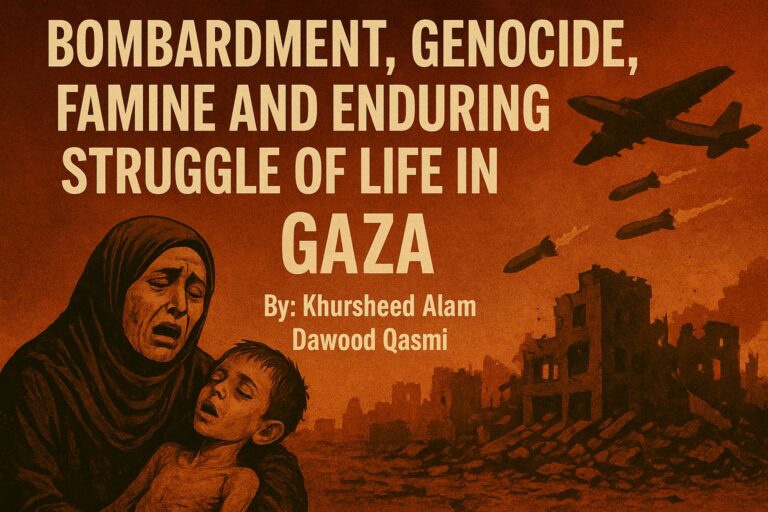
Bombardment, Genocide, Famine and Enduring Struggle of Life in Gaza
Bombardment, Genocide, Famine and Enduring Struggle of Life in Gaza By: Khursheed Alam Dawood...
 Islam
IslamEid in Islam: A Spiritual, Social, and Civilizational Gathering — Not a Celebration of Vanity
By: Mohammad Taukir Rahmani EC Exclusive Islam is not merely a religion confined to...
 Islam
IslamEasy Way of Performing Hajj
Easy Way of Performing Hajj By: Mufti Jaseemuddin Qasmi Lecturer: Markazul Ma'arif Education and...
 International Politics
Over a Year and a Half of Horrific Ethnic Cleansing of the Palestinian People
Over a Year and a Half of Horrific Ethnic Cleansing of the Palestinian People...
Comments (0)
Leave a Comment