
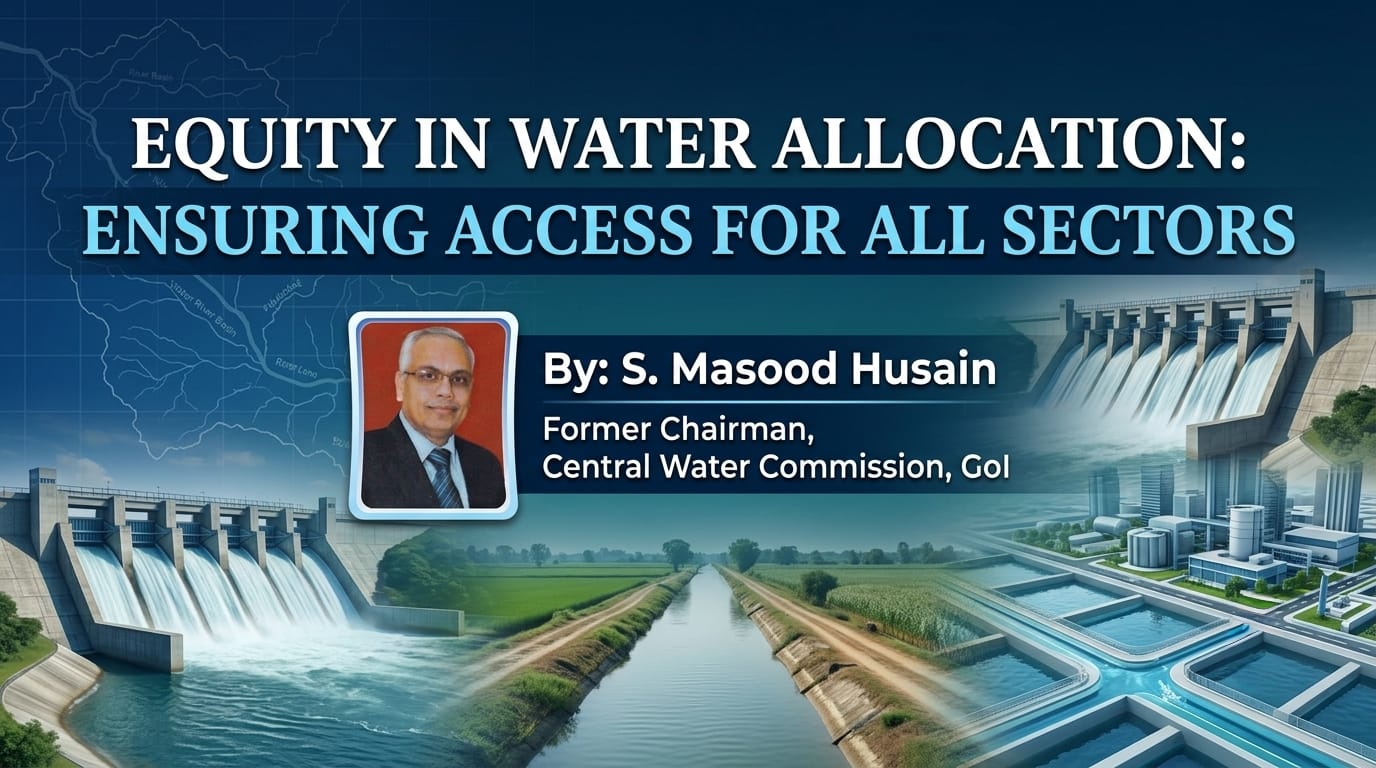
Equity in Water Allocation: Ensuring Access for All Sectors

Equity in Water Allocation: Ensuring Access for All Sectors
By: S. Masood Husain
Former Chairman, Central Water Commission, GoI
Water is perhaps the most fundamental natural resource for human survival, food production, economic development and ecological security. Yet water is neither uniformly available in space nor evenly distributed across time. India receives most of its annual rainfall during a few months, while large regions experience seasonal and geographical water shortages. At the same time, demands from drinking water, agriculture, industry, energy and the environment continue to grow.
The challenge, therefore, is not merely to increase water availability but to ensure equitable, efficient and sustainable allocation among competing uses. Equity, however, should not be confused with equal distribution. The objective should be fair access based on need, priority, efficiency, social considerations and the availability of water.
Equity Does Not Mean Equal Allocation
If water were divided equally among all sectors, the result might actually be inequitable. Drinking water for a large population cannot be treated in exactly the same manner as an industrial requirement that may have alternatives such as recycling. Similarly, agriculture has an important role in food and livelihood security and therefore cannot be evaluated solely on the basis of its volume of water use.

Equitable allocation must consequently consider need, necessity, vulnerability, efficiency, economic importance and sustainability. Historical consumption should also not automatically become the basis for future allocation if that consumption reflects inefficient practices.
Equity has several dimensions: between sectors, between regions, between rural and urban populations, between different sections of society, and between present and future generations. It must also recognise the legitimate water requirements of rivers, wetlands, aquifers and other ecosystems.
Begin With a Scientific Water Balance
The foundation of equitable allocation must be a reliable assessment of the water actually available.
Planning should consider dependable surface-water availability, groundwater resources and recharge, reservoir storage, return flows, evaporation and transmission losses, environmental requirements, existing interstate commitments and the implications of drought and flood conditions.
Particular attention should be given to dependable rather than merely average annual availability. An allocation based on average rainfall and river flows can become unsustainable during drought years.
Modern water planning should therefore increasingly use probabilistic assessments and different hydrological scenarios. A basin’s water balance must be periodically updated as population, land use, cropping patterns, urbanisation and water-use efficiency change.
Balancing the Needs of Different Sectors
Basic drinking water and public health should receive the highest social priority as provided in our National Water Policy. This does not mean, however, that other legitimate uses can be ignored.
Agriculture is India’s largest user of water and is central to food security and rural livelihoods. The objective should be to obtain more agricultural productivity per unit of water, rather than simply increasing irrigation withdrawals. Efficient irrigation, suitable cropping patterns, improved irrigation scheduling, reduction of conveyance losses, conjunctive use of surface and groundwater, and groundwater recharge can all contribute.
Industry requires reliable water supplies for economic development. But industrial allocations should increasingly be accompanied by recycling, reuse, wastewater treatment and greater water-use efficiency.

Energy planning must also explicitly consider water availability. Hydropower, thermal power and other energy systems have important water requirements or interactions. Projects located in water-stressed basins therefore need careful assessment of competing demands.
Rivers and Aquifers: Need for Basin-Level Management
Water does not recognise administrative boundaries. River basins and aquifers are therefore more appropriate units for integrated water planning than administrative boundaries alone. The National Water Policy also advocates the water planning based on river basin as a unit.
Basin planning should bring together surface water, groundwater, irrigation, domestic supply, industry, energy and environmental requirements. It should also consider upstream-downstream relationships, interstate commitments and drought-management arrangements.
For interstate rivers, technically competent institutions, reliable hydrological data and transparent decision-making are essential. Such an approach can reduce conflicts by replacing fragmented project-by-project planning with a comprehensive assessment of the basin’s overall water balance.
Rural–Urban Equity
Rapid urbanisation has created a new dimension of water inequity. Cities increasingly depend upon reservoirs, rivers and groundwater located far from their boundaries. While urban water security is essential, it should not be achieved simply by continuously transferring more water from rural areas.
Cities must first improve the efficiency of their existing systems. Reduction of leakage and non-revenue water, metering, demand management, rainwater harvesting, protection of local water bodies, aquifer recharge and extensive reuse of treated wastewater can significantly reduce dependence on freshwater sources.
The future objective should be urban water security through a diversified portfolio of sources, rather than dependence upon a single distant source.
Groundwater: The Hidden Equity Challenge
Groundwater presents a particularly difficult equity problem because its extraction is often individually controlled while the aquifer itself is a shared resource.
When groundwater levels decline, people with deeper wells and greater pumping capacity may continue to obtain water while smaller farmers and poorer households suffer. Sustainable groundwater management therefore requires aquifer-level assessment, monitoring, regulation in critical areas, managed recharge and conjunctive use with surface water.
Energy policies also influence groundwater extraction and must be considered as part of the water-management framework. Ultimately, groundwater needs to be viewed less as an unlimited individual resource and more as a shared resource requiring responsible stewardship.
Environmental Water Is Also an Equity Requirement
A river cannot be regarded merely as a pipeline for human consumption. Rivers, wetlands and floodplains provide ecological services, support biodiversity and contribute to groundwater recharge and downstream livelihoods.
Environmental flows should therefore form part of water planning. However, they should preferably be determined through site-specific scientific assessment, taking account of seasonal flow requirements, aquatic ecosystems, sediment movement, wetlands, estuaries and groundwater interactions. A uniform percentage of river flow may not be appropriate for every basin.
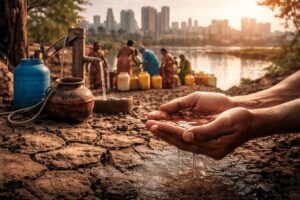
This is also an issue of inter-generational equity: today’s development should not destroy the ecological functions upon which future generations will depend.
Water Quality Is Part of Water Equity
Access to water has little meaning if the water is polluted. Water equity must therefore address both quantity and quality.
Pollution can impose disproportionate costs on downstream communities while upstream users or industries obtain the economic benefits. Strict treatment of wastewater before discharge, protection of drinking-water sources, recycling, continuous monitoring and the polluter-pays principle are therefore important components of equitable water management.
Pricing, Efficiency and Protection of the Poor
Water pricing can encourage conservation, but pricing policies must be designed carefully. Excessively low prices may encourage waste, while excessive tariffs can adversely affect poor households and small farmers.
A differentiated approach may provide affordable basic domestic consumption while progressively increasing charges for higher consumption. Commercial and industrial users can appropriately bear greater costs, with incentives for recycling and efficient technologies.
Water revenues should also contribute to proper operation, maintenance and modernisation of water infrastructure.
Data and Transparent Governance
No equitable allocation system can function without reliable information. India needs comprehensive and accessible water accounts covering rainfall, river flows, reservoir storage, groundwater, quality, withdrawals, consumption and sectoral demands.
Telemetry, remote sensing, GIS, automated monitoring and artificial intelligence can significantly improve water accounting. Transparent data and stakeholder participation can also strengthen public confidence in allocation decisions.
Preparing for Uncertainty
Water allocation must recognise uncertainty caused by droughts, floods, rainfall variability, urbanisation and changing patterns of demand. Planning should therefore incorporate different scenarios rather than depend upon a single estimate of future water availability.
At the same time, individual floods or droughts should not automatically be attributed to climate change. Water policy should be based on observed hydrological evidence, scientifically supported projections and risk assessment.
A New Water Allocation Framework
India needs a framework based on ten broad principles: scientifically assess available water; prioritise basic human needs; recognise agricultural, industrial and energy requirements; maintain scientifically determined environmental needs; improve water-use efficiency; integrate surface and groundwater management; promote wastewater reuse; ensure transparent data and participation; protect vulnerable users through appropriate economic instruments; and periodically review allocations as conditions change.

Conclusion: From Competition to Shared Responsibility
Equity in water allocation is ultimately about balancing competing legitimate demands within finite hydrological limits. It cannot be achieved simply by assigning fixed percentages to different sectors or by continuously transferring water from one region to another.
India needs an integrated approach combining engineering, hydrology, economics, environmental science and sound institutional governance. The goal should be to provide every citizen with adequate and safe water while ensuring sufficient water for agriculture, industry, energy and ecosystems.
The guiding principle should be simple:
Allocate water equitably, use it efficiently, protect its quality, maintain ecological sustainability and ensure that present use does not compromise the water security of future generations.
Such a shift—from competition over water to shared responsibility and sustainable water security—is essential for India’s long-term development.
(Concept Note for above titled Technical Session during the India International Water Week 2026 chaired by: _S. Masood Husain_, _Former Chairman, CWC_)
You May Also Like
 Culture
How to Combat Hate Speech and Hate Crime in India
How to Combat Hate Speech and Hate Crime in India By: S. Masood Husain...
 Children
The Architecture of Attention: Parenting in the Age of Digital Distraction
The Architecture of Attention: Parenting in the Age of Digital Distraction By: Mohammad Taukir...
 Breaking News
Environmental Champion of the Earth Visits MMERC to Raise Environmental Awareness
Environmental Champion of the Earth Visits MMERC to Raise Environmental Awareness By: Arshad Ansari...
 Articles
The Tree of Language and the Senses of Its Leaves
The Tree of Language and the Senses of Its Leaves How Arabic endures, evolves,...
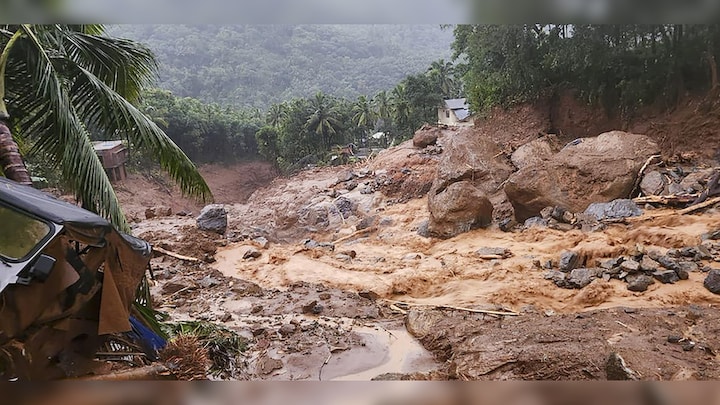 Breaking News
Wayanad Landslide - Flooding in the Hills
Wayanad Landslide - Flooding in the Hills: Even Minor Support can Be a Crucial...
 Breaking News
Beware of Phishing Scams: Fraudulent Message Circulating in the Name of the Chief Justice of India
Beware of Phishing Scams: Fraudulent Message Circulating in the Name of the Chief Justice...
Comments (0)
Leave a Comment