
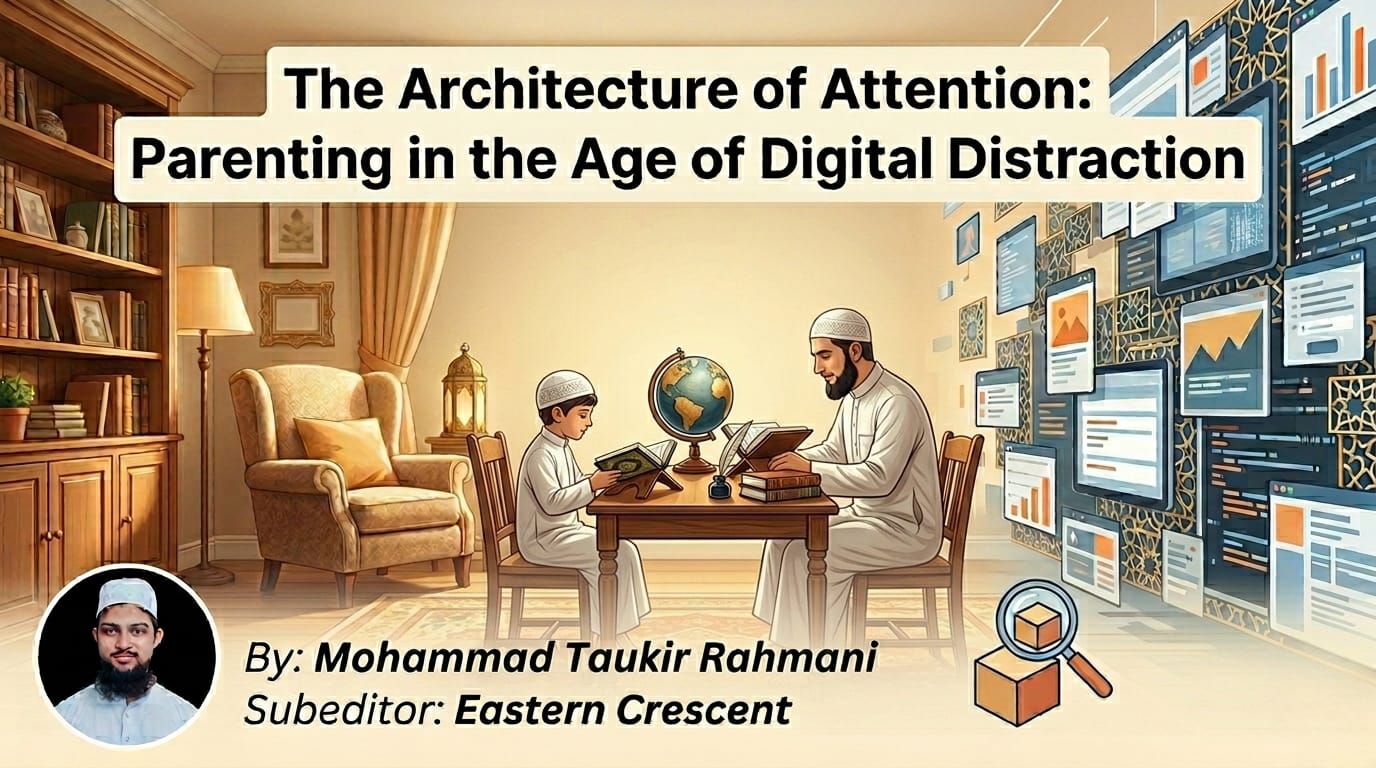
The Architecture of Attention: Parenting in the Age of Digital Distraction

The Architecture of Attention: Parenting in the Age of Digital Distraction
By: Mohammad Taukir Rahmani
Subeditor: Eastern Crescent
Parents are often heard lamenting that their children no longer listen, remain endlessly absorbed in mobile phones and screens, and seem impossible to rescue from this growing dependence. The question of how to free them from this attachment continues to trouble many households. Yet, in the midst of this anxiety, a fundamental truth is frequently overlooked: no habit emerges all at once. Every habit is born gradually, shaped by a series of small decisions made in moments of convenience.
What initially appears to be a harmless source of temporary relief slowly transforms into a permanent necessity. The beginning is often deceptively simple. A child cries, becomes restless, throws a tantrum, or grows impatient, and the easiest solution appears to be placing a mobile phone in their hands. Within moments, silence returns. Peace is restored, and parents feel as though the problem has been resolved. But what seems like an easy remedy is, in reality, the quiet planting of a deeper dependence. When this response is repeated again and again, an unspoken association takes root in the child’s mind: that discomfort finds its cure in the screen, that boredom is to be escaped through digital distraction, and that restlessness can only be soothed by virtual engagement. Gradually, the screen ceases to be a mere object of entertainment; it becomes a psychological refuge. Thereafter, at every minor unease, every fleeting emptiness, every small disturbance of the heart or mind, the child instinctively turns to it for comfort.
A child’s mind resembles soft clay: it takes the shape of the mold into which it is pressed. When a child repeatedly experiences the mobile phone as the primary source of comfort, entertainment, and attention, this repeated exposure gradually crystallizes into a part of their very disposition. In time, sitting quietly for a few moments, developing a relationship with books, or engaging in thoughtful and meaningful activity begins to feel burdensome and unnatural. Only later do parents awaken to the realization that the child has become dependent on the screen, and they begin searching for immediate remedies. Yet the real question is not merely how the child became attached to the screen; the deeper question is: who taught the child what comfort means, and where interest is to be sought?

For upbringing is shaped far less by verbal instruction than by the silent repetition of the environment. It is here that the matter ceases to be merely about breaking a habit and becomes a call to re-examine an entire educational and parental approach. When the roots of a habit sink deep into one’s nature, the first human response is usually impatience. We long for immediate results. Parents, too, often wish to decide today and witness transformation tomorrow. Such a desire is natural, for every conscious person wishes to see improvement within themselves, within their surroundings, and within their children. Yet life is governed by an unchanging principle: whatever is formed gradually can only be reformed gradually.
Transformation is not brought about by the pressing of a button. It is born from the union of awareness, patience, and consistency. Just as a seed requires the passing of seasons before it becomes a tree, so too does the correction of an unhealthy habit demand time, wisdom, and steadfast perseverance.
If a child slowly inclined toward the mobile phone, then grew familiar with it, and eventually absorbed it into the fabric of their temperament, this did not happen overnight. It was a silent journey, in which each small concession of each passing day gathered together until it assumed the strength of an entrenched habit. To expect that such a deeply rooted pattern can be shattered in a single moment is much like attempting to redirect a river that has flowed for years along one course. A river’s path can indeed be changed—but only by carving a new channel, preparing a new course, and gradually allowing the waters to grow accustomed to a different flow. The same principle applies to the upbringing of children.
The beginning of this transformation lies within the home, for the home is that silent teacher which educates without uttering a single word. If the atmosphere of the household is perpetually submerged in the glow of screens, if each individual remains absorbed in a separate digital world, then expecting a child to independently resist this attraction is to demand what runs contrary to human nature.
The first step, therefore, is to cultivate—so far as possible—a mobile-free environment, where the device remains a tool of necessity rather than the axis around which life revolves. Unnecessary use before children should be consciously avoided.

When a child observes their parents giving preference to conversation, reading, meaningful relationships, and practical engagement, they unconsciously begin to absorb the same pattern of living. Children learn far less through their ears than through their eyes. Merely taking something away is never a complete solution unless something better is placed in its stead. Human nature does not tolerate emptiness. When one door is closed, another must be opened. If a child is deprived of the mobile phone only to be left with loneliness, boredom, and aimlessness, they will inevitably seek to return to it. But if they are offered games, creative pursuits, meaningful conversation, physical activity, and engaging alternatives, their attention naturally begins to disperse. The mind, once presented with a richer and healthier source of delight, gradually begins to loosen itself from the grip of its former attraction.
Another profoundly important link in this chain is the cultivation of reading. A book is not merely a collection of pages; it is a silent companionship that grants the mind concentration, expands the horizons of imagination, and lends depth to personality. Yet friendship with books, like every meaningful attachment, does not arise suddenly. It must be nurtured through a consciously created environment.
If parents themselves spend time with books, if there are moments each day when the noise of routine subsides and reading becomes an organic part of family life, a child gradually develops an inclination toward it as well. The beginning may be modest—only a few minutes, with illustrated books suited to the child’s interests—but these brief encounters can, over time, mature into a lasting bond. Such a bond gently draws the mind away from the superficial glitter of the screen and introduces it to the deeper realms of reflection and thought.
Throughout this entire journey, there is one fundamental mistake that is often committed in the name of correction: the reliance on harshness, scolding, constant criticism, fear, and the creation of an atmosphere of shame. Outwardly, such methods may appear to produce immediate obedience, but in truth they erode a child’s inner confidence. Fear may impose temporary silence, but it cannot produce conscious transformation. A plant that is repeatedly shaken does not grow straighter; rather, it weakens from within. In the same way, a child who is constantly subjected to criticism either becomes inwardly suppressed or adopts stubbornness and defiance as a shield. In both cases, the pathways of creativity and healthy development are obstructed.
Encouragement, by contrast, possesses the power to unlock the closed windows of personality. When a child’s positive action is acknowledged at the right moment, a natural desire is born within them to repeat it. Yet even here, balance and consistency are indispensable.
If a child is praised for an action today but reprimanded for the same action tomorrow, confusion takes root in their mind. Their nature becomes caught in uncertainty, and they are left unable to discern what the right conduct truly is. Consistency in upbringing is the light that gives direction to a child’s understanding.

Ultimately, one truth must always remain before us: children are shaped more by atmosphere than by words. They absorb far less from advice than from conduct. If parents themselves cultivate positivity, establish balance in their routines, bring clarity and coherence into their behavior, and transform the home into a sanctuary of love, trust, and intellectual growth, then change ceases to be a distant wish and begins to emerge as a gradual reality. It is at this point that upbringing transcends command and becomes influence. And here the child does not merely distance themselves from the mobile screen; rather, they begin to grow into a personality capable of recognizing the true worth of their attention, their abilities, and the vast inner world that lies waiting to be discovered within them.
You May Also Like
 Children
Evicted from Kochutoli near Guwahati, Kids Drop Out, Take to Grazing to Support Family
Evicted from Kochutoli near Guwahati, Kids Drop Out, Take to Grazing to Support Family...
 Children
Silent Cries: Confronting Child Marriage under the Cloak of Tradition
Silent Cries: Confronting Child Marriage under the Cloak of Tradition Rafiqul Islam ...
 Articles
Child Abuse, the Need for Legal Knowledge among Activists, and the Abuse of Power by Law Enforcement
Child Abuse, the Need for Legal Knowledge among Activists, and the Abuse of Power...
 Children
Scholars Decide to Open Online English Medium Madrasa
(Press Release: Mumbai/ June - 5) On Saturday, the 3rd of June, 2023 Markazul...
 RELIGION
A Glance Over Major Religions of the World
A Glance Over Major Religions of the World By M. Burhanuddin Qasmi Director: Markazul Ma’arif...
 Qur'anic Wisdom
System of Zakat: Purifying Wealth, Empowering Society
System of Zakat: Purifying Wealth, Empowering Society By: Mufti Jaseemuddin Qasmi Coordinator Online Darul...
Comments (0)
Leave a Comment