

Unity of Muslims in India: The Way Forward

Unity of Muslims in India: The Way Forward
By: Syed Masood Husain
Bridging the Shia-Sunni divide for the unity of Muslim community in India is both a religious and a social challenge. India has a long history in which Shias and Sunnis have often lived together, studied together, participated in common institutions, and cooperated in public life despite theological differences. While localized tensions have occurred, there is also a rich tradition of coexistence that can be built upon.
A constructive approach would not seek to erase doctrinal differences. Theological differences regarding succession to the Prophet (saws), certain aspects of hadith, jurisprudence, and historical interpretation are deeply rooted and are unlikely to disappear. The more realistic objective is to develop a culture of mutual respect despite disagreement.

Some important steps include:
1. Accept legitimate diversity within Islam.
Both communities should acknowledge that Muslims have held different theological and legal opinions for over fourteen centuries. Differences need not become grounds for hostility.
2. Focus on shared beliefs.
Shias and Sunnis share belief in: One God (Allah). Prophet Muhammad (saws) as the final Messenger. The Qur’an. The Day of Judgment. Prayer, fasting, charity, and pilgrimage. These common foundations greatly outweigh the issues that divide them.
3. Discourage hate speech from the pulpit.
Religious scholars from both traditions should clearly discourage insulting revered personalities of the other community. Respectful academic discussion should replace inflammatory rhetoric.
4. Promote scholarly dialogue.
Institutions such as Aligarh Muslim University, Nadwatul Ulama, and Shia seminaries can organize conferences where scholars discuss areas of agreement and disagreement with civility and intellectual honesty.
5. Joint community service.
Working together on education, healthcare, disaster relief, poverty alleviation, environmental protection, and social welfare builds trust far more effectively than theological debate.
6. Improve religious literacy.
Many prejudices arise from misinformation. Publishing balanced books and organizing educational programmes explaining each tradition from its own authentic sources can reduce suspicion.
7. Encourage youth interaction.
Student exchanges, leadership programmes, debates, sports, and cultural activities involving young Shias and Sunnis can help prevent inherited prejudices.

8. Respect each other’s rituals.
Muharram processions, Eid celebrations, Milad gatherings, and mosque practices should be respected even where theological agreement does not exist. Local administrative mechanisms can help resolve practical issues peacefully.
9. Cooperation on common challenges.
Indian Muslims, regardless of denomination, face common concerns relating to education, employment, economic development, women’s education, and social reform. Joint efforts on these issues can strengthen community cohesion.
10. Develop a shared civic identity.
Muslims of different schools can cooperate as equal citizens of India while remaining faithful to their respective traditions.

The role of scholars
Prominent scholars from both traditions have advocated Muslim unity while maintaining theological integrity.
Among Shia scholars, figures such as Ayatollah Murtaza Mutahhari, Muhammad Husayn Tabataba’i, and India’s Syed Ali Naqi Naqvi emphasized respectful dialogue. On the Sunni side, scholars including Abul Hasan Ali Nadwi and Muhammad al-Ghazali argued for Muslim solidarity while preserving doctrinal convictions.
Principles for dialogue
A successful dialogue should be based on:
No coercion to change sect.
Freedom to discuss differences respectfully.
No takfīr (declaring fellow Muslims unbelievers).
Rejection of violence and sectarian incitement.
Commitment to justice, truthfulness, and good character.

Realistic expectations
Complete theological agreement is neither likely nor necessary. The more achievable and valuable goal is a relationship in which Shias and Sunnis:
– Understand one another accurately.
– Debate respectfully where they differ.
– Cooperate on matters of common concern.
– Reject sectarian hatred and violence.
For India, with its long tradition of pluralism and constitutional democracy, such a model of respectful coexistence could strengthen not only the Muslim community but also contribute positively to the country’s broader social harmony.
(The author Syed Masood Husain is an alumnus of Aligarh Muslim University and IIT, Delhi, and former Chairman, Central Water Commission, Ministry of Water Resources, Government of India)
You May Also Like
 RELIGION
A Glance Over Major Religions of the World
A Glance Over Major Religions of the World By M. Burhanuddin Qasmi Director: Markazul Ma’arif...
 Qur'anic Wisdom
System of Zakat: Purifying Wealth, Empowering Society
System of Zakat: Purifying Wealth, Empowering Society By: Mufti Jaseemuddin Qasmi Coordinator Online Darul...
 Qur'anic Wisdom
"We Called to Him, ‘O Ibrahim, You Have Fulfilled the Dream.”
“We Called to Him, ‘O Ibrahim, You Have Fulfilled the Dream.’” [Part: 33, from...
 Islam
Islam“Good and evil are not equal. Repel evil deed by that deed which is better”
By Mufti Jaseemuddin Qasmi Coordinator Online Darul Ifta & Lecturer at MMERC, Mumbai [Part...
 Breaking News
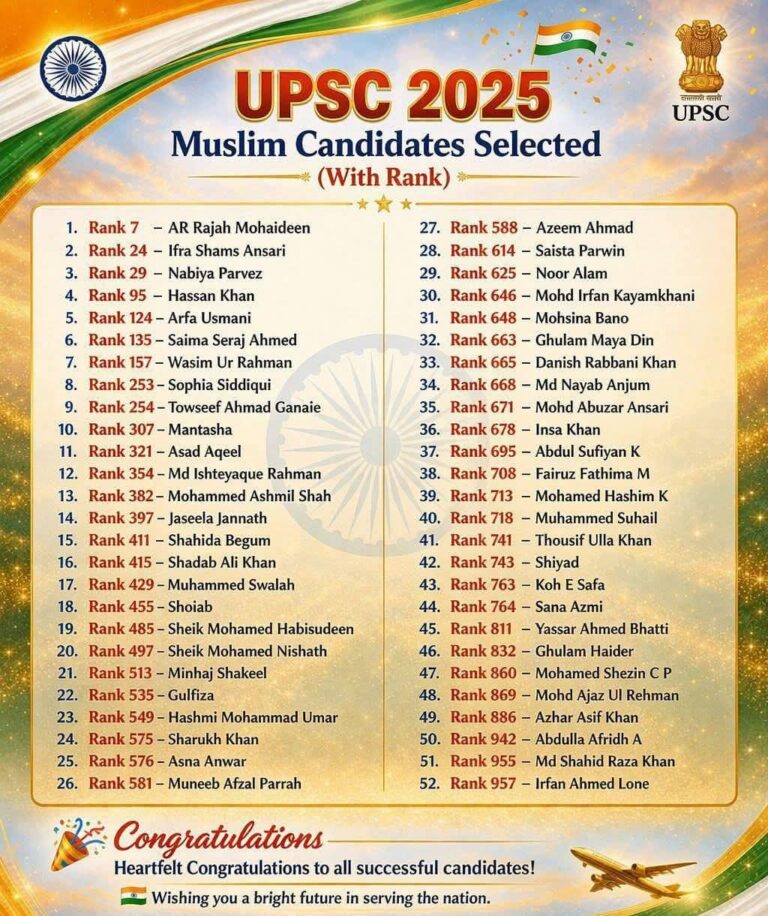
52 Muslim Candidates Selected in UPSC Civil Services Examination 2025; Three Secure Places in Top 30
53 Muslim Candidates Selected in UPSC Civil Services Examination 2025; Three Secure Places in...
 Breaking News
Moral Inculcating Summer Camp Concludes Successfully at Al-Hidya Campus, Badlapur
Moral Inculcating Summer Camp Concludes Successfully at Al-Hidya Campus, Badlapur EC News Desk 4...
Comments (0)
Leave a Comment