
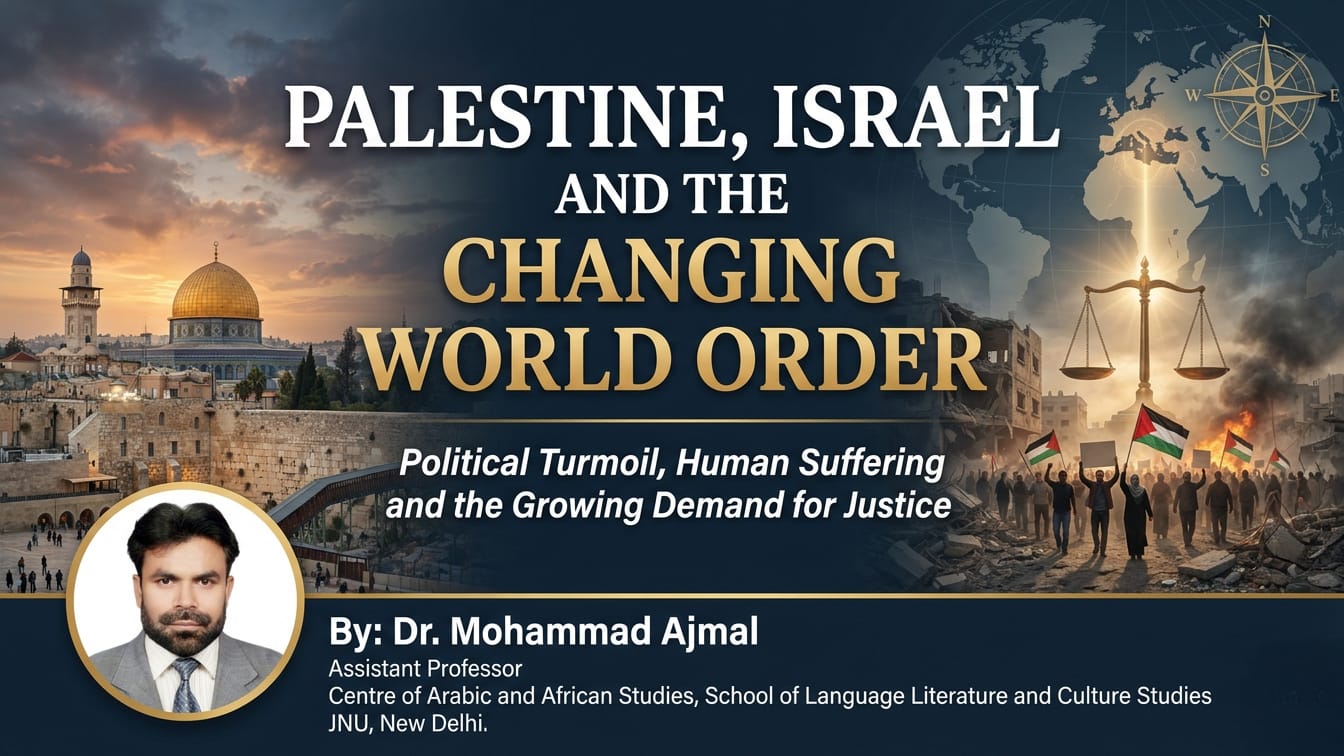
Palestine, Israel and the Changing World Order: Political Turmoil, Human Suffering and the Growing Demand for Justice

Palestine, Israel and the Changing World Order:
Political Turmoil, Human Suffering and the Growing Demand for Justice
By: Dr. Mohammad Ajmal
Assistant Professor :Centre of Arabic and African Studies, School of Language Literature and Culture Studies JNU, New Delhi.
Despite the establishment of the Board of Peace and the announcement of a ceasefire, Palestinians remain far from experiencing peace, security or even basic relief. The continuing violence, destruction and humanitarian suffering expose the limitations of international diplomatic initiatives and raise serious questions about the effectiveness of the global community. According to UNICEF’s reporting for 2026, between 7 October 2023 and 9 September 2026, at least 1,216 Palestinians, including 263 children, were killed by Israeli forces or settlers in the occupied West Bank, while more than 13,300 Palestinians were injured. These figures reflect only part of the wider tragedy, particularly when the devastation in Gaza, the destruction of homes and infrastructure, and the plight of thousands of displaced families are taken into account. The persistence of such suffering demonstrates that diplomatic declarations and ceasefire arrangements, however significant, cannot by themselves guarantee the safety and fundamental rights of Palestinians.
The humanitarian crisis has also coincided with an important political development inside Israel. The general election held on 27 October 2026 produced an inconclusive result and significantly increased the parliamentary importance of Arab political parties. Their electoral performance revealed not only the growing political participation of Arab citizens but also the deep divisions within Israeli society over their role in determining the country’s future. Instead of welcoming their participation as an expression of democratic rights, sections of the far right responded with hostility. On 8 November, a group of far-right activists marched through an Arab neighbourhood in Lod, resulting in a violent confrontation, injuries and eleven arrests. The incident demonstrated how the political empowerment of Arab citizens has become a source of tension in a society already divided over the future of its political leadership and its policies towards Palestinians.

The electoral outcome subsequently became the subject of allegations of fraud and irregularities, particularly among supporters of Prime Minister Benjamin Netanyahu. Some claimed that irregularities and alleged foreign interference had influenced the Arab vote. However, Israel’s Central Elections Committee found no irregularities capable of changing the overall election results after examining 9,069 polling stations. The controversy nevertheless developed into a wider political confrontation involving the attorney general, Gali Baharav-Miara, and questions about the handling of allegations of electoral manipulation. The debate also exposed the increasingly strained relationship between the political establishment, the legal authorities and the institutions responsible for safeguarding democratic processes.
The controversy intensified when President Isaac Herzog commented on the unusually high participation of Arab voters, suggesting that their electoral enthusiasm was partly a response to the hard-line policies of National Security Minister Itamar Ben-Gvir towards Arab communities. His remarks provoked an angry reaction from the far-right Otzma Yehudit party. Its parliamentarian Tally Gotliv described the president as a “pet Jew” of the Arabs, an offensive expression intended to question his political loyalty. Ben-Gvir supported the aggressive rhetoric, declaring that he was proud to be the only person feared by supporters of terrorism. He also vowed to continue imposing harsh conditions on Palestinian prisoners, demolishing illegal structures and pursuing an uncompromising campaign against terrorism. These exchanges illustrate the growing influence of far-right politics and the increasingly hostile atmosphere surrounding Arab political participation in Israel.
At the centre of this political uncertainty is the question of who will govern Israel. Netanyahu’s Likud-led bloc secured 53 seats, while the opposition bloc led by former military chief Gadi Eisenkot won 48. The Arab-led Ra’am party, headed by Mansour Abbas, and the Joint List, led by Yousef Jabareen, together secured 19 seats in the 120-member Knesset. Since a government requires the support of at least 61 members, neither principal bloc could independently command a majority. The Arab parties consequently emerged as crucial political actors in the negotiations over the country’s future leadership. Their parliamentary strength has demonstrated that Arab citizens can no longer be ignored in calculations concerning the formation of an Israeli government.

Following consultations with political parties, President Isaac Herzog formally entrusted Eisenkot with the task of forming a government on 8 November. The decision followed recommendations from 67 members of the incoming Knesset in his favour, compared with 46 who recommended Netanyahu. The remaining seven lawmakers did not recommend either candidate. Eisenkot therefore received the mandate, but this did not mean that he had already secured a parliamentary majority or successfully formed a government. He was given 28 days to complete the task, with the possibility of a further 14-day extension. The negotiations have consequently assumed considerable importance, especially because the support of Arab representatives could prove decisive in determining whether Netanyahu’s long period in power comes to an end.
The Arab parties, however, have sought to distinguish between supporting an alternative government and becoming part of a coalition whose policies they may not be able to endorse. The Joint List and Ra’am indicated their willingness to support Eisenkot without necessarily joining his governing coalition. Their position reflects an attempt to exercise parliamentary influence while avoiding collective responsibility for policies that continue to harm Palestinians. Mansour Abbas has also emphasised the importance of dialogue and political engagement rather than deepening divisions. Nevertheless, differences over the position of Hamas and the broader Palestinian question remain significant obstacles to cooperation. Netanyahu, meanwhile, has advocated a national unity government rather than depending on Arab parliamentary support. The outcome of these negotiations will therefore be an important test of whether Israel’s political establishment is prepared to accept a more inclusive parliamentary arrangement.
The changing political situation has also attracted considerable attention in Washington, particularly because of the growing criticism of Israel among sections of the American electorate. Commenting on the possibility of an Eisenkot-led government, President Donald Trump suggested that there would be little difference between Eisenkot’s policies and those of Netanyahu, adding that Eisenkot also liked him. In an interview with CBS’s 60 Minutes, broadcast on 8 November, Trump discussed his Republican Party’s disappointing performance in the 3 November 2026 midterm elections. He referred to several issues that had influenced voters, including the conflict involving Iran, rising living costs and immigration policies. Significantly, he also acknowledged the growing negative sentiment towards Israel among American voters. This admission is particularly noteworthy because it suggests that criticism of Israeli policies has become an increasingly visible issue in American domestic politics, extending beyond traditional critics of Israel.

Nevertheless, the changing political mood in the United States has not yet brought meaningful relief to Palestinians living under occupation. In the West Bank, military operations, restrictions on movement, demolitions and settler violence continue to affect Palestinian communities. The olive harvest season, traditionally an important period for Palestinian farmers, has become particularly dangerous. Farmers have faced intimidation, attacks and restrictions on access to their agricultural land. International organisations have documented repeated incidents of violence against Palestinian communities, including attacks on olive harvesters and the destruction of crops and property. These developments reveal the contrast between political discussions about democratic change in Israel and the continuing insecurity experienced by Palestinians on the ground.
The situation has also raised concerns about the safety of international human rights activists and independent observers who travel to the occupied territories to document violations. Reports of restrictions and deportations of foreign activists have drawn attention to the difficulties faced by those seeking to monitor settler violence and the destruction of Palestinian property. Such restrictions are particularly troubling because independent observation and documentation are essential for ensuring accountability. When those who attempt to record violations are prevented from carrying out their work, the possibility of establishing an accurate picture of events becomes increasingly difficult.
While the West Bank continues to experience military restrictions and settler attacks, Gaza faces the additional burden of a devastating humanitarian crisis. Heavy rainfall and strong winds in November flooded displacement camps, damaged makeshift shelters and left thousands of families struggling to protect their belongings. According to the United Nations Office for the Coordination of Humanitarian Affairs, more than 26,000 households had reported damage to their shelters or possessions by 8 November. Thousands of family shelters were destroyed or damaged, adding to the suffering of people who had already been displaced repeatedly by the war. The destruction of infrastructure, inadequate drainage systems and shortages of essential supplies have made the consequences of severe weather even more devastating.
The situation has been further complicated by the limited capacity of emergency services and the shortage of fuel and equipment. Reports indicated that local authorities received approximately 1,500 distress calls during the flooding, while humanitarian organisations struggled to respond to the growing needs of displaced families. Tents, blankets, bedding, drainage equipment and other essential supplies remain urgently necessary. The crisis demonstrates that a ceasefire without adequate reconstruction, humanitarian access and the provision of safe shelter cannot provide displaced Palestinians with genuine security. Yet, despite these hardships, the resilience of Gaza’s people remains remarkable. Families continue to rebuild temporary shelters and support one another, determined not to abandon their homes and homeland.
The continuing suffering in Gaza has also mobilised public opinion across Europe. On Sunday, 8 November, more than 200,000 people reportedly gathered in Amsterdam, the capital of the Netherlands, for a major demonstration against Israel’s military campaign in Gaza. Organised under the slogan “Red Line”, the protest called upon the Dutch government to impose stronger restrictions on Israel and suspend arms sales. Demonstrators carried placards questioning how many more Palestinian children would have to die before the international community took decisive action. The scale of the gathering reflected growing frustration among European citizens over what they regard as the inadequate response of their governments to the humanitarian catastrophe. It also demonstrated that Palestine has become an important issue in public debates about human rights, international law and the moral responsibilities of democratic governments.

Alongside street demonstrations, another battle is being fought in the information sphere, where competing political interests increasingly seek to influence public opinion through social media. A report by the French Foreign Ministry reportedly examined attempts by Israeli-linked accounts, media organisations and sections of the pro-Trump MAGA movement to exploit unrest in France and promote a particular political narrative. The central argument of this narrative was that Islamic extremism and immigration were the principal causes of instability in French society. President Trump also attributed the unrest to France’s immigration policies. The controversy highlighted the growing importance of digital platforms in shaping political perceptions and influencing discussions about immigration, national identity and social cohesion.
According to the report, between 16 and 18 October, the ten most-viewed posts concerning the French unrest from Israeli officials, government accounts, media organisations and associated groups received more than 35 million views on X. During the same period, the ten most-viewed posts from American MAGA circles attracted more than 49 million views. These figures demonstrate how domestic disturbances can become instruments of international political competition. They also underline the danger of allowing carefully constructed narratives to replace a balanced examination of the actual causes of social and political unrest. Although the amplification of a particular narrative does not, by itself, establish that a government organised or directed a campaign, it does show how information warfare can influence public opinion and intensify political divisions.
Taken together, these developments reveal a complex and rapidly changing international landscape. Israel is experiencing an internal struggle over political leadership, the electoral influence of Arab citizens is becoming increasingly significant, and far-right rhetoric continues to deepen divisions within society. At the same time, criticism of Israeli policies is becoming more visible in the United States and Europe. The electoral influence of Arab parties, the growing public protests and the increasing scrutiny of Israel’s military actions all indicate that the political environment surrounding the Palestinian question is changing. What was once treated in many Western political circles as an issue of limited domestic relevance has increasingly become a subject of public debate, electoral calculation and international diplomatic concern.
It would nevertheless be premature to assume that these developments will automatically produce a fundamental transformation in Israeli policy towards the Palestinians. A new government, even if formed under Eisenkot, may not necessarily bring an end to the occupation or the violence in the Palestinian territories. Similarly, the growing parliamentary influence of Arab parties cannot by itself guarantee justice, equality or security for Palestinians. Yet their political participation represents an important challenge to the traditional balance of power and to the assumption that Arab citizens can be excluded from decisions concerning Israel’s future. In the wider international context, the growing willingness of ordinary citizens, intellectuals, journalists and political representatives to question Israeli policies is equally significant.

Ultimately, the real significance of this changing political environment will be determined not by electoral calculations or diplomatic statements but by whether it can bring tangible improvements to the lives of Palestinians. International sympathy must translate into effective measures to protect civilian lives, end settler violence, secure humanitarian access, ensure accountability and uphold Palestinian rights. Palestinians must be able to live without fear, move freely in their own land, rebuild their homes, cultivate their fields and raise their children in peace. Until these fundamental rights are secured, neither a change of government in Israel nor the creation of new international peace initiatives can be regarded as a genuine achievement. The growing international support for Palestine must therefore develop into a sustained political commitment to justice, equality, accountability and an end to occupation. Only then can the emerging changes in global opinion contribute to a just and lasting peace in the Middle East.
You May Also Like
 Articles
Amidst Bloodshed continues in Lebanon, Gaza and the West Bank
Amidst Bloodshed continues in Lebanon, Gaza and the West Bank Iran, US war takes...
 Articles
Another Major Blow to the US-Israel Axis in the Middle East
Another Major Blow to the US-Israel Axis in the Middle East By: M. Burhanuddin...
 Articles
Human Rights in Islam
Human Rights in Islam By: Shafiul Haque Balrampuri A DELL Student: Darul Uloom Deoband...
 Articles
Smart Selection of Qur'anic Verses by Iran During Ayatullah's Funeral
Smart Selection of Qur'anic Verses by Iran During Ayatullah's Funeral By M. Burhanuddin Qasmi...
 Articles
Disagreement among Scholars is an Intellectual Reality and a Source of Islamic Guidance
Disagreement among Scholars is an Intellectual Reality and a Source of Islamic Guidance By: Maulana...
 Articles
Radiant Beacon of Spirituality: Hazrat Maulana Zulfiqar Ahmad Naqshbandi (Rah.)
By: Khursheed Alam Dawood Qasmi First Acquaintance with Peer Sahib: It was around the...
Comments (0)
Leave a Comment