
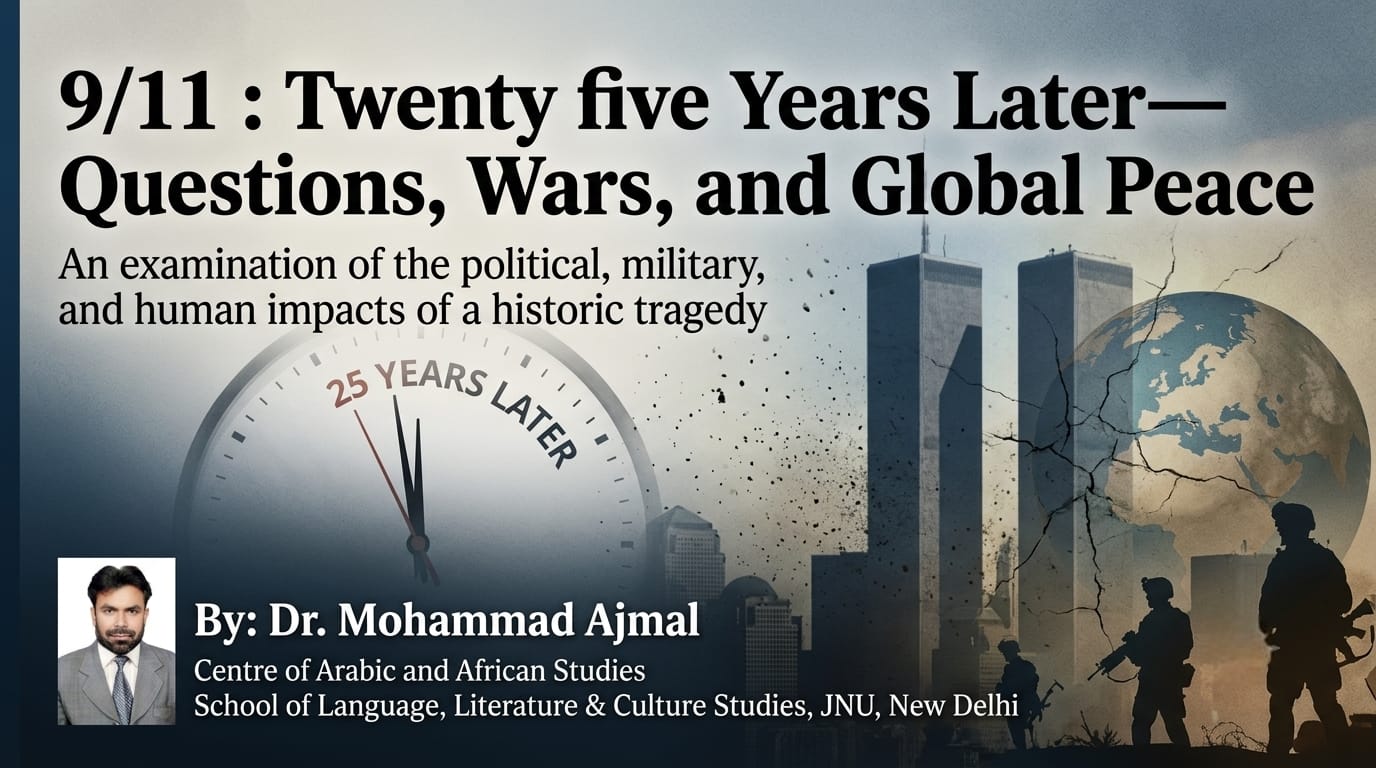
9/11 : Twenty five Years Later—Questions, Wars, and Global Peace

9/11 : Twenty five Years Later—Questions, Wars, and Global Peace
An examination of the political, military, and human impacts of a historic tragedy
By: Dr. Mohammad Ajmal
Centre of Arabic and African Studies School of Language Literature and Culture Studies, JNU, New Delhi
September 11, 2026, marked the completion of 25 years since the 9/11 tragedy. Despite the passage of a quarter of a century, this event remains not merely a date associated with a terrorist attack but a focal point for fundamental questions regarding global politics, U.S. foreign policy, the Middle East, and the Muslim world. While there is extensive documentation and research regarding the events of September 11, 2001, the historical significance of the incident extends far beyond the details of the attacks themselves. A more critical question concerns the political, military, and security architecture that emerged in the wake of the tragedy: to what extent did it transform global relations, and in what forms do its impacts persist today?
Following 9/11, the United States declared a global war on terror. This declaration led to the launch of military operations in Afghanistan, followed by the invasion of Iraq in 2003. In subsequent years, various parts of the Middle East—including Libya and Syria—also became focal points for American or Western military intervention, airstrikes, and political pressure. This entire period ushered in a new era in global politics, wherein issues such as national security, the war on terror, intelligence, surveillance, border security, and military alliances gained unprecedented importance. On the other hand, these conflicts impacted the lives of millions, weakened state structures, damaged essential civic infrastructure, and plunged numerous societies into prolonged political instability and humanitarian crises.
This is why, even after twenty-five years, the fundamental question remains: to what extent did the War on Terror stay confined to its stated objectives, and at what point did it become intertwined with broader geopolitical, economic, and strategic interests? The answer to this question cannot be found in any single event or the policy of a single nation. Each conflict had its own unique circumstances, drivers, and political decisions; yet, none of them can be viewed in isolation from the global landscape that emerged in the wake of 9/11. That tragedy prompted the United States to re-evaluate its defense and security paradigms, while simultaneously fostering a realization across many nations that the military priorities of global powers had expanded far beyond their previous scope.

It is difficult to measure the human cost of the post-9/11 wars, as various organizations employ different methods to gauge casualties, displacement, and war-related losses. Recent reports in Arab media have presented figures indicating millions of deaths and the displacement of tens of millions of people resulting from US military operations and airstrikes across regions including Afghanistan, Iraq, Pakistan, Yemen, Somalia, Libya, and Syria. Given the discrepancies in these figures, it is essential to consider their sources and methodologies rather than presenting them as definitive or universally agreed-upon numbers. However, these statistical variations do not diminish the fundamental reality that these wars—spanning more than two decades—forced ordinary civilians to pay an extraordinary human price.
Afghanistan serves as a prominent example of this situation. The war that began there after 9/11 lasted for nearly two decades. The fall of the Taliban regime, operations against Al-Qaeda, the construction of a new Afghan state, and the subsequent return of the Taliban—these were all stages that profoundly impacted Afghanistan’s political and social landscape. Millions of Afghans were displaced, families were torn apart, and multiple generations lived amidst the realities of war. When US forces withdrew in 2021 and the Taliban regained power, a fresh debate emerged regarding the long-term consequences of the conflict: did such a prolonged military intervention achieve its stated political and security objectives? The answer to this question remains a subject of debate among various political circles and researchers to this day.
The situation regarding Iraq was even more complex. No direct link was established between the 9/11 attacks and Iraq, yet the country was invaded in 2003. The alleged presence of weapons of mass destruction was cited as a primary justification for the war, but these claims could not be substantiated after the conflict. Consequently, global confidence in U.S. intelligence and government assertions suffered a severe blow. The Iraq War did not merely affect Iraqi society; it also impacted the political balance, sectarian relations, regional power dynamics, and subsequent military conflicts across the entire Middle East. The then U.S. Secretary of State Colin Powell later described the address he delivered at the United Nations regarding this matter as a painful experience of his political career.
The burden of these wars was not borne solely by the societies where the fighting took place; American military personnel were also killed and wounded, while the costs associated with veteran care, combat operations, and long-term rehabilitation placed a heavy financial strain on the US economy. Various studies have estimated the total cost of the post-9/11 wars to be in the trillions of dollars. This figure encompasses not only direct military expenditures but also the medical and social care of veterans, debt, and future financial obligations. Thus, the post-9/11 era of warfare proved to be a long-term ordeal with profound human, political, and economic consequences.

Against this backdrop, questions have periodically been raised regarding the official US narrative of 9/11. Various researchers, journalists, and authors have offered differing interpretations of the event, touching upon the potential roles of US and Israeli intelligence agencies, the involvement of Saudi nationals, and the broader context of US foreign policy. However, it is incorrect to treat these diverse views as equally credible evidence. Some claims amount to mere allegations or hypotheses, whereas in other instances, documentary investigations and official records are available. A serious historical and journalistic inquiry requires maintaining a clear distinction between questions, hypotheses, political interpretations, and substantiated evidence.
In 2007, former Italian President Francesco Cossiga made serious allegations in an interview regarding the roles of the CIA of US and the Israeli Mossad in the 9/11 attacks. Given that Cossiga had held Italy’s highest political offices, his statement garnered significant attention; however, no credible and independently verified evidence emerged to substantiate these claims or establish them as proven fact. Similarly, the debate surrounding 9/11 often invokes references to “Operation Gladio” and the clandestine networks that existed in Europe during the Cold War. While historical investigations into Gladio certainly shed light on the history of Western intelligence structures and certain controversial activities, asserting a direct link to the planning of 9/11 is a separate claim that would require distinct and concrete evidence.
Over the past two decades, authors such as Thierry Meyssan, David Ray Griffin, Nafis Mosaddiq Ahmed, and others have presented numerous books and studies questioning the official narrative regarding 9/11. Western media also featured critical programs and documentaries concerning the Iraq War, the policies of the Bush administration, and the political climate that emerged in the wake of 9/11. Michael Moore’s “Fahrenheit 9/11” is a prominent example of this broader critical discourse. While the conclusions drawn in these works are neither uniform nor necessarily correct, the fact remains that critical debate surrounding 9/11 was not confined to the Muslim world; questions also arose within Western societies, influencing public discourse on war, intelligence, government transparency, and foreign policy.
A section comprising 28 pages of the US Congress’s report on 9/11 was kept classified for a long time before being released in 2016. The discussion within these pages regarding certain matters and potential links involving Saudi Arabia raised further questions among the affected families and the American public. However, the release of these pages did not constitute definitive proof of the claim that the Saudi government had orchestrated the 9/11 attacks. The 9/11 Commission’s 2004 report also did not implicate the Saudi government—as an institution—in planning the attacks, although issues concerning financial support and links involving specific individuals from Saudi Arabia were examined. Therefore, conflating state-level responsibility with an individual’s suspicious connections or an organization’s potential financial or personal ties into a single claim would be analytically unsound.
It is crucial here to maintain the distinction between questions and evidence. If evidence emerges regarding the suspicious ties of a Saudi citizen or former official, it does not directly prove that the CIA or Mossad orchestrated the 9/11 attacks. Similarly, the failure of US agencies, intelligence errors, or the inability to stop the attackers cannot automatically be equated with orchestrating the attack. The aim of an investigation is not merely to reiterate suspicions but to scrutinize evidence, cross-reference various sources, and clarify the nature of the claims. Questions surrounding major historical events often persist for years, yet not every question necessarily leads to a conspiracy theory.

One of the most significant geopolitical questions following 9/11 was why—despite the fact that the majority of the attackers hailed from Saudi Arabia—US military action was directed at Afghanistan, and why Iraq was targeted just two years later. In the case of Afghanistan, Osama bin Laden’s presence and his ties to the Taliban regime formed the core justification for US action. The situation regarding Iraq was different, as no direct link between Iraq and the 9/11 attacks had been established. Nevertheless, Iraq was invaded, a move that impacted the political balance across the entire Middle East. This decision also sparked a global debate regarding where the boundary should be drawn between the scope of the war on terror and conventional international warfare.
The war in Afghanistan, the invasion of Iraq, the intervention in Libya, the protracted conflict in Syria, and persistent military tensions in the Middle East have raised a broader question across the Muslim world: were the wars initiated after 9/11 merely a fight against terrorism, or did they also serve to expand the American military and political presence in the region? Some critics argue that energy, economic, and strategic interests are also key factors in understanding these policies. At the same time, it is essential to acknowledge the specific circumstances of each conflict and avoid attributing all events to a single factor. A balanced historical analysis is only possible when various factors are viewed in light of their respective weight and context.
Relations between the United States and Saudi Arabia remained a significant issue in the post-9/11 political landscape. Although the majority of the attackers were Saudi nationals and questions had long persisted regarding the suspected ties of certain Saudi individuals to the plot, the relationship between the two nations did not collapse; instead, it strengthened on several occasions. Some critics view this as a reflection of the priorities and interests driving U.S. foreign policy, arguing that principles concerning terrorism, human rights, and global security are sometimes treated differently when weighed against economic, energy, and strategic interests. However, alongside this discussion, it is essential to consider the conclusion of the 9/11 Commission Report: that no evidence was found to implicate the Saudi government, as an institution, in the planning of the 9/11 attacks.
Another significant aspect of this entire matter is that 9/11 transformed the concepts of civil liberties and state surveillance. In response to the threat of terrorism, the United States and numerous other countries adopted new laws, surveillance systems, and security policies. Proponents argued that these measures were intended to protect citizens from future attacks, whereas critics raised concerns regarding the impact of certain measures on civil liberties, privacy, and legal rights. Thus, the legacy of 9/11 was not confined to the battlefield; it also brought to the fore fundamental questions concerning the relationship between the state and the citizen, the balance between security and liberty, and the legal boundaries applicable during national emergencies.
The military actions undertaken by the US and Israel against Iran in 2026, alongside escalating regional tensions, shifted the discourse surrounding the Middle East in a new direction. Iran’s nuclear program, its missile capabilities, its long-standing conflict with Israel, and the ongoing friction between the US and Iran are among the various factors contributing to this situation. Therefore, it would be historically inaccurate to attribute the 2026 war or military action directly to the events of 9/11. However, from an analytical perspective, one can certainly observe how major military operations—ranging from Afghanistan after 2001 and Iraq in 2003 to Iran in 2026—have highlighted the military dimension of US policy in the Middle East. To fully grasp this progress, it is essential to consider the distinct political contexts and decision-making processes characterizing each of these eras.
The significance of 9/11 extends far beyond the narrative of nineteen hijackers, four aircraft, and the destruction of the World Trade Center. This event exemplifies the profound impact a single terrorist attack can have on the foreign policies, wars, economies, intelligence systems, civil liberties, and international relations of global powers. In the wake of the event, the United States embarked on a prolonged era of warfare in the name of national security and defense—a period whose human and political consequences continue to be felt today in Afghanistan, Iraq, and various parts of the Middle East. Simultaneously, this era shaped global perceptions regarding terrorism, religious extremism, Islamophobia, migration, and the public image of Muslims.

Following 9/11, global cooperation against terrorism intensified; however, a debate also emerged regarding the extent to which military force is effective in combating terrorism versus where political, economic, educational, and diplomatic measures become more crucial. Understanding the root causes of violence and upholding the rule of law within any society are fundamental to long-term peace. It is difficult to achieve a permanent resolution to an ideology or a political conflict through military might alone. The experiences in Afghanistan and Iraq have also compelled the world to recognize that, in the aftermath of war, sustainable peace cannot be established without the reconstruction of state institutions, public trust, political inclusion, and economic recovery.
Twenty-five years later, the memory of 9/11 draws our attention to the human tragedy of terrorism while simultaneously compelling us to examine the decisions made in the wake of that event. Terrorism is condemnable in any form, yet the war against it cannot be exempt from the principles of transparency, the rule of law, human rights, and accountability. When a single tragedy serves as the justification for global wars, it becomes essential to understand the objectives for which those wars were fought, who bore the human and economic costs, and who ultimately benefited from them. Equally important is ensuring that, in seeking answers to these questions, we do not accept unverified claims as fact simply because they align with pre-existing political narratives.
Credible answers to the lingering questions surrounding 9/11 cannot be found based on political interests or predetermined conclusions; rather, they must be sought in the light of evidence, independent investigations, documentary records, and historical scrutiny. The purpose of history is not merely to recall the past but to learn from its decisions, consequences, and errors. If questions persist even after twenty-five years, it does not imply that every alternative claim is valid; instead, it signifies a continuing need for research, documentation, and transparency. A responsible society upholds the right to question while simultaneously prioritizing the importance of evidence.
Perhaps the greatest significance of 9/11 lies in how it demonstrated to the world that a geographically localized event could alter the course of global politics. In its wake, wars were fought, governments changed, societies were impacted, economies were burdened, millions were displaced, and various aspects of civic life were transformed in the name of security. Today, as the world once again grapples with conflicts and tensions across different regions, the twenty-year experience following 9/11 must be viewed not merely as a historical memory, but through the lens of peace, the rule of law, human dignity, and international responsibility. Lasting global peace is achievable only if, alongside the condemnation of terrorism, equal and serious consideration is given to the root causes of war, the use of state power, human rights, justice, and the imperatives of international law.
(The opinions and viewpoints expressed by the author in this article do not necessarily reflect the views, opinions, or policies of Eastern Crescent)
You May Also Like
 Articles
Amidst Bloodshed continues in Lebanon, Gaza and the West Bank
Amidst Bloodshed continues in Lebanon, Gaza and the West Bank Iran, US war takes...
 Asia
AsiaThe Burning Middle East
The Burning Middle East Gaza and Lebanon on the same page 78 years since...
 Gulf Countries
Iran-US Negotiations: Apprehensions, Prospects and Expectations
Iran-US Negotiations: Apprehensions, Prospects and Expectations By: Dr. Mohammad Ajmal Assistant Professor at Centre...
 International Politics
Attack on Iran: Understanding the Reality and a New War on the Diplomatic Front
Attack on Iran: Understanding the Reality and a New War on the Diplomatic Front...
 International Politics
Israel – Gaza War; From Balfour Declaration 1917 to Donald Trump’s 21 Points 2025: Concerns, Prospects and Expectations
Israel – Gaza War; From Balfour Declaration 1917 to Donald Trump’s 21 Points 2025:...
 Europe
Under the Shadow of Starvation and Famine in Gaza; Netanyahu's Dream for Greater Israel; A Clarion Call to the Arab Leaderships
Under the Shadow of Starvation and Famine in Gaza; Netanyahu's Dream for Greater Israel;...
Comments (0)
Leave a Comment