
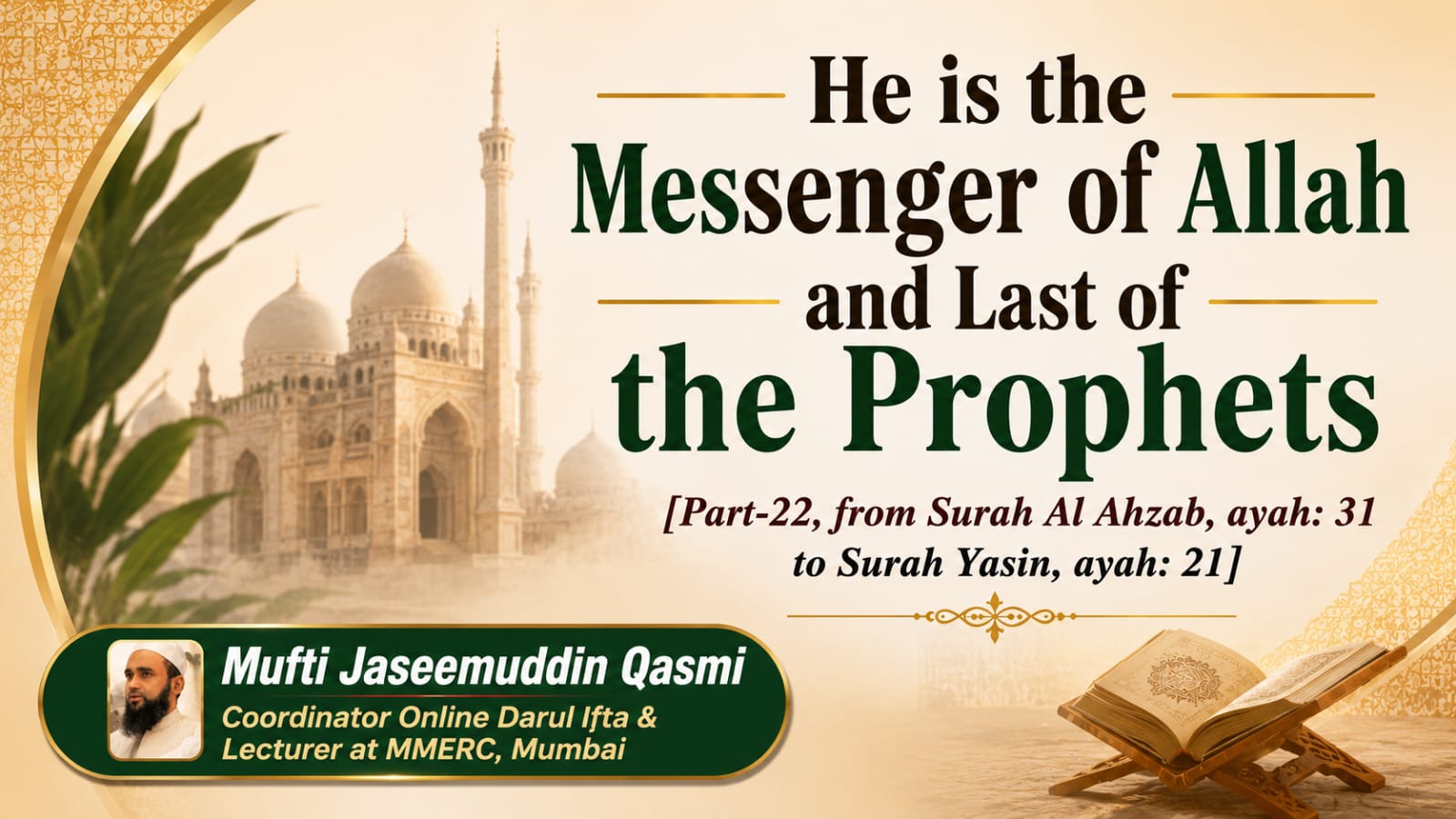
“He is the Messenger of Allah and Last of the Prophets”

“He is the Messenger of Allah and Last of the Prophets”
[Part-22, from Surah Al Ahzab, ayah: 31 to Surah Yasin, ayah: 21]
By: Mufti Jaseemuddin Qasmi
Coordinator Online Darul Ifta & Lecturer at MMERC, Mumbai
The summary of ayah 32 is that the status of the noble wives of the Prophet (saws) is higher than that of ordinary women. Therefore, if they adopt piety, their reward will be doubled, and if they commit any sin, its punishment will also be doubled.
Further in this ayah, while addressing the wives of the Prophet (saws), guidance is given to all the women of the Ummah: when speaking to non-Mahram men, they should not deliberately soften their tone or create any form of allure. Rather, they should convey their words in a plain and modest manner, but not in inappropriate manner.
Real Abode of a Woman is Her Home
In ayah 33, the message conveyed is that a woman’s primary abode is her home. This does not mean that she is not permitted to go out; the Ahadith of the Prophet (saws) have clearly explained that when there is a need, a woman may go out with proper hijab. However, this phrase lays down a great principle, that is, a woman’s essential responsibility is nurturing the family. Any activities that disrupt this purpose go against the primary objective of her life and disturb the balance of society.
Since the ayahs before and after this, discuss the noble wives of the Prophet (saws), the word Ahl al-Bayt mentioned in this ayah directly refer to the blessed wives. However, by the general wording, the Prophet’s daughters and their children are also included in it. Accordingly, the Prophet (saws) once gathered Fatimah (ra), Ali (ra), Hasan(ra)and Husain (ra) under his cloak and recited this ayah.
Allah and His Messenger’s Decision is Final
Allah says in ayah 36, “It is not for a believing man or a believing woman, to have any choice in their affair when Allah and His Messenger have decided an affair for them…”
This noble ayah was revealed in the background of certain incidents in which the beloved Prophet (saws) proposed marriage on behalf of some of his Companions. Initially, however, the woman or her relatives were not willing to accept the proposal. The Companions for whom the Prophet (saws) conveyed the marriage proposal, had no deficiency whatsoever, but the woman or her family declined the proposal at first solely due to a sense of social or financial superiority.

On the other hand, the Prophet (saws) generally wished that people should abandon the tendency to reject good marriage proposals merely on the basis of family lineage or financial superiority.
Although Islamic law does give some consideration to compatibility (kafā’ah) in marriage, if there are other significant grounds for preference in a proposed match, a woman and her guardians should not refuse the proposal solely because the prospective husband does not match the family in terms of lineage.
So, after the revelation of this ayah, the marriage proposals in all these cases were accepted, and the marriages were solemnized as per the suggestion of the Prophet (saws).
The Adopted Son of the Prophet (saws), Zayd ibn Ḥārithah (raz)
Among these events, the most significant is that of Ḥaḍrat Zayd ibn Ḥārithah (raz), which is also connected to the forthcoming ayahs. He was initially a slave of Ḥaḍrat Khadījah (raz), who gifted him to the Noble Prophet (saws). The Prophet (sawz) set him free and then adopted him as his son.
Accordingly, the Prophet (saws) sent a proposal for his marriage to his paternal aunt’s daughter, Zaynab bint Jaḥsh (raz). Ḥaḍrat Zainab belonged to a noble family, and at that time, marrying a freed slave was considered disgraceful for a woman of such lineage. Therefore, she initially refused. Upon this, the relevant ayah was revealed, after which she accepted the proposal, and her marriage to Ḥaḍrat Zayd ibn Ḥārithah (raz) took place. The mahr (dower) was paid by the Prophet (saws) himself.
Although this noble ayah was revealed in the context of these events, its wording is general. It clearly establishes a fundamental principle of the Sharīʿah: once Allah and His Messenger have given a command, no creature has the authority to impose their own opinion thereafter.
The summary of ayah 37 is that although the marriage between Zainab (raz) and Zaid (raz) had taken place, Zaid would complain that the sense of her family superiority had not been removed from her mind. This complaint increased to the extent that he consulted the Prophet (saws) about divorcing Zainab (raz).
On the other hand, Allah Almighty had already informed the Prophet (saws) through revelation, even before Zaid (raz) sought his counsel, that Zaid (raz) would eventually divorce Zaynab (raz). After this, by Allah’s command, the Prophet (saws) would have to marry her. This divine order was intended to practically abolish the custom prevalent among the Arabs, who regarded it as shameful to marry the former wife of an adopted son.

This was a difficult trial for the Prophet (saws). Firstly, he himself had arranged this marriage with great insistence; secondly, it would give the opponents an opportunity to raise objections and fabricate allegations. Therefore, when Zaid (raz) consulted him regarding divorce, the Prophet (saws) advised him not to divorce her, and he did not disclose the fact that Allah Almighty had already decided that Zaid (raz) would one day divorce his wife and that she would then come into the Prophet’s (saws) marriage. It is this very matter that Allah Almighty has expressed in the ayah 37 of Surah Al Ahzab in the following words:
“…and you were concealing in your mind that which Allah was going to disclose, and you were fearing mankind…”
Allah says in ayah 40 of Surah Al Ahzab, “Muhammad is not the father of any one of your men, but he is the Messenger of Allah and last of the prophets…”
It was also prohibited to call Zaid (saws) as Zaid son of Muhammad. Accordingly, in this ayah it has been stated that the Prophet (saws) is not the biological father of any man (because among his children who remained alive, there were only daughters). However, by virtue of being the Messenger of Allah, he is the spiritual father of the entire Ummah, since he is the final Prophet and no other prophet will come until the Day of Judgment.
Iddah in Case of Divorce before Consummation
In ayah 49, it is stated that if a woman is divorced before the marriage is consummated, then no waiting period (ʿiddah) is obligatory upon her. The husband is also instructed that in such a case he should release the woman in a gracious manner by giving her matāʿ (a gift). By matāʿ it is meant that at the time of sending the wife away through divorce, she should be given a set of clothing, which is technically referred to as matʿah. This gift is in addition to the mahr and is separate from it.
Special Rulings Concerning Marriage Specific to the Prophet (saws)
In ayahs, 50 and 51of Surah Al Ahzab, Allah Almighty has explained those rulings related to marriage that is specific to the Prophet (saws) alone. The first of these rulings is that while ordinary Muslims are not permitted to have more than four wives, the Prophet (saws) was granted permission to have more than four wives. There were many underlying wisdoms behind this special permission.
The second ruling specific to the Prophet (saws) is that while ordinary Muslims are permitted to marry any Muslim woman and also women from the People of the Book, it was not made permissible for the Prophet (saw) to marry a Jewish or Christian woman. Moreover, among Muslim women as well, it was not made lawful for him (saws) to marry those who had not migrated from Makkah to Madinah.
The third special ruling for the Prophet (saws) is that while it is not permissible for ordinary Muslims to marry a woman without specifying a mahr (dower), it was permitted for him (saws). However, although this ayah of the Noble Qur’an granted him this special concession, the Prophet (saws) never made practical use of it.
In ayah 51, the obligation upon the Prophet (saws) to strictly fix turns among his wives was lifted. Accordingly, he was granted permission to defer the turn of any of his noble wives if he so wished. However, this was a concession that the Prophet (saws) never made use of it throughout his life; rather, he always treated all his noble wives with complete equality. The same ayah also states that when the noble wives would realize that Allah Almighty had not placed upon the Prophet (saws)the obligation of strict equality, then whatever kindness and good treatment he showed towards them, would be received by them with happiness, considering it more than what they deserved.
Ayah 52 was revealed some time after the previous two ayahs. Earlier, in ayahs 28 and 29, the noble wives had been given a choice, and in response, all of them preferred the Hereafter and the companionship of the Prophet (saws) over the adornments and comforts of worldly life. As a reward for this choice, Allah Almighty, in this ayah, prohibited the Prophet (saws) from marrying any other woman, and also forbade him from divorcing any of his existing noble wives in order to marry someone else in their place.
Home Etiquette and the Command of Veiling
In ayah 53of Surah Al Ahzab, three social injunctions are laid down. The first is that one should not enter anyone’s house without permission, and when invited, one should come at the appointed time—not earlier—and after the purpose has been fulfilled, one should not remain for long in a way that causes inconvenience to the household. This command was revealed on the occasion of the wedding ceremony following the Prophet’s (saws) marriage to Zainab (raz), when some of the Companions arrived early and stayed for an extended period.
The second injunction is about hijab and veiling. The third injunction declares that no one can ever marry the noble wives of the Prophet (saws), as they are the mothers of the believers. Ayah 55 further clarifies the ruling of hijab by exempting maḥram relatives and women, stating that no veiling is required from them.
In ayah56of Surah Al Ahzab, Allah says “Indeed Allah and His angels send blessings on the Prophet; O People who Believe! Send blessings and abundant salutations upon him.”
In ayah59of Surah Al Ahzab, Allah says “O Prophet! Say to your wives and your daughters and the women of the believerstobring down over themselves (faces) their outer garments. That is more suitable that they will be known and not be abused…”
Some hypocrites used to harass women in the streets. In this ayah, the wisdom behind going out with proper veiling is explained: when women go out observing hijab, everyone who sees them will recognize that they are respectable and chaste women, and therefore the hypocrites will not dare to harass or molest them. In contrast, women who go out uncovered and attractively adorned are more likely to become targets of such harassment and molestation. This ayah also serves as evidence for the covering of the face.
﷽
From here begins Surah Saba. This is a Makkan surah and it contains 54 ayahs. The central theme of this surah is to invite the people of Makkah and other polytheists to the fundamental beliefs of Islam. In this context, their objections and doubts are also answered, and they are warned of the evil consequences of disobedience.
Construction of Bait al-Maqdis through the Jinn
The summary of ayah 10 is that Prophet Dāwūd (as) he possessed a very beautiful voice. The rebellious jinn, who were normally beyond anyone’s control, were made subservient by Allah to Prophet Sulaimān (as), and they carried out various tasks for him. Prophet Sulaimān (as) appointed the jinn for the construction of Bait al-Maqdis. By nature, these jinn were disobedient and would work only under the direct supervision of Prophet Sulaimān (as). There was a concern that after his death they would stop working.
Therefore, when the time of his death drew near, he adopted a strategy whereby he stood in his place of worship, which was made of transparent glass, leaning on a staff, so that the jinn could continue to see him. In this very state, he passed away, but Allah kept his body standing with the support of the staff, and the jinn continued to believe that he was still alive. They kept working until they completed the construction. Thereafter, Allah sent termites upon the staff, which began to eat it. When the staff weakened and broke, the body of Prophet Sulaimān (as) fell, and only then did the jinn realize how mistaken they were in thinking themselves to be possessors of knowledge of the unseen. Had they truly known the unseen, they would not have remained in this false assumption for so long, nor would they have endured the hardship of laboring at the construction. This incident is mentioned in ayah 14.
Destruction of the People of Saba
Next comes the story of the people of Saba. The people of Saba lived in Yemen and, at one time, held a distinguished position in terms of their culture and civilization. Because of their evil deeds, the punishment that befell them was that there was a dam at the place called Ma’rib, from whose water their lands were irrigated. Allah Almighty caused that dam to collapse, as a result of which floods engulfed the entire settlement and all their gardens were destroyed.
In ayah 28 of Surah Saba, Allah says, “And We have not sent you except as a giver of glad tidings and a Warner to all mankind, but most people do not know.”
﷽
From here begins Surah Fāṭir. This is a Makkan surah and it contains 45 ayahs. In this surah, the polytheists are primarily invited to believe in the Oneness of Allah and in the Hereafter. It is explained that the signs of Allah’s perfect power and profound wisdom, which are spread throughout the universe, clearly show, when reflected upon seriously, that the All-Powerful Creator of this universe has no need of any partner or helper in running His divine system.

Secondly, these signs make it evident that Allah has not created this universe aimlessly or without purpose. Rather, it has a definite purpose: that those who live a righteous life in following His commands be rewarded, and those who disobey, be punished.
The surah also offers consolation to the Prophet (saws), stating that if the disbelievers do not accept his message, no responsibility falls upon him. His duty is only to convey the truth to the people in a clear and proper manner.
﷽
From here begins Surah Yā Sīn. This is a Makkan surah and it consists of 83 ayahs. The Prophet (saws) has described this surah as the heart of the Qur’an. In this surah, Allah Almighty has set forth signs of His perfect power and profound wisdom that are found not only throughout the universe but also within the very existence of the human being himself. From these manifestations of Allah’s power, it becomes clear on the one hand that the Being who possesses such power and wisdom needs neither a partner nor a helper to run His divine system; therefore, He alone is worthy of worship.
From ayahs 13 to 29, the incident of a community is mentioned which did not accept the call to the truth. Rather, it treated the callers to the truth with oppression and brutality. As a result, while the caller to the truth attained the best outcome, those who denied the truth were seized by the punishment of Allah.
You May Also Like
 Qur'anic Wisdom
“Read in the Name of Your Lord Who Created.”
“Read in the Name of Your Lord Who Created.” (Part / Juz: 30, from...
 Qur'anic Wisdom
“And do not bestow favor to acquire more”
“And do not bestow favor to acquire more” [Part/ Juz 29 — From Surah...
 Qur'anic Wisdom
“…so that it (wealth) may not circulate only between the rich among you...”
“…so that it (wealth) may not circulate only between the rich among you...” [Part...
 Qur'anic Wisdom
“I Have not Created Jinn and Mankind Except to Worship Me.”
“I Have not Created Jinn and Mankind Except to Worship Me.” [Part /Juz'-27 from...
 Mufti Jaseemuddin Qasmi
“If A Sinful Person Brings You a News, Investigate…”
“If A Sinful Person Brings You a News, Investigate…” (Part /Juz - 26 from...
 Qur'anic Wisdom
“Whoever Desires the Harvest of the Hereafter, We will Increase for him his Harvest…”
“Whoever Desires the Harvest of the Hereafter, We will Increase for him his Harvest…”...
Comments (0)
Leave a Comment