
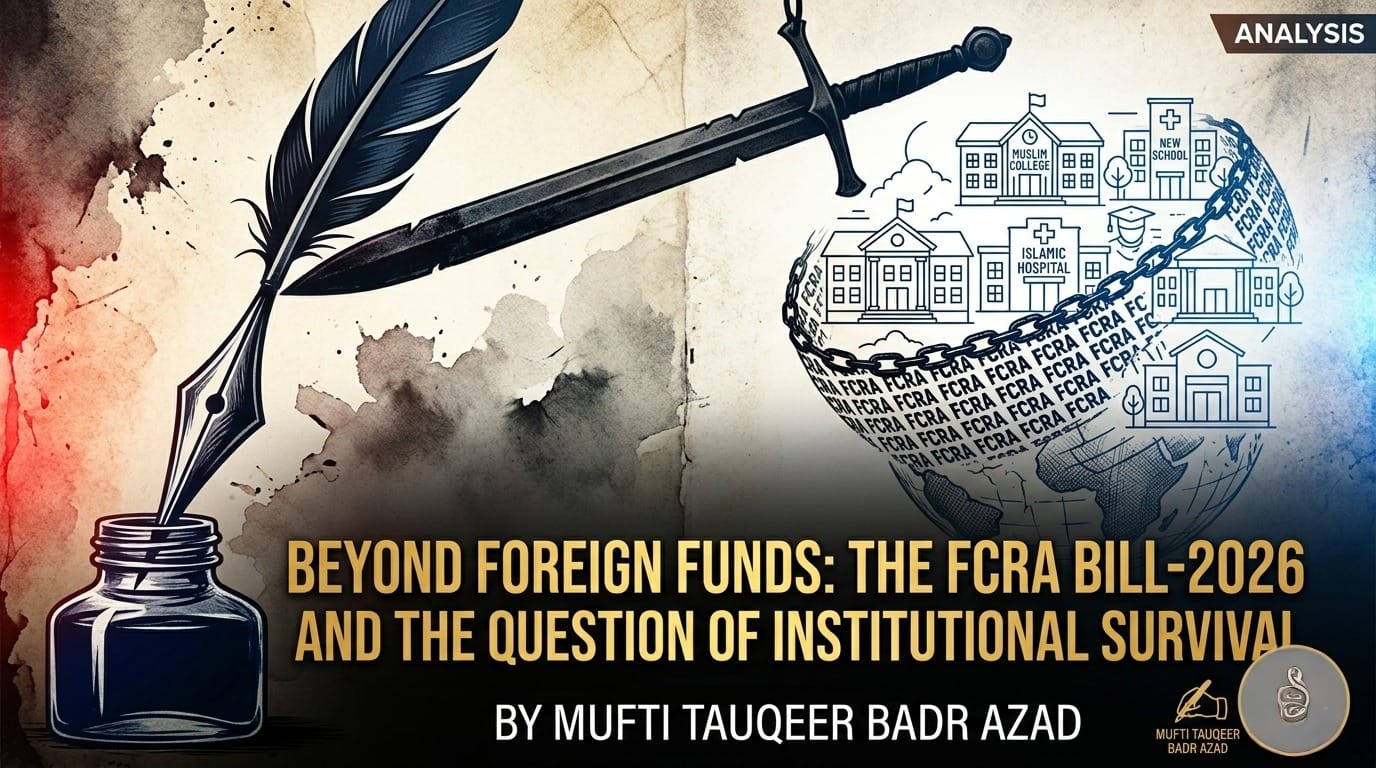
Beyond Foreign Funds: The FCRA Bill and the Question of Institutional Survival

Beyond Foreign Funds: The FCRA Bill and the Question of Institutional Survival
By: Mufti Tauqeer Badr Azad
There are moments in the course of history that signify far more than a mere change of time; they have the power to shape the destiny of generations yet unborn. The FCRA Amendment Bill, introduced in Parliament on 12 August 2026 for debate and consideration, is not merely another piece of legislation. It represents a defining line drawn between the expanding reach of state power and the shrinking space of civil liberties—a line that could have far-reaching consequences for the future. The issue at stake is not simply one of foreign contributions. It concerns institutional survival, ownership of assets, and, ultimately, the spirit of the Constitution of India.
A Moment for Reflection: The Story of a Garden Nurtured with Blood and Sweat
Imagine an institution built over decades through relentless effort, sacrifice and the contributions of well-meaning members of the community. Someone donated land; another contributed life savings towards the construction of a building; someone else gave a portion of their income to support orphaned children. A part of the institution’s foundation may also have been laid with foreign contributions. Then, years later, a government order arrives announcing the cancellation of the institution’s FCRA registration.

Perhaps the institution accepts the decision and says, in the hope of avoiding further complications, “We will no longer accept foreign funding.” But what if the response is: “The land and assets acquired by the institution are no longer yours either”?
What happens then?
This is precisely where a serious tension may arise between the rule of law and institutional ownership. It is a question that deserves careful attention from everyone associated with educational, charitable or social institutions.
The Evolution of the Law: From Regulation to Control
The Foreign Contribution Regulation Act (FCRA) is hardly a new piece of legislation. It dates back to 1976, when it was introduced primarily to prevent foreign money from influencing India’s political and social affairs. Over the years, the law has undergone several amendments, including those in 2010, 2016, 2018 and, most significantly, 2020.
The stated objective has consistently been greater regulation and transparency. Yet the trajectory of these amendments has now brought the debate to a more fundamental question: how far can administrative powers extend?

The issue is no longer merely about accounting for foreign funds. It is about what happens to the assets created with those funds.
The government’s concerns, too, cannot simply be dismissed. Foreign money can potentially be misused for money laundering or activities affecting national security. There is little disagreement with the principle that the source and utilisation of funds should be transparent and properly regulated.
But can an administrative irregularity justify the confiscation of an entire institution?
The Supreme Court has held that receiving foreign contributions is not an absolute fundamental right. But does that necessarily mean that assets lawfully acquired by an institution can subsequently become subject to state control That distinction deserves serious constitutional scrutiny.
The Core Concern: Provisional and Permanent Vesting of Assets
Perhaps the most troubling aspect of the proposed legislation is the concept of a Designated Authority. If an institution’s FCRA registration is cancelled, its assets could potentially be placed under provisional vesting and subsequently under permanent vesting by the state.
For institutions that have, in good faith, received foreign contributions in the past, such a provision could amount to a sword hanging over their heads.
The central question is therefore not whether the government should regulate foreign contributions. It plainly has the authority to do so. The real question is whether the cancellation of a regulatory registration should automatically expose an institution’s accumulated assets to state control, and whether adequate safeguards exist against arbitrary or disproportionate action.
How Long Can Silence Last? Christian Institutions Raise Their Voice While We Remain Silent
Reports indicate that Christian institutions have emerged as among the most vocal opponents of the proposed changes. Their schools, colleges and hospitals have served society for decades, and their concerns are not merely emotional; they are rooted in concrete institutional realities.
Representatives have met Home Minister Amit Shah to convey their concerns. Chief Ministers of several northeastern states have also voiced opposition. Even NDA allies from Mizoram and Meghalaya have indicated their intention to oppose the Bill. This raises an important question for institutions belonging to the Muslim community as well.

If other minorities can approach the corridors of power to protect their institutional interests, why should major madrasas, community organisations and educational trusts remain silent?
A prolonged and exhausting legal battle after a law has already been enacted is far more difficult than making a principled and effective representation while the legislative process is still underway.
The time to raise legitimate concerns is before the law takes final shape—not after the consequences have become irreversible.
Five Demands: A Call for Justice
The demand is not for special treatment or exemption. It is simply for justice, due process and constitutional safeguards. Muslim organisations, educational institutions and civil-society bodies should place the following five-point agenda before the government:
1. Distinguish Technical Irregularities from Serious Offences
A minor administrative or technical lapse should not be treated as an offence threatening national security, nor should it invite disproportionate punishment.
2. Guarantee the Right to a Hearing
Before cancelling an institution’s registration, the authorities should be required to issue proper notice, provide a meaningful opportunity to be heard, and communicate a reasoned written decision.
3. Ensure Judicial Review
Permanent vesting of institutional property should require independent judicial scrutiny. No institution should lose its legally acquired assets solely through an administrative order without effective access to an independent judicial remedy.
4. Recognise the Distinction Between Domestic and Foreign Funding
Where an institution has received both domestic and foreign contributions, there should be a transparent and legally recognised mechanism for determining which assets, if any, were created from foreign contributions. Property acquired through domestic funds should not automatically be treated as foreign-funded property.
5. Provide a Dignified Exit Route
Institutions that no longer wish to receive foreign contributions should have a clear legal mechanism to withdraw from the FCRA framework after completing all necessary financial disclosures, audits and compliance requirements.
The Final Question: Rule of Law or Political Instrument?
One principle must never be forgotten:
Governments change, but the powers created by law remain.
If a law is capable of being used today against one particular group, its powers may be used tomorrow against another. That is why constitutional safeguards matter more than the intentions of any particular government.
Article 14 of the Constitution guarantees equality before the law. Article 19 protects fundamental freedoms, including freedom of speech and association, while Articles 25 and 26 safeguard religious freedom and the rights of religious denominations to manage their affairs.

These constitutional guarantees provide the framework within which state power must operate.
The best law is not one that merely strengthens the hands of the government of the day. The best law is one that ensures that every government of tomorrow remains bound by constitutional limits.
If the real objective of the FCRA amendments is national security, then transparency, proportionality and meaningful judicial oversight must be integral to the framework. National institutions are larger than individual governments, and the Constitution must always stand above those who temporarily exercise political power.
The time has come to shed the cloak of expediency and defend the future of our institutions through legitimate constitutional means—before the opportunity is lost.
Because once institutional property, autonomy and civil liberties are placed at the mercy of unchecked administrative power, reclaiming them may become far more difficult than protecting them was in the first place.
You May Also Like
 Breaking News
Nepal’s Himalayan Flood: When a Glacier Collapse Turned into a Catastrophe
Nepal’s Himalayan Flood: When a Glacier Collapse Turned into a Catastrophe By: S. Masood...
 Breaking News
US Envoy Takes Dig at Indian TV News, Says Late-Night Shows Get ‘Crazier’
US Envoy Takes Dig at Indian TV News, Says Late-Night Shows Get ‘Crazier’ EC...
 Breaking News
Renowned Saudi Hanafi Scholar Mufti Muhammad Umar Shafiq Hijazi Visits MMERC, Mumbai
Renowned Saudi Hanafi Scholar Mufti Muhammad Umar Shafiq Hijazi Visits MMERC, Mumbai EC News...
 Breaking News
Moral Inculcating Summer Camp Concludes Successfully at Al-Hidya Campus, Badlapur
Moral Inculcating Summer Camp Concludes Successfully at Al-Hidya Campus, Badlapur EC News Desk 4...
 Breaking News
Moral Inculcating Summer Camp Organized in Badlapur in Collaboration with MMERC, Mumbai
Moral Inculcating Summer Camp Organized in Badlapur in Collaboration with MMERC, Mumbai (A Sincere...
 Breaking News
“Differences in Thought Lead to Advancement” (MB Qasmi)
“Differences in Thought Lead to Advancement” (MB Qasmi) EC News Desk 12 April 2026...
Comments (0)
Leave a Comment