
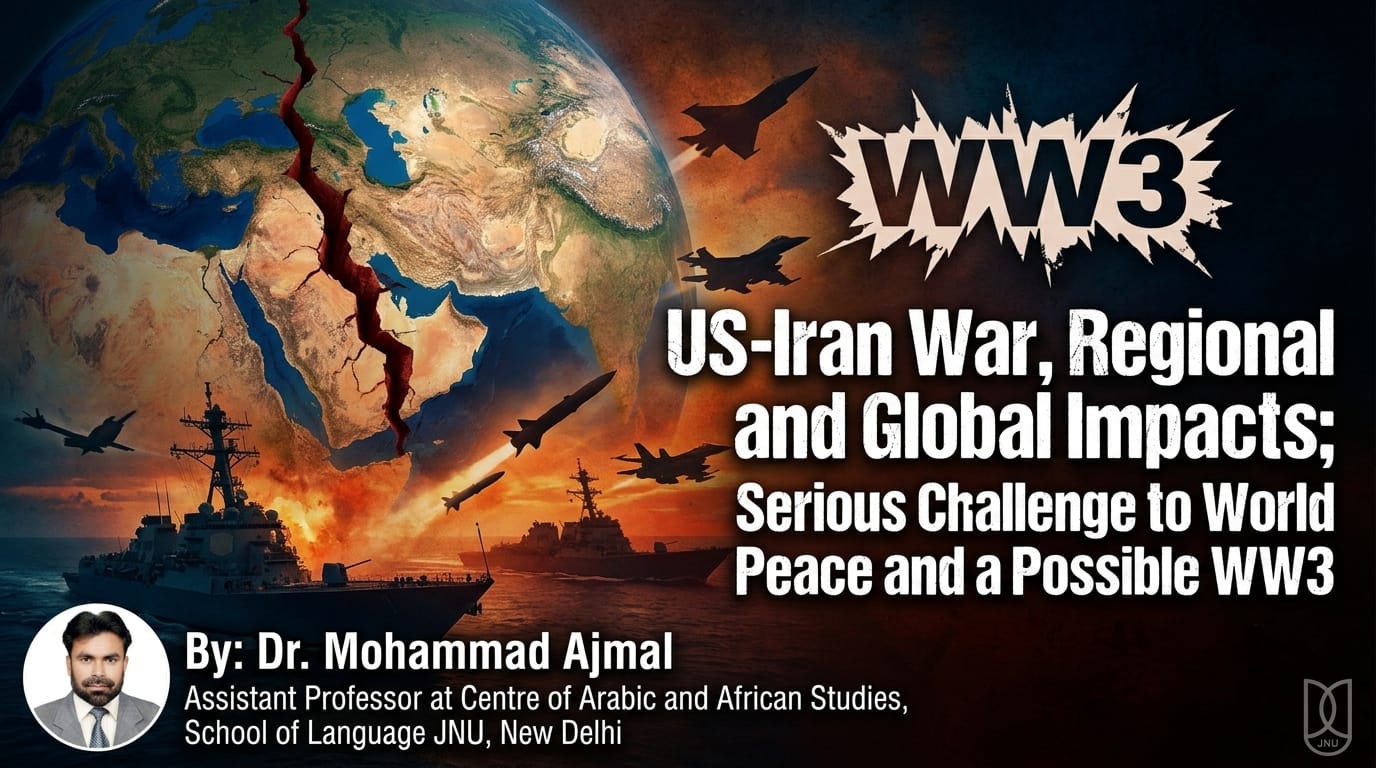
US-Iran War, Regional and Global Impacts; Serious Challenge to World Peace and a Possible WW3

US-Iran War, Regional and Global Impacts;
Serious Challenge to World Peace and a Possible WW3
By: Dr. Mohammad Ajmal
Assistant Professor at Centre of Arabic and African Studies, School of Language JNU, New Delhi
With the rapidly changing orders in world politics, the new balance of power in the West Asia, the recent war between the US and Iran, diplomatic efforts for a ceasefire and their regional and global implications, and the tension arising between this triangle in the current global context is not just a regional conflict but its effects are being felt on the politics, economy and security of the entire world. The world has today taken the form of a true “global village”, where a crisis in one region begins to affect the global economy, energy markets, trade, diplomacy and international relations within a few days. Since Iran is a neighbor and a close friend of the Indian subcontinent, it is natural that US-Iran tensions would have a direct impact on these countries. The United States launched its recent war against Iran not as a hasty decision, but after a long-term plan and a phased strategy. Initially, attempts were made to create internal political instability in Iran and regime change. When these efforts failed to yield the desired results, the United States and Israel significantly increased their naval presence in the Persian Gulf to increase diplomatic and military pressure on Iran to force it to abandon its nuclear program. But Iran did not accept this pressure, after which the scope of military operations expanded and the Iranian political, military, and religious leadership were targeted.
But one thing is clear: both sides suffered heavy casualties, military and economic losses in the war. Several Iranian military and civilian facilities were targeted, while the United States also paid a heavy price in terms of war costs, large numbers of troops killed, military operations and global pressure. America suffered billions of dollars in economic losses, damages of military equipment and growing uncertainty in the region, while Iran spoiled American interests through its defense capabilities and domestically developed drone technology. The events that occurred during the war eventually forced both sides to move towards a ceasefire, although the reasons for this were different. After Iran targeted various US military bases in the region and caused casualties in Israel, the situation reached a stage where many regional countries, including the US, appeared to be seeking a ceasefire. The signing ceremony of the ceasefire memorandum of understanding was scheduled for June 14, 2026 in Switzerland, however, due to some security concerns, electronic signatures were adopted the traditional ceremony instead.
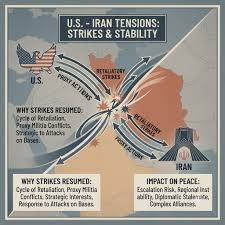
The effects of the US-Iran tension were not limited to the West Asia, but also had a clear impact on the Russia-Ukraine war. Due to which, the US’s focus shifted to the Gulf crisis, which led to a decrease in military assistance to Ukraine, which provided Russia with relatively better opportunities for its strategy. The biggest economic beneficiary of the situation has been China. China has been steadily increasing its economic power over the past several decades while avoiding direct wars. When major powers are embroiled in wars, new opportunities for global trade and investment often accrue to countries that remain relatively neutral. In the present era, it is not possible to understand international politics simply on the basis of news or social media information, but such academic and research discussions play an important role in shaping national consciousness, intellectual training of the younger generation, and understanding various aspects of foreign policy. The US-Iran tension is not just a conflict between two countries, but its effects extend to West Asia, South Asia, the global energy market, international trade, great power rivalry, and the future global political system.
Notwithstanding, the war between the USA and Iran has not come to a halt and the entire West Asian region is still in trouble, the Strait of Hormuz, which is considered the lifeblood of global energy supply and maritime trade, is currently in one form or another at war, due to which it is in the grip of economic problems. Recent statements issued by the Iranian authorities clearly state that shipping through this important waterway has been completely suspended due to the continuous aggressive gestures of the US forces. On the other hand, the harsh statements of the President Donald Trump, and the claims of the military leadership of Tehran indicate that this dispute has taken the form of a comprehensive crisis whose effects are engulfing the economy and security of the entire world.
The Strait of Hormuz is the world’s waterway through which a large part of the world’s oil and gas passes and reaches various global markets. The closure of this waterway or the cessation of commercial shipping through it is a terrible economic blow not only for the region but also for the entire world. The Iranian Maritime Traffic Supervision and Management Authority has made it clear in its social media statement that in the current war and aggressive environment, safe passage of ships through it is absolutely not possible. According to the Iranian stand, no new requests for shipping will be considered until peace and stability are fully restored in the region. Permits for the use of this waterway will be issued in stages only after the situation returns to normal. On the other hand, the Revolutionary Guards have also confirmed that two ships attempting to pass through the Strait of Hormuz under US surveillance have been targeted. This situation is clear evidence that Tehran is willing to go to any lengths to maintain its strategic superiority in this waterway, even if it means disrupting global trade. US President Donald Trump’s stance in this crisis has been extremely tough and aggressive.
Referring to the previous long wars in Vietnam and Afghanistan, Trump said that the United States has been involved in this conflict for only five months and a few days, and during this short period they have severely damaged Iran’s military capability. While the Iranian parliamentary speaker Baqer Qalibaf has claimed victory in the war in a significant and surprising statement. He said that we have won this long and hard war, and now it is time to give this victory a solid and documented form. Baqer Qalibaf reiterated the determination that Iran must move forward with the hope of a brighter future and a better vision. The international security and defense analysts’ view of the crisis is quite serious and realistic. They categorically stated that it is not remotely possible for the United States to completely eliminate the Iranian threat to shipping in the Strait of Hormuz and the North Arabian Sea. The most the United States can do is to reduce or temporarily limit the number of such attacks by targeting the resources, launch pads, and military installations used by Iran to attack shipping.

They say that at present, Washington’s overall strategy seems to be based on a “hot and cold” approach. That is, whenever Iran targets ships that violate the established rules or are suspicious of the Strait of Hormuz, the United States responds with a strong response, but no permanent and sustainable solution to this conflict is currently in sight. This war is no longer limited to a bilateral confrontation between Tehran and Washington, but has also engulfed the Gulf states and other countries in the region. The targeting of US military bases in the Gulf countries during Tehran’s retaliatory actions is proof that no country in the region can be immune to the effects of this fire. The Gulf countries, which were determined to promote economic development and tourism, are currently in deep concern.
Their economies are based on peace and stable trade, but the closure of the Strait of Hormuz and the ongoing missile attacks from both sides have put all their economic plans at risk. The leaders of the region are afraid that if this war is not stopped immediately through diplomatic means, it could turn into a devastating regional war that will scorch the entire world. The crisis in the Strait of Hormuz and the US-Tehran conflict have become the biggest political and economic headache in the world today. On the one hand, US President Donald Trump, drunk on his power, is trying to force the rogue Iran to completely kneel, while on the other hand, the Iranian leadership is determined to respond to this aggression with its ideological and military power. This conflict and war between the United States and Iran have not only threatened global peace but have also plunged the entire world into a state of uncertainty. History is a witness that wars always bring destruction, bloodshed and human tragedies. Although reports of ceasefires have emerged on some occasions, the fact is that tensions between the United States and Iran still persist. Political experts have already described US President Donald Trump as an unpredictable and unreliable figure, however, despite this; a lasting solution to every conflict lies in negotiations.

Iran expressed confidence in Pakistan’s mediation efforts, but the US still stands by its policy. Both countries are causing each other human and financial losses. On the one hand, the US is threatening Iran with severe consequences; while on the other hand, Iran has made it clear that it has the right to retaliate against countries from wherever its territory is attacked. Iran has also warned some Arab countries that if they continue to be facilitators for the US, they too will have to face the consequences. The Revolutionary Guards have also claimed to have targeted US soldiers, warplanes and drones in recent clashes. The saying still holds true today that “America’s friendship is expensive, as is its hostility.” History is a witness to the fact that the US has always put its national interests above everything else.
Years ago, the United States spent billions of dollars to create sectarian divisions in the Muslim world by calling the Iranian revolution a “Shiite revolution,” but it did not achieve much success. Later, it frightened Arab countries about the threat from Iran and established military bases on their soil and made them part of its defense strategy. Today, pressure is being exerted on Iran and other Muslim countries from these bases, while American influence is also established on the natural resources of these countries. The tragedy is that Muslims are the ones who are suffering the most in this entire conflict. Be it Iran’s retaliation or American attacks, it is Muslims who are suffering. Arab countries should also now seriously consider that the American guarantees on which they allowed the establishment of military bases in their countries are only not able to provide them with protection, but are themselves becoming a source of danger for them. On the other side, Iran, which has been quite active in the diplomatic field, has also appeared to be a victim of internal weaknesses in the recent war. Accusations of spying for the enemy have surfaced against several senior military officers and prominent figures, including former President Mahmoud Ahmadinejad. This situation reflects the fact that the intelligence agencies of the United States and Israel work in a highly organized manner to achieve their goals.

It is also a fact that the vast oil and gas reserves of West Asia have been the focus of attention of world powers. A large part of the US economy is related to arms manufacturing and the energy sector, so the war environment is also linked to its economic interests. This is why the interests of some world powers, including the US, seem to be linked to the continuation of tension instead of peace. Although according to reports, both countries have shown their willingness to temporarily stop the war and adopt diplomatic means, and efforts by Pakistan and Qatar are also ongoing, the effects of this conflict are being felt throughout the region. According to media reports, despite the ceasefire, fresh attacks on each other seem to indicate that this West Asia war is now spreading to other regions. In response to the damage done to Saudi Arabia by the Houthis supported by Iran, the US and Saudi Arabia have jointly launched attacks against Iranian-backed groups in Iraq, which Tehran has strongly condemned. According to the Revolutionary Guards, it has targeted three oil tankers in Hormuz, while in response to the aggressive actions of the US military; it has targeted the US military air base and the Central Command center in Jordan with multiple ballistic missiles. President Trump has threatened that Iran will pay a heavy price for the attack on the US bases in Jordan. Such a tense situation and attacks and threats against each other do not seem to indicate that this war is going to end soon.
World peace is already under threat, and if this war is prolonged, the consequences will be very serious for the entire world. US President Trump himself has admitted that defeating Iran is not easy, as it is a country with a large population, vast territory, and strong defense capabilities. On the other hand, despite the attacks on the leadership and heavy losses in Iran, national unity has been further strengthened, while the US and Israel have been surprised by the Iranian resistance. Protests against this war are also going on within the US, and a large part of public opinion is opposing it. This issue could create political problems for Trump in the upcoming mid-term elections. Similarly, Israeli Prime Minister Netanyahu is also facing accusations of war crimes and increasing isolation on the global level, while the upcoming elections could also prove decisive for his political future. Today, the need of the hour is for Muslim countries to put aside their differences and demonstrate unity and solidarity, and for international organizations to play an effective role in bringing the US and Iran to the table for a permanent ceasefire and meaningful negotiations. Because war is not a solution to any problem, but a constant threat to humanity, the economy, and world peace. If the world is to be freed from inflation, hunger, poverty, and unrest, then the path of dialogue, justice, and peace must be adopted instead of force.

Defense experts seem to be absolutely right in their opinion that it is not possible to eradicate the tension in this region through military force alone. Wars are not the solution to problems rather the harbinger of new disasters. What is needed at this time is for the international community, the United Nations and the peaceful countries of the region and the world to come forward and play their effective role in bringing both sides to the negotiating table. If this series of stubbornness, intransigence and use of force continues, then this storm in the Strait of Hormuz will not only devastate the region of West Asia but will also bring the entire world to the brink of a horrific economic crisis and a possible world war. The need of the hour is to wake up and end this serious impasse through dialogue.
You May Also Like
 Asia
AsiaThe Burning Middle East
The Burning Middle East Gaza and Lebanon on the same page 78 years since...
 Asia
AsiaMaulana Badruddin Ajmal Included for the 16th Consecutive Time in the List of the World's 500 Most Influential Muslims
Maulana Badruddin Ajmal Included for the 16th Consecutive Time in the List of the...
 Asia
AsiaLessons from Hasina's Downfall
Lessons from Hasina's Downfall Mohammad Taukir Rahmani EC Exclusive The end was sudden and...
 Asia
AsiaForgotten Pages of History: Contributions of Ulama in the Freedom of India
By M. Burhanuddin Qasmi The author is Director Markazul Ma'arif Education & Research Centre...
 Articles
Amidst Bloodshed continues in Lebanon, Gaza and the West Bank
Amidst Bloodshed continues in Lebanon, Gaza and the West Bank Iran, US war takes...
 RELIGION
A Glance Over Major Religions of the World
A Glance Over Major Religions of the World By M. Burhanuddin Qasmi Director: Markazul Ma’arif...
Comments (0)
Leave a Comment