
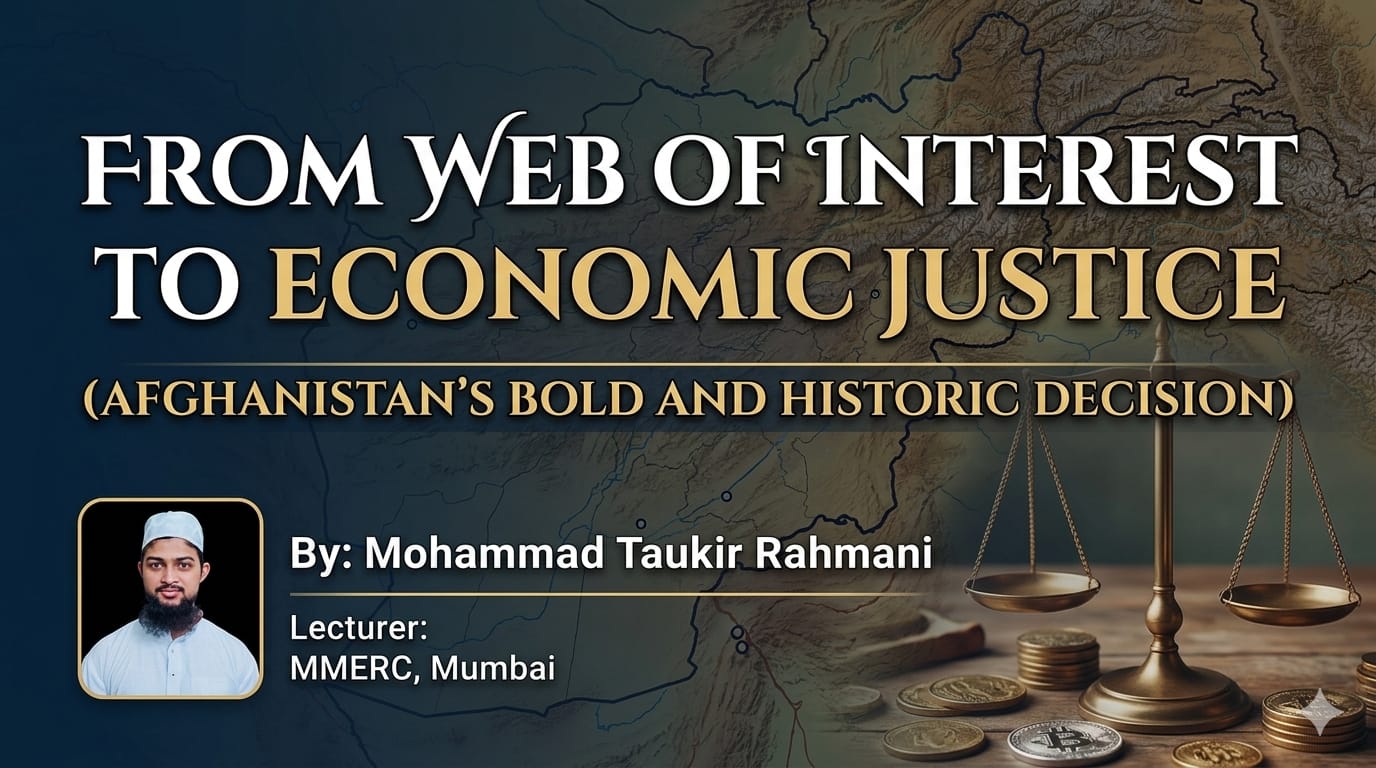
From Web of Interest to Economic Justice

From Web of Interest to Economic Justice
(Afghanistan’s Bold and Historic Decision)
By: Mohammad Taukir Rahmani
Lecturer: MMERC, Mumbai
An interest-based system, despite its outward sheen, carries within it a deep internal contradiction. On the surface, it appears to offer convenience—almost as if placing temporary relief into the hands of the needy. Yet in reality, that very relief gradually transforms into a burden that erodes human freedom and autonomy. It is akin to a thirsty person drinking saltwater: a fleeting sense of satisfaction may arise, but with the passage of time, the thirst only intensifies. Such is the nature of this system—it seems to open doors of ease, but in its ultimate outcome, it widens the pathways of constraint and hardship.
The structural design of this system itself resists equilibrium. Wealth begins to flow in a single direction and eventually accumulates there. For the one who owns capital—whether an individual or an institution—profit becomes almost guaranteed, regardless of participation in any real economic effort. Meanwhile, the one driven by need, who extends his hand for assistance, gradually finds himself dispossessed of his own resources. It is as though the roots of a tree are continually cut while an attempt is made to keep its branches green. The foliage may appear lush from the outside, but internally, the very system of life is being weakened.
There is yet another profound dimension to this reality: within such a framework, the notion of compassion is reduced to a mere façade. The lender appears as a benefactor, but the assistance he offers is tied to conditions that entrap the borrower in an unending cycle. The borrower begins to shrink his basic needs, suppress his aspirations, and at times even compromise his dignity—only to lighten a burden that, paradoxically, grows heavier with each passing day. It is a circle that is easy to enter, but exceedingly difficult to escape.

When this phenomenon is viewed on a broader scale, the same pattern becomes evident at the level of nations. When a society or a state attempts to build itself upon such a system, it may initially perceive signs of progress. There is an illusion of growth, a sense of forward movement. Yet, gradually, its sovereignty begins to erode. Its decisions no longer remain entirely its own; instead, they begin to align with the will of those forces that hold financial leverage over it. In this way, a subtle dependency takes shape—one that outwardly appears as cooperation and mutual agreement, but in essence represents a quiet transfer of control.
The real question, therefore, is not whether this system yields short-term benefits, but what its ultimate consequences are, and how it affects human dignity, freedom, and the balance of life. Any framework that guarantees profit without effort or responsibility, while placing the burden of pressure continuously upon the needy, carries within it an inherent imbalance—no matter how rational or attractive it may seem on the surface. Such an imbalance does not remain concealed indefinitely; sooner or later, it manifests itself. And when it does, its impact is not confined to the economic sphere alone, but extends into the moral and human fabric of society, leaving marks that are difficult to erase.
When the scope of this system is examined at the global level, its grip becomes even more pronounced. Major financial institutions, such as the World Bank, the International Monetary Fund(IMF) and such other institutions often present themselves as champions of economic stability and development. Yet in practice, their operational frameworks tend to resemble a web—one that appears easy to enter, but exceedingly difficult to escape. At the outset, loans seem like support, a lifeline extended to a struggling economy. But over time, that very support transforms into a weight that begins to dictate the direction of an entire nation’s economic trajectory.

Once a country steps into this orbit, its policy autonomy gradually weakens. Decisions are no longer shaped solely by internal needs and priorities; instead, they become subject to external conditions and stipulations. It is much like an individual who, driven by necessity, extends a hand for help, only to find that in doing so, he has also surrendered a measure of his freedom to decide. With time, this dependency deepens to the extent that not only the economy, but even national priorities and social structures begin to bear its imprint.
Perhaps the most intricate aspect of this system is that once entangled within it, the path of return appears almost sealed. To repay one loan, another must often be taken, and thus the process evolves into a self-perpetuating cycle. It is a motion without real progress—a rotation that continues endlessly, yet leads nowhere. Though it is framed in the language of agreements and cooperation, in reality it becomes a binding attachment, where every attempt at disengagement risks further entanglement.
One is left with the impression that complete liberation from this grip has become more of a theoretical possibility than a practical reality—an exception rather than the norm. This is why, at times, it appears that escaping such a system does not lie in minor adjustments or isolated reforms, but in a fundamental transformation—one that reconsiders not only the structure of the system, but also the underlying worldview that sustains it. At this point, the issue ceases to be merely economic; it evolves into a profound intellectual and human question.
In such an environment—where the entire world appears to be flowing in a single economic current, and even the thought of deviating from it seems almost inconceivable—when a society chooses to chart a different course, it is not merely an economic decision; it is an intellectual declaration. It reflects a conviction that systems devised by human beings, no matter how stable or sophisticated they may appear, are not beyond flaw. And that, alongside them, there exists an alternative path—one that is more closely aligned with human nature, genuine need, and the demands of justice.
It is against this backdrop that Afghanistan’s move to adopt an interest-free Islamic economic system emerges as a remarkable and unconventional step. This is not simply the initiation of a new experiment, but rather a return to a principle that has, in different forms, already been tested within human societies. At its core lies the idea that the flow of wealth should maintain a natural balance, rather than concentrating in a way that becomes a source of disproportionate power.
Within this framework, profit is not tied merely to the possession of capital. Instead, it is linked to effort, responsibility, and the sharing of risk. The intention is to ensure that no single party bears the burden alone, and that no other party enjoys guaranteed gain without corresponding participation. In this way, the system seeks to restore equilibrium—not only in economic transactions, but in the broader moral logic that governs them.

The official announcement of this historic decision was made on April 15, 2026, by Dr. Lutfullah Khairkhwa, Director of Banking and Financial Services at Da Afghanistan Bank, the country’s central bank. According to this declaration, interest (riba) has been completely eliminated from all commercial and state financial institutions in Afghanistan, and the nation’s banking sector has now been fully transitioned to the principles of Islamic Shariah. Although the process had begun earlier—following the return of the Taliban government, with an initial directive issued in March 2022—the April 2026 announcement marks the culmination and final implementation of this transformation. In this sense, it stands not only as a domestic policy shift, but as a challenge to the prevailing global economic order and a call to the conscience of the Muslim world.
At a deeper level, when a society embraces such a principle, it is in fact redefining the direction of its economic behavior. Transactions no longer remain mere instruments for maximizing gain; they begin to take the form of mutual cooperation. Assistance to the needy is structured in a way that does not convert their vulnerability into a permanent disadvantage, while those who possess capital are reminded that their benefit should not be built upon the loss of others. It is at this point that economic activity enters an ethical domain, where material exchange is guided by moral considerations.
Afghanistan’s recent move reflects precisely this shift in outlook. The removal of interest-based dealings from its financial institutions is not a symbolic gesture; rather, it signifies an attempt to reconstruct the very foundation of the system upon new principles. This implies that the transformation is not confined to terminology, but is meant to permeate every aspect of the economy, allowing a fundamentally different mindset to take root in practice. Such transitions are rarely without difficulty. Moving away from entrenched structures and stepping onto a new path inevitably brings challenges. Yet it is in navigating these challenges that a society’s true resolve is revealed.

From another perspective, this step carries profound significance because it challenges the widely held assumption that no viable alternative exists beyond the current global system. When a country demonstrates, in practical terms, that it can organize its economy on a different set of principles, it opens an intellectual horizon. The question then is no longer limited to which system is dominant, but extends to which system is more just, more sustainable, and more consistent with human dignity.
Ultimately, the true measure of any economic system lies not in its statistics, but in its human consequences. If a framework preserves dignity, prevents need from turning into burden, and fosters balance within society, it is that framework which proves enduring. Afghanistan’s initiative is, in essence, an attempt in that direction—an attempt that leaves the world with a compelling question: is an economy grounded in justice and balance merely an ideal to be imagined, or a reality that can, in fact, be achieved?
You May Also Like
 Culture
The Flood of Heresy: A Manifestation of Ideological Colonialism and a Trial for Islamic Consciousness
The Flood of Heresy: A Manifestation of Ideological Colonialism and a Trial for Islamic...
 Islam
IslamThe Wisdom Behind Islamic Festivals: A Path to Social Harmony
The Wisdom Behind Islamic Festivals: A Path to Social Harmony By: Mohammad Taukir Rahmani...
 News
NewsLaunch Ceremony of Concept of Life After Death in World's Major Religions Held in Deoband
Launch Ceremony of Concept of Life After Death in World's Major Religions Held in...
 Health
Discussing daughters' rights, 35000 ft above the ground
Discussing daughters' rights, 35000 ft above the ground By Mohammed Wajihuddin The plane was...
 OPINION
“Iran War and the Coming Geopolitical Realignment in the Middle East”
“Iran War and the Coming Geopolitical Realignment in the Middle East” By: Adv. Mohammad...
 Europe
Two Years of Genocide, Resistance, Ceasefire and Hope in Gaza
Two Years of Genocide, Resistance, Ceasefire and Hope in Gaza By: Khursheed Alam Dawood...
Comments (0)
Leave a Comment