
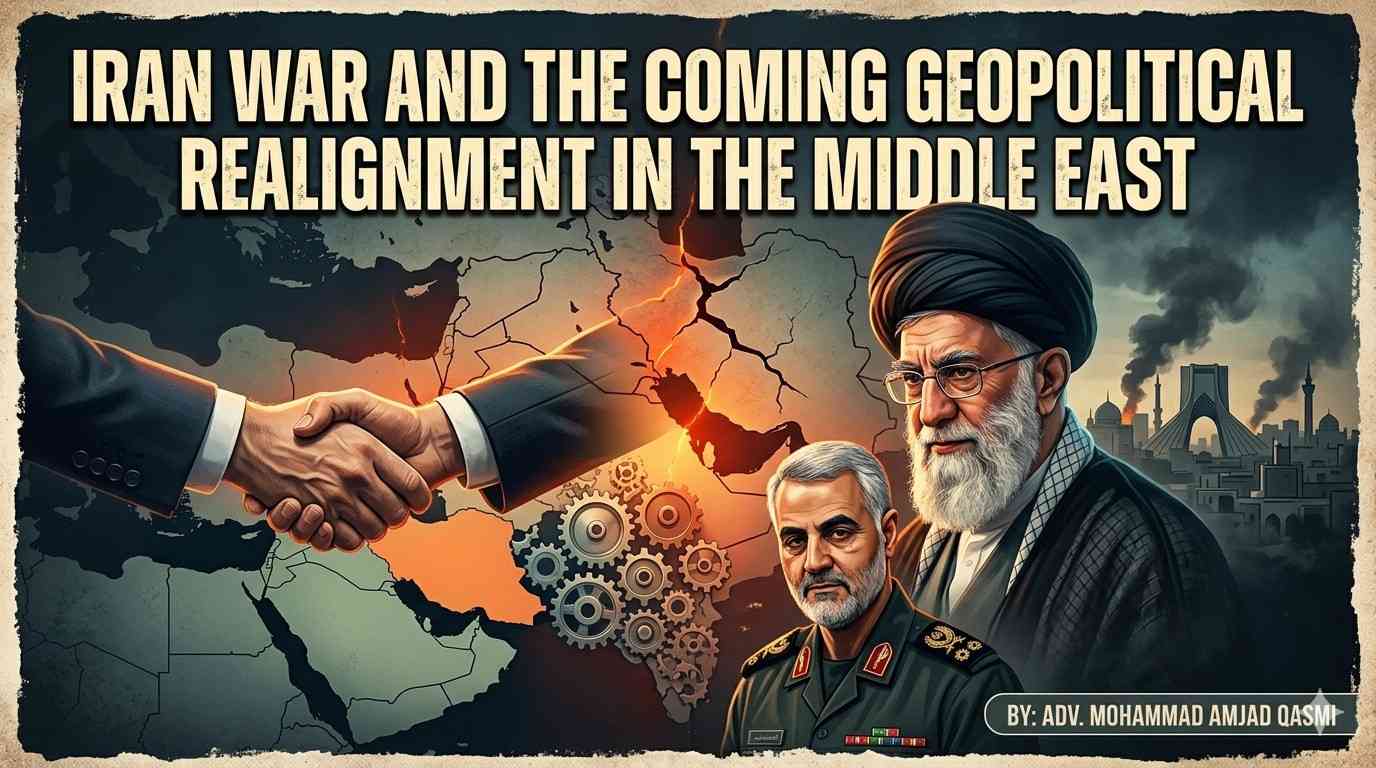
“Iran War and the Coming Geopolitical Realignment in the Middle East”

“Iran War and the Coming Geopolitical Realignment in the Middle East”
By: Adv. Mohammad Amjad Qasmi
If the assumption that the United States may eventually exit the conflict without any gains, which is more likely to happen, turns out to be correct, the consequences may not be limited only to a loss of image for the U.S. and Israel or a strategic gain for Iran.
In such a scenario, Arab countries, particularly the Sunni states, may face a much more difficult and uncertain phase. If Iran emerges from this conflict with increased geopolitical influence, it could shift the balance of power in the Middle East. This would likely force many Arab governments to reassess their security policies, alliances, and regional strategies, and they may find themselves struggling to maintain their political influence and strategic autonomy in the region, shifting from reliance on the West toward realignment with Russia.
Moreover, the implications would not remain confined to the Middle East alone. Iran’s strengthened position could also translate into greater influence for its strategic partner Russia. Through cooperation with Iran, Russia could expand its geopolitical presence in the region, while China may also benefit from the weakening of U.S. influence in the Middle East.

However, it is also important to consider that the US is unlikely to allow such a major geopolitical shift to occur easily. Historically, US has often attempted to reassert its influence when its global image or strategic position is challenged. Therefore, even if the U.S. withdraws from the immediate confrontation, it may seek other avenues to demonstrate its power and restore strategic balance. This could involve reshaping the political situation in Gaza Strip, pushing current Afghan-government to accept women and minority rights in Afghanistan, or increasing its involvement in regional security arrangements in Asia or Europe, or reopening strategic theaters in conflict-prone countries.
Such moves could serve as a form of geopolitical “face-saving” for the US while also signaling to rivals that American power and influence remain intact. As a result, the outcome of this conflict may trigger a prolonged period of geopolitical competition and realignment across the Middle East and beyond.
In that sense, what we are witnessing may be the early stages of a broader restructuring of the global order, where China and Russia seek greater influence while the United States attempts to maintain its longstanding strategic dominance.
You May Also Like
 News
NewsLaunch Ceremony of Concept of Life After Death in World's Major Religions Held in Deoband
Launch Ceremony of Concept of Life After Death in World's Major Religions Held in...
 Health
Discussing daughters' rights, 35000 ft above the ground
Discussing daughters' rights, 35000 ft above the ground By Mohammed Wajihuddin The plane was...
 OPINION
From Web of Interest to Economic Justice
From Web of Interest to Economic Justice (Afghanistan’s Bold and Historic Decision) By: Mohammad...
 Europe
Two Years of Genocide, Resistance, Ceasefire and Hope in Gaza
Two Years of Genocide, Resistance, Ceasefire and Hope in Gaza By: Khursheed Alam Dawood...
 International Politics
Israel – Gaza War; From Balfour Declaration 1917 to Donald Trump’s 21 Points 2025: Concerns, Prospects and Expectations
Israel – Gaza War; From Balfour Declaration 1917 to Donald Trump’s 21 Points 2025:...
 International Politics
Greater in disguise, Israel’s Attack on Qatar’s Mediation a Paradigm shift of Israel, US Dual Policy Game towards West Asia
Greater in disguise, Israel’s Attack on Qatar’s Mediation a Paradigm shift of Israel, US...
Comments (0)
Leave a Comment