
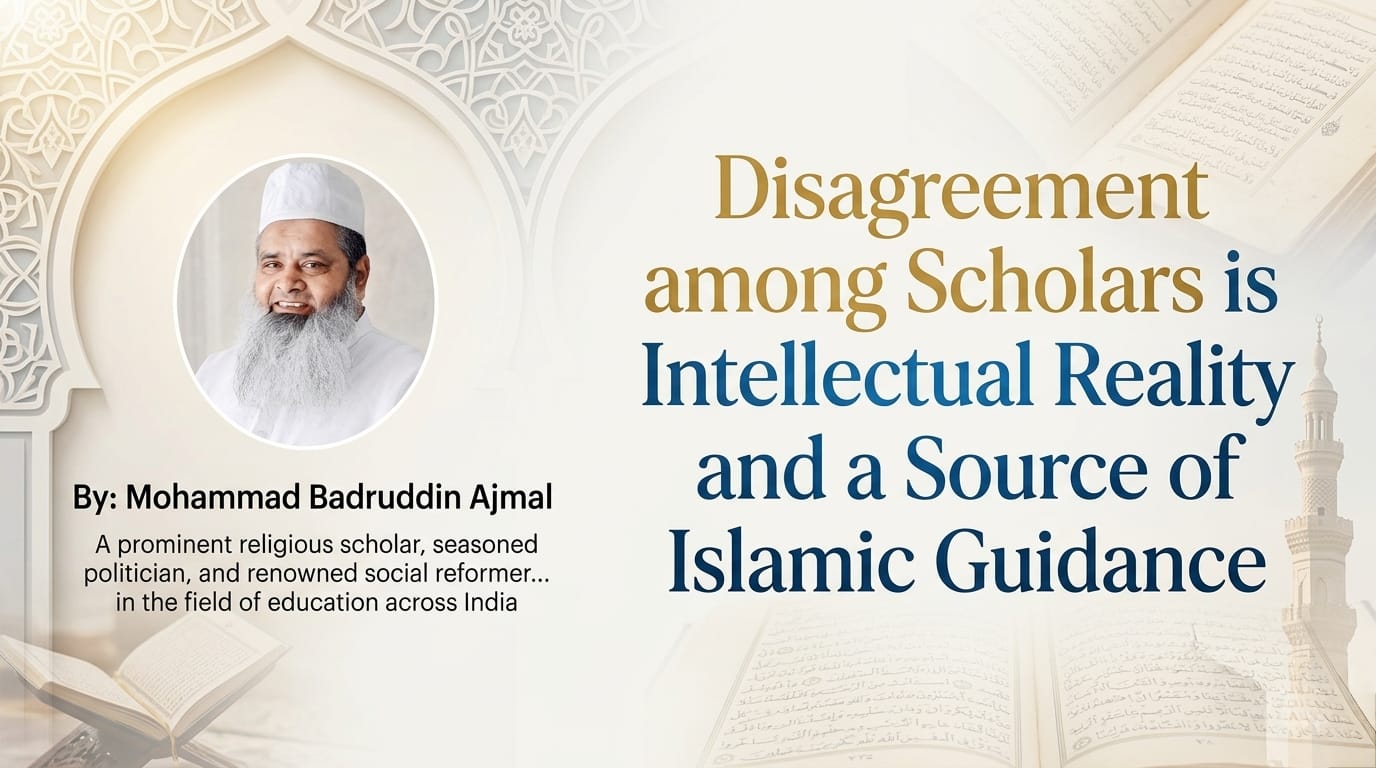
Disagreement among Scholars is an Intellectual Reality and a Source of Islamic Guidance

Disagreement among Scholars is an Intellectual Reality and a Source of Islamic Guidance
By: Maulana Mohammad Badruddin Ajmal Al-Qasmi
(A prominent religious scholar, seasoned politician, and renowned social reformer in the field of education across India)
Disagreement or difference of opinion is a natural instinct of human nature. When two individuals think, understand, and analyze an issue, differences in opinion are bound to arise. Islam does not ignore this natural reality; rather, it provides a structured and dignified framework for it. That is why Islamic teachings do not completely reject (difference of opinion); instead, it clearly defines its principles and etiquettes.
In essence, disagreement refers to the existence of two or more opinions on a matter, provided that they are based on sound knowledge and aim at reaching the truth or useful practice, not at asserting one’s ego or stubbornness. When disagreement is accompanied by evidence, sincerity, and proper conduct, it becomes a source of mercy. On the contrary, when it turns into ignorance, prejudice, and hostility, it becomes a cause of corruption and discord.
Islam teaches a remarkably balanced and refined approach to disagreement. The Qur’an instructs: “If you disagree over anything, refer it back to Allah and His Messenger.”[The Qur’an, Surah An-Nisa, Chapter 4, Ayat 59]
This principle makes it clear that the ultimate criterion in any disagreement is not opinion, but divine revelation.

In the life of the Prophet ﷺ and his noble companions, we find numerous examples of scholarly disagreement. Yet, despite their differences, mutual love, respect, and unity always remained intact. Even among the great jurists (Imams), there were differences in jurisprudential matters, but none of them considered the other misguided or an enemy. This is the true Islamic methodology: differences may exist, but morality must never be compromised.
According to Islamic teachings, the first principle of disagreement is sincerity, meaning that the intention should be to clarify the truth, not to impose one’s own opinion. The second principle is knowledge, meaning that no opinion should be formed without proper research and evidence. The third principle is etiquette (adab), which requires that even in disagreement, the dignity and respect of others must be preserved.
The correct way to disagree is to present arguments with evidence, maintain a calm tone, and avoid personal attacks. The Qur’an even commanded that Pharaoh be addressed with gentle speech; so how can harshness and abusive language be justified among ordinary people?
When disagreement is based on knowledge, research, and sincerity, it becomes a means of progress. Juristic differences (fiqhi disagreements) have provided the Muslim community with solutions suited to different times, geographical regions, and circumstances. Such differences foster intellectual breadth and depth of thought, and ease for followers of Islam.
However, when disagreement is driven by prejudice, stubbornness, ego, and ignorance, it becomes a deadly poison for the Ummah. In today’s time, most problems arise not from scholarly disagreement, but from negative attitudes. Having different opinions on the same issue is not the problem; the real problem is that we have turned disagreement into hostility.

When properly understood, disagreement is a source of goodness for the Ummah, as it promotes intellectual expansion, independent reasoning, and research. If everyone were forced into a single opinion, intellectual growth would come to a halt. This is why multiple schools of thought emerged in Islamic jurisprudence, serving as a means of ease and flexibility for the Ummah.
But when disagreement is turned into personal conflict, factionalism, and hatred, it becomes one of the greatest trials for the Ummah. Today, one of the greatest tragedies is the inability to tolerate scholarly differences, leading to major divisions over even minor issues.
Here, it is essential to understand a very important point: “ikhtilaf” (difference of opinion) and “khilaf” (conflict) are not the same. Ikhtilāf means a difference in opinion that exists with evidence and mutual respect, whereas khilaf refers to hostility, stubbornness, and confrontation.
Ikhtilaf represents intellectual engagement and thoughtful discourse, while khilāf represents hatred and discord. Ikhtilaf expands and enriches the Ummah, whereas khilaf divides and weakens it. Sadly, today we have abandoned constructive exchanges and instead adopted destructive self-imposition, the result of which is visible in disunity and distance among us.
Islam teaches us that completely eliminating the differences is not always possible, but preserving its etiquette is always within our control. If the Muslim Ummah returns to the methodology of the Qur’an, the Sunnah, and to the path of the righteous predecessors, then once again it can become a source of mercy; otherwise, it will remain a cause of hardship and trial.
The Khawarij declared Hazrat Ali (ra) a disbeliever and even took up arms against him. Despite this, when he was asked about them—whether they were disbelievers—he replied: “No, they fled from disbelief.” When asked if they were hypocrites, he said: “No, the hypocrites remember Allah very little, whereas these people remember Him day and night.” Then he said: “They are our brothers who have rebelled against us.”
If Hazrat Ali (ra) could call those who raised swords against him “brothers,” then how can we declare someone from Islam as Kafir (disbeliever) or treat them as an enemy merely over a difference of opinion or being from different school of thought?

Similarly, an incident from the life of Imam Shafi (rah.)beautifully illustrates this principle. Once, a scholarly debate took place between him and his student Yunus ibn Abdul-Aʿla. The discussion became intense, and Yūnus, in anger, left the gathering and went home.
Later that night, there was a knock on his door. When he asked who it was, the reply came: “Muhammad ibn Idris” (the name of Imam Shafi). Yunus says that he never imagined that the Imam himself would come to his house. When he opened the door, Imam al-Shafi said words that remain a guiding light for every Muslim today: “O Yūnus! Hundreds of matters unite us—should one issue divide us?”
He further advised: “Follow the truth, but do not consider the one who disagrees with you as your enemy. Your role is to build bridges, not walls.”
Today, however, we often sever years of relationships and family ties over minor issues. This is a clear deviation from the noble Islamic approach to disagreement.
Imam Ahmad ibn Hambal (rah.) was a student of Imam Shafi (rah.), yet in many matters he held strong scholarly differences with his teacher. Despite this, Imam Ahmad used to say: “For forty years, I have not offered a single prayer without supplicating for Imam al-Shaf’i.”
When his son once asked, “Father, who was al-Shafi that you make so much Dua for him?” Imam Aḥmad replied: “My son! Al-Shafi was like the sun for the world and like well-being for the body.”
Let’s think about it—on one side there were strong scholarly disagreements, and on the other, there were sincere supplications for him in the depths of the night. Today, when we disagree with someone, do we have the courage to pray for him, or are we only concerned with putting him down?
The need of the hour is that we learn to tolerate differences of opinions, adopt evidence-based reasoning, and prioritize good character in all circumstances. Because the strength of the Ummah lies not only in knowledge, but also in noble character and broad-mindedness.
In conclusion, difference of opinion is not an evil; rather, it is a sign of intellectual richness and freshness of thought—provided it is not turned into hostility and enmity. In the delicate times through which the Muslim Ummah is passing today, we must focus on what unites us rather than what divides us.
If we want our scholarly differences to become a mercy instead of a burden, then we must cultivate the same gentleness in our speech, the same openness in our hearts, and the same sincerity in our intentions that distinguished our pious predecessors.
Remember, the Ummah is not strengthened merely through reading books, but through mutual love, good character, and respecting the opinions of others.
We pray to Allah, the Lord of Majesty, to grant us the ability to understand the proper etiquettes of disagreement and to act upon them. May He give us the courage to accept the truth, free us from mutual prejudice, and make us a means of unity, love, and harmony within the Ummah of the Prophet Mohammadﷺ – A’meen!
You May Also Like
 Articles
Another Major Blow to the US-Israel Axis in the Middle East
Another Major Blow to the US-Israel Axis in the Middle East By: M. Burhanuddin...
 Articles
Human Rights in Islam
Human Rights in Islam By: Shafiul Haque Balrampuri A DELL Student: Darul Uloom Deoband...
 Articles
Smart Selection of Qur'anic Verses by Iran During Ayatullah's Funeral
Smart Selection of Qur'anic Verses by Iran During Ayatullah's Funeral By M. Burhanuddin Qasmi...
 Articles
Amidst Bloodshed continues in Lebanon, Gaza and the West Bank
Amidst Bloodshed continues in Lebanon, Gaza and the West Bank Iran, US war takes...
 Articles
Radiant Beacon of Spirituality: Hazrat Maulana Zulfiqar Ahmad Naqshbandi (Rah.)
By: Khursheed Alam Dawood Qasmi First Acquaintance with Peer Sahib: It was around the...
 Articles
Mufti Muhammad Azharul Haq (Rah.): A Beacon of Knowledge Extinguishes
Mufti Muhammad Azharul Haq (Rah.): A Beacon of Knowledge Extinguishes By: Khursheed Alam Dawood...
Comments (0)
Leave a Comment