
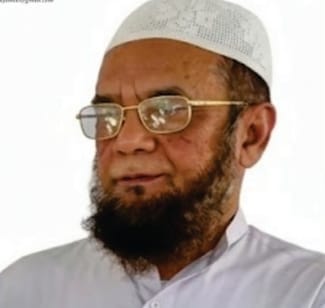
Syed Iqbal Zaheer and His Lifelong Quest for Knowledge and Scholarship

Syed Iqbal Zaheer and His Lifelong Quest for Knowledge and Scholarship
By: Dr. Manzar Imam Qasmi
Author, Islamic scholar and editor of Bangaluru-based English monthly Young Muslim Digest (YMD), Syed Iqbal Zaheer passed away in the United Arab Emirates on Thursday April 2, 2026. Inna lillahiwainnailaihiraji’ūn (Truly, to Allah We Belong, and Truly, to Him We Shall Return: The Qur’an 2: 156).
Having spent his time dedicated to learning, research, reflection, speech and writing, Syed Iqbal Zaheer stayed out ofthe limelight. I had the opportunity to meet him first in New Delhi at MarkazulMa’arif Education & Research Centre (MMERC). Although Iqbal Zaheer did not formally attend any madrasa, he looked more like a traditional ‘aalim/maulana. He was a great scholarwho acquired immense knowledge and possessed scholarly insights. He drew heavily from the thoughts and writings of eminent Indian, Arab and African ‘ulamā(plural of ‘ᾱlim). It was not only the ‘ulamā whose books and ideas shaped his personality and thinking, he also read scientists and important Western writers and literary geniuses who influenced his thought process.
When MMERC shifted from Delhi to Mumbai, I was one of the eight MMERCians chosen to study there in a somewhat liberal environment to fulfill the mission of its founder Maulana Badruddin Ajmal Qasmi. From Mumbai I went to Bangaluru (then Bangalore) to work as a trainee at YMD where I worked under Syed Iqbal Zaheer, the editor of the English-language Islamic monthly. He then used to live in Dammam. Our first meeting in Bangaluru during his India visit was a mere formality in which I was asked to give a brief introduction, and a few words of wisdom were shared by Iqbal Zaheer. It was during our second meeting a couple of months later that he asked me what I wanted to be. And my answer was: I want to be a writer.
Having freshly graduated in Islamic theology and jurisprudence from Darul Uloom Deoband with no outside exposure other than a little over two-years off and on training in English, translation and D’awah, I did not exactly know what would be a better choice for me: to be a journalist or a writer. In fact, I did not even have the clarity about the difference between a writer and a journalist. Iqbal Zaheer’s immediate next question was, “Do you know what it takes to be a writer?” As I went blank, he quickly suggested to focus on reading and also asked me to attend the London School of Speech to brush up my English communication skills. The YMD library had a fair collection of books by prominent English writers. It was there that I took a liking for English literature and gradually developed a habit of reading. I read a number of books by Charles Dickens, Thomas Hardy and other writers. As I was new to the city and quite young then, there was no pressure on me. In fact, my training was stress-free with no serious assignments except reading newspapers, identifying news stories for a particular section of YMD and giving a few weekly classes of basic Arabic at the Darussalam building.
Whenever Syed Iqbal Zaheer visited Bangaluru, he would be invited by members of the city’s mosque committees and Muslim organisations to deliver speeches. The topics of those talks used to be seminal that needed deep knowledge, hermeneutical understanding and foresight. Mics were arranged as he generally spoke in a low voice. His speeches made a good impact on the audience. The best part of his speeches, like his famous “Letters to the Editor” segment in YMD, used to be the Q&A session which opened a plethora of discussions during which he would share his valuable insights.
Although I could not live more than one year in Bangaluru, I still carry great memories of the times spent at YMD and the people of diverse socio-cultural and academic backgroundthat I met and interacted with there.
At YMD office, we were a group of seven-eight persons from Bihar, Karnataka, Kerala and Uttar Pradesh with one person from Bangaluru in charge of local administrative work. Syed Iqbal Zaheer’s younger brother Syed Bilal Zaheer would sometimes meet us to inquire whether things ran smooth.
As computer sets then used to be large and heavy with very few experts to repair them, in case of any technical glitch, and typing; a necessary skill for media professionals, required speed and accuracy which needed practice. I was therefore suggested to enroll for typing classes which I gladly did. And it helped me gain both accuracy and speed. It proved handy when I joined the reputed English fortnightly, The Milli Gazette in New Delhi.
An engineer by profession, who, later obtained a Bachelor’s and a Master’s degree in English, Syed Iqbal Zaheer had developed a keen interest in Islamic sciences after his frequent interactions with ‘ulamā and after reading their books. He was highly influenced by Maulana Ashraf Ali Thanwi(1863-1943), Syed Sulaiman Nadwi (1884-1953), Qari Muhammad Tayyib (1897-1983). During his visit to Darul Uloom Nadwatul Ulama in 1993, he met some prominent ‘ulamᾱ including Maulana Syed Abul Hasan Ali Nadwi (1913-1999) who left a lasting impression on him. In Bangaluru, he kept in touch with prominent ‘ulamā like Mufti Ashraf Ali Baqwi (1940-2017), Maulana Syed Mustafa Rifai Jilani (d. February 27, 2025), Mufti Shuaibullah Khan Miftahi.

The real strength of Syed Iqbal Zaheer lay in his wide range of study from multiple sources in multiple languages. He would frequently read the works of American astronomer and planetary scientist Carl Edward Sagan besides reading English writers, philosophers and psychologists. He was a voracious reader and would sometimes lock himself in a room for hours for deep study. The books which he wrote stand a testimony to his deepknowledge and scholarship and the capacity to infer meaning. The fourteen-volume Tafsir Ishraq al-Ma’ani and the 1,300-pages longAn Educational Encyclopedia of Islam are two of his great contributions toQur’anic exegeses and Islamic sciences. His other books like Islam: The Religion You Can No Longer Ignore; Fake Pearls; A Short History of Israel; Muhammad: The Unlettered Prophet Who Changed the World in 23 Years; Bilal: The Abyssinian Outrunner; An Introduction to the Arabic Language through Islamic Texts, etc. bear remarkable intellectual impressions and are full of academic rigour and intellectual grasp. He was working on some important projects completing which would be a befitting tribute to his academic dedication. He not only wrote books, but also translated some critical works from Arabic into English and also engaged some of the YMD staff in translation and abbreviation of some important books.
Syed Iqbal Zaheer would not write without research. An incident that happened in Bangaluru would explain it better. Pamphlets were distributed outside some mosques in the city which made allegations against two renowned scholars of Deoband: Maulana Rashid Ahmad Gangohi (1826-1905) and Maulana Ashraf Ali Thanwi. Syed Iqbal Zaheer got wind of this. When he visited the office, he assigned my colleague Abdul Malik and me to visit the library of Darul Uloom Sabeelur Rashad, also known as Arabic College to consults the books and see if the references provided in the pamphlets were correct. We went there and, to our surprise, found that the pamphlets were spreading lies. Syed Iqbal Zaheer was highly perturbed with this mischief-mongering against two towering ‘ulamᾱ of the Indian subcontinent.

His talks and speeches bore the mark of his academic depth, meaning-making and the ability to answer critical questions that appealed the seekers after knowledge and truth.
Syed Iqbal Zaheer is no more but his legacy in the form of books, translations and ideas lives on to guide generations. May Allah get him the highest reward for his lifelong dedication to the service of knowledge and Deen by engaging wholeheartedly in pursuit of knowledge, research, scholarship, introspection, reflection and writing.
You May Also Like
 Lifestyle
The Rising Trend of Suicide: Causes, Context and Prevention
The Rising Trend of Suicide: Causes, Context and Prevention By: Mohammad Taukir Rahmani Subeditor:...
 Lifestyle
Dr. Muhammad Manzoor Alam: A Scholar, Thinker and Reformer
Dr. Muhammad Manzoor Alam: A Scholar, Thinker and Reformer By: Khursheed Alam Dawood Qasmi...
 Islam
IslamTrailblazer: Where Faith, Philosophy, and Science Converge
Trailblazer: Where Faith, Philosophy, and Science Converge By: Mohammad Taukir Rahmani Lecturer at MMERC,...
 Lifestyle
The Blessed Birth of Prophet Muhammad (saws) and Conditions of Arabia
The Blessed Birth of Prophet Muhammad (saws) and Conditions of Arabia By: Khursheed Alam...
 Articles
Mufti Muhammad Azharul Haq (Rah.): A Beacon of Knowledge Extinguishes
Mufti Muhammad Azharul Haq (Rah.): A Beacon of Knowledge Extinguishes By: Khursheed Alam Dawood...
 FEATURE
Mufakkire Islam Maulana Sayyid Mohammad Wali Rahmani (Rah.): A Genius Scholar and Fearless Leader
Mufakkire Islam Maulana Sayyid Mohammad Wali Rahmani (Rah.): A Genius Scholar and Fearless Leader...
Comments (0)
Leave a Comment